
What Are the Different Clock Chimes: Practical Guide for 2026
Learn what are the different clock chimes, how hourly melodies operate, and which silencing options suit your home for October 2026.
 By Daniel Noyed
Updated October 6, 2026
By Daniel Noyed
Updated October 6, 2026
The soothing acoustic resonance of an hourly melody transforms a room into a structured, peaceful environment. While harsh digital alarms can startle the senses, melodic chiming provides an ambient sense of passing time throughout the day without creating sudden stress. Exploring what are the different clock chimes allows homeowners and sleepers to select timepieces that provide auditory charm without disrupting domestic rest. Pairing melodic daytime timekeeping with proper nighttime rest often begins with finding top-rated bedroom alarm clocks that respect peaceful evening hours.
From classic four-stage liturgical progressions to modern quartz modules, the variety of available chimes covers both historical horology and contemporary digital electronics. Today’s options include rich carillon patterns, mechanical bell strikes, recorded nature audio, and customizable quartz movements equipped with automatic evening mutes. Evaluating the different clock chimes involves examining not only the musical progression, but also the physical speaker baffling, volume adjustments, and light-sensing quiet modes. Balancing daytime melody with overnight silence ensures your clock enhances the home atmosphere while preserving a completely restful sleep environment.
| Award | Product | ACR Score About ACR ScoreThe ACR Score is our own rating from 0 to 10, based on performance, design and build, ease of use, and value. It reflects independent research and is never influenced by manufacturers, retailers, or affiliate commissions. Learn more › | |
|---|---|---|---|
| Best Overall |
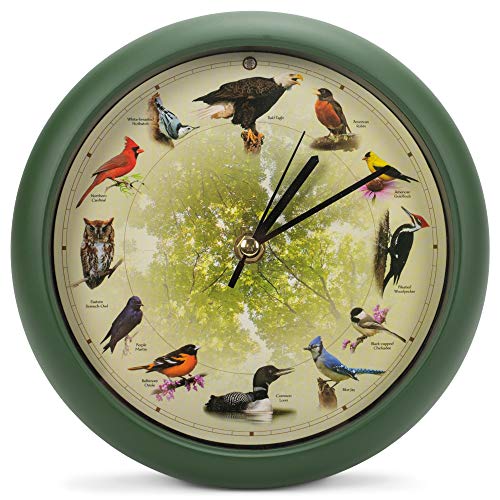
Mark Feldstein 8-Inch Singing Bird Clock
|
9.1/10 | Buy |
| Best Budget |
 WinTaim 12888 Westminster Chime Pendulum Clock
|
8.9/10 | Buy |
 Clockswise 16-Inch Chiming Wall Clock
|
8.3/10 | Buy |
Mark Feldstein 8-Inch Singing Bird Clock
This compact 8-inch timepiece plays authentic calls from 12 North American birds each hour, making it an engaging desktop or wall accent for nature lovers. An integrated light sensor automatically keeps the audio quiet at night without requiring manual adjustment.
Pros
- Features 12 distinct North American bird calls
- Automatic night shutoff via ambient light sensor
- Flexible tabletop standing or wall hanging placement
- Compact 8-inch size fits small spaces
Cons
- Three AA batteries are not included
WinTaim 12888 Westminster Chime Pendulum Clock
The WinTaim 12888 Westminster Chime Pendulum Movement Kit repairs or upgrades chiming home clocks while protecting nighttime sleep with an automatic 9:00 PM to 6:00 AM audio pause. It is a solid choice for clock restorers and homeowners wanting classic hourly chimes without midnight disruptions.
Pros
- Automatic overnight silence prevents chiming between 9:00 PM and 6:00 AM to protect uninterrupted sleep
- Four selectable chime modes give flexibility between full musical melodies and discreet hourly strikes
- Independent battery bays allow the movement to track time even if audio batteries are removed
- Comprehensive kit includes the movement, speaker, pendulum, mounting hardware, and two hand sets
Cons
- Overnight quiet period from 9:00 PM to 6:00 AM is hard-coded and cannot be rescheduled
- Requires three AA batteries that are not included in the package
- Speaker output can sound muffled if placed inside a solid clock cabinet without an acoustic opening
Clockswise 16-Inch Chiming Wall Clock
This 16-inch rustic wall clock from Clockswise features a non-ticking movement and an hourly chime that automatically silences between 11:00 PM and 5:59 AM. It is an excellent choice for homeowners, seniors, and bedroom decorators seeking decorative vintage timekeeping without nighttime sleep disruption.
Pros
- Automatic mute feature reliably silences chimes overnight between 11:00 PM and 5:59 AM for restful sleep.
- Non-ticking movement eliminates annoying mechanical clicking in quiet bedrooms and study spaces.
- Large 16-inch dial offers effortless visibility from across the room at any viewing angle.
- Dedicated sound battery compartment allows easy conversion to a 100% silent wall clock if desired.
- Includes wall-mounting hooks and nails right out of the box for fast installation.
Cons
- Requires following a specific initial dial-calibration sequence at 5:45 to align AM and PM chime cycles correctly.
- Runs on three AA alkaline batteries that are not included in the package.
- Time adjustments must always be made clockwise to prevent misaligning the internal chime mechanism.
The Anatomy and Progression of Traditional and Modern Clock Chimes
Clock chimes represent a sophisticated union of horological mechanics and musical composition, designed to announce the passing of time through recognizable tonal sequences. Rather than simply sounding a repetitive tone, distinct chime melodies historically guided towns and households without requiring anyone to gaze at a clock dial. Modern horology maintains these classic patterns while introducing quartz playback and solid-state sensors to adapt to residential bedrooms and living rooms. Determining how each chime operates, how sequences unfold, and how overnight silence features function ensures you choose an acoustic timepiece tailored to your lifestyle.
Traditional Architectural and Liturgical Chime Melodies
The most famous and enduring chime pattern in the world is the Westminster chime, originally composed in 1793 for the University Church of St Mary the Great in Cambridge. Later adopted by the Great Clock of Westminster at the Palace of Westminster in London, this four-note sequence in the key of E major remains the worldwide standard for pendulum wall clocks and mantelpieces. Each quarter hour introduces an additional four-note phrase, building up to a sixteen-note carillon performance directly before the hourly bell strikes. Its symmetrical progression provides an intuitive sense of how much of the hour has elapsed without glancing at physical clock hands.
Another celebrated sacred melody is Ave Maria, often attributed to the melodic compositions of Franz Schubert or liturgical hymns honoring traditional devotions. Clocks featuring Ave Maria sound this uplifting, reflective sequence on the hour, presenting a softer, more devotional tone compared to the brisk cadence of civic bell towers. The progression typically builds through resonant arpeggios that mimic cathedral bells, terminating in counted single strikes that correspond to the exact hour. For residential spaces, this melody offers a serene, reverent presence that distinguishes itself from standard municipal chimes.
Beyond these two common sequences, classical horology includes other historical patterns such as the Whittington and St. Michael chimes. Whittington chimes originated at the church of St. Mary-le-Bow in London and feature a lively eight-bell melody that changes pitch patterns across every quarter hour. St. Michael chimes trace their origin to historic bells in Charleston, South Carolina, offering a solemn, ringing cadence that echoes maritime and colonial American history. For simpler timepieces, the Bim-Bam chime uses two alternating tonal bars to announce half-hours and count the full hours with concise two-tone acoustic strikes.
Quarter-Hour Sequences Versus Hourly Strike Counting
A fundamental distinction among chiming clocks lies in whether the movement sounds only on the hour or provides quarter-hour updates throughout the day. Full carillon movements divide the sixty-minute cycle into four discrete musical chapters that progressively expand. At fifteen minutes past the hour, the movement plays a single quarter-melody consisting of four notes. At thirty minutes, two stanzas sound, followed by three stanzas at forty-five minutes, culminating in the complete four-stanza melody and subsequent hour count at the top of the hour.
In contrast, strike-only modes omit the musical flourishes entirely, sounding simple bell or hammer tones only when the minute hand crosses the twelve. This mode appeals to users who appreciate an acoustic reminder of the time but find frequent fifteen-minute musical interludes distracting in a home office or bedroom. Counted strikes provide immediate utility because listeners can identify the exact hour simply by counting the strikes without looking at the face. Some sleepers who employ sunrise alarm clocks for heavy sleepers intentionally select strike-only daytime clocks to keep their personal bedrooms free from frequent mid-day audio cues.
Mechanical clocks achieve this striking rhythm using either a count wheel or a rack-and-snail striking mechanism. The count wheel features fixed notches around its perimeter, mechanically limiting the hammer strikes to a set sequence regardless of where the hands point. The rack-and-snail mechanism, invented in the late seventeenth century, uses a stepped cam attached to the hour wheel that physically measures the position of the hour hand. This prevents the clock from losing strike synchronization if the hands are accidentally spun forward during time adjustments.
Electronic Quartz Modules and Multi-Chime Movement Kits
While antique mechanical clocks use cast bronze bells, tuned metal chime rods, or tubular gongs, modern quartz movements reproduce these sounds electronically through dedicated sound synthesis boards. Replacement mechanisms, such as the 12888 Westminster Chime Pendulum Clock Mechanism, pack four selectable operational modes into a single compact housing. Users can toggle between Ave Maria on the hour, Westminster quarter-hour melodies, hourly Westminster with strikes, or minimalist strike-only announcements. This electronic flexibility enables clock restoration enthusiasts to modernize antique cabinets while retaining classic acoustic character.
Electronic chime units typically separate the mechanical quartz timekeeping circuit from the audio generation module using distinct battery channels. In a typical three-battery setup, one alkaline cell powers the quartz motor that moves the hands and swings the decorative pendulum, while two separate cells drive the sound chip and speaker. This physical separation prevents audio amplifier draw from causing voltage dips that could slow the movement and introduce timing drift. Furthermore, removing the audio batteries instantly mutes all sound while permitting continuous, accurate quartz timekeeping on the dial.
Acoustic fidelity in electronic units depends heavily on speaker placement, amplifier impedance, and proper cabinet resonance. Most quartz kits utilize an eight-ohm, one-watt dynamic speaker wired directly to the chime controller. If this speaker is mounted directly against a solid backing board or tightly enclosed without acoustic vents, the chime sounds muffled and distorted. Horologists recommend aiming the speaker cone toward an open grill or escapement aperture to allow sound waves to disperse naturally throughout the room.
Nature Recordings and Novelty Hourly Chimes
Not all chiming timepieces rely on cathedral bells or liturgical sequences to announce the passing hours. Nature-inspired clocks provide an alternative acoustic profile by replacing metallic strikes with authentic wildlife recordings. The 20th Anniversary Singing Bird Clock 8 exemplifies this approach by assigning twelve distinct North American bird calls to individual hour positions on the dial. Instead of counting strikes, listeners hear the distinctive morning whistle of the American Robin or the energetic drumming of the Pileated Woodpecker.
These organic sounds introduce natural auditory variety that prevents the ear from growing fatigued by identical hourly chime repetitions. Each hour carries its own unique acoustic signature, allowing listeners to recognize the time based purely on species identification. Because these recordings capture genuine field audio, they blend seamlessly into rustic kitchens, sunrooms, or home offices where traditional brass bell strikes might feel overly rigid or formal. The educational value also appeals to families, turning regular timekeeping into an interactive nature study.
Novelty horology also encompasses traditional Black Forest cuckoo clocks, which blend mechanical bellows with miniature wooden pipe whistles. In mechanical cuckoo clocks, two small bellows lift and fall alternately to force air through wooden pipes cut to produce two distinct musical pitches. Modern electronic interpretations replace these delicate leather bellows with digital recordings of chirping birds, babbling brooks, or German folk melodies. Whether utilizing recorded avian calls or synthesized pipes, novelty chimes prove that hourly announcements can celebrate the outdoors alongside horological precision.
Overnight Silence Mechanics: Automatic Shutoffs Versus Light Sensors
The primary challenge of owning a chiming clock in a modern home is preventing nighttime sleep disruption. Historically, owners had to physically trip a mechanical strike-silent lever before bed or tolerate bells tolling through the night. Modern timepieces resolve this through automated silencing systems designed around either fixed chronological schedules or optical environmental sensors. Understanding these silencing systems prevents nighttime awakenings while preserving delightful daytime chimes.
Fixed chronological shutoffs operate on pre-programmed internal clocks that mute all speaker output during standard sleep hours. For example, the 12888 Westminster Chime Pendulum Clock Mechanism automatically suppresses all quarter-hour and hourly chimes after 9:00 PM and resumes playback at 6:00 AM. Similarly, the Clockswise 16″ Round Vintage Decorative Chiming wall clock establishes a quiet period spanning 11:00 PM to 5:59 AM. These programmed schedules operate regardless of ambient room illumination, ensuring that bedroom lamps or evening television viewing will not accidentally trigger an unwanted chime.
In contrast, light-sensing shutoffs rely on an integrated cadmium sulfide photodiode mounted directly on the clock dial to govern chime activity. The 20th Anniversary Singing Bird Clock 8 utilizes this smart optical sensor to deactivate bird songs as soon as ambient light drops below a specific threshold. This approach eliminates the need to program complex AM or PM schedules, as the timepiece remains silent whenever the room goes dark. However, light-sensing units placed near nightlights, streetlamps, or glowing screens may fail to mute, making bedroom placement sensitive to ambient illumination.
Selecting between a chronological timer and a photodiode sensor depends primarily on where the timepiece resides in the home. In a living room where family members stay up late with lights on, a fixed chronological timer prevents late-night chiming. Conversely, in a guest bedroom or hallway, a light sensor aligns chime silence directly with sleep habits without requiring manual adjustments for seasonal daylight shifts. For modern nightstands, combining chiming wall decor with dedicated bedside alarm clocks with wireless chargers ensures that essential morning alarms sound reliably while ambient daytime chimes remain quiet overnight.
Synchronization, Hand Alignment, and Resolving Strike Errors
A frequent frustration with chiming clocks occurs when the audible strike count fails to match the hour indicated by the hands. This discrepancy typically arises when batteries are inserted at random times or when the hands are spun backward during setup. Quartz chime modules maintain an internal counter that advances sequentially with each pulse sent from the movement. If the audio module believes the time is three o’clock while the hands show seven o’clock, the clock will consistently strike the wrong number.
Correcting this error requires using the dedicated calibration button or following manufacturer-specific setup routines. On quartz kits featuring a manual SET button, pressing the switch advances the internal chime register by exactly one hour without moving the physical hands. The initial press typically defaults the chime circuit to 6:00 AM, and each subsequent press steps forward one hour through the twelve-hour cycle. Users must count their button presses carefully rather than listening for audio tones, because presses that fall within the overnight silent window remain completely mute.
If a clock strikes during the dead of night and stays completely silent at midday, the internal chime module is inverted by twelve hours. Resolving this issue requires advancing the SET button twelve full presses or advancing the minute hand twelve hours clockwise past noon. Furthermore, if the chime sequence lands several minutes early or late, the physical minute hand must be unbolted and reseated precisely over the twelve-o’clock arbor mark. Always turn the central setting dial in a clockwise direction during manual adjustments, as counter-clockwise motion can damage internal trigger levers.
Acoustic Resonance and Bedroom Placement Considerations
A chime that sounds warm and charming in an open living room can quickly become an intrusive nuisance inside a quiet sleeping environment. Wooden clock cases made from solid oak, walnut, or pine act as natural sounding boards that amplify acoustic vibrations and deepen lower frequencies. Metal and plastic cases tend to reflect high frequencies, creating a brighter, sharper chime that carries easily through drywall and doors. Evaluating room acoustics helps prevent sound from penetrating bedroom walls during restful evening hours.
Volume regulation provides the most direct way to tailor clock acoustics to personal sensitivity. Quality quartz chime modules include a stepless rotary potentiometer or a stepped volume switch located directly on the sound board. Turning this dial down lowers the sound pressure level, transforming loud cathedral chimes into subtle ambient notifications. When setting up a clock in an open floor plan, testing volume from adjacent sleeping quarters ensures the chimes remain audible in common areas without echoing down the hallway.
Battery health also plays a substantial role in maintaining crisp, melodic chime fidelity over years of operation. Alkaline batteries supply a steady 1.5 volts per cell, which provides sufficient current for both quartz motor oscillation and sudden audio amplifier surges. As batteries degrade, the audio amplifier starves for current, leading to sluggish tempo, scratchy distortion, or premature silencing of the chime sequence. Replacing cells annually ensures reliable mechanical movement, accurate hourly counts, and clean acoustic performance throughout the seasons.
Selecting the Ideal Chime Architecture for Your Household
Choosing the right chime system balances historical tradition, acoustic tone, and practical household sleeping schedules. Traditional Westminster and Ave Maria carillons suit formal living rooms, dining spaces, and entryways where their grand, recognizable patterns establish a welcoming domestic tempo. Birdsong clocks and novelty wildlife themes excel in kitchens, casual dens, and home offices, adding seasonal charm while eliminating harsh bell tones. Those seeking subtle hourly awareness often prefer strike-only movements that offer concise counting without extended musical interludes.
Above all, verifying the presence of an effective overnight shutoff mechanism ensures that your timepiece remains a source of comfort rather than a sleep disruptor. Whether your clock utilizes a fixed chronological schedule, a smart photodiode light sensor, or a dual-battery compartment that allows total audio muting, controlling sound during sleep hours is essential. By aligning chime melodies with room acoustics and household routines, you can enjoy timeless horological beauty every waking hour of the day.
About the author
Daniel Noyed is a Certified Sleep Science Coach and experienced product editor with extensive knowledge of sleep health and sleep-related products. He has hands-on experience testing hundreds of products and translating technical features into practical guidance for everyday sleepers.