
What Are Radio Controlled Watches: Practical Guide for 2026
Learn what are radio controlled watches, how WWVB signals maintain split-second accuracy, and key features to look for this October 2026.
 By Daniel Noyed
Updated October 6, 2026
By Daniel Noyed
Updated October 6, 2026
Morning routines and precise scheduling rely on uncompromised accuracy, yet many traditional battery timepieces slowly drift out of sync over months of operation. Understanding what are radio controlled watches begins with recognizing how micro-receivers tune into dedicated atomic clock radio transmissions, eliminating the tedious chore of setting seconds or correcting for seasonal shifts. Pairing precise personal wristwear with dependable top rated bedside alarm clocks creates an environment where schedule anxiety disappears, whether preparing for work commutes or organizing medication timing. This synchronization technology keeps daily timekeeping exact without demanding persistent smartphone connections or wireless home networks.
Daily timekeeping becomes significantly simpler when wrist instruments update automatically overnight using standardized governmental radio frequencies like North America’s WWVB tower. Wearers who require physical cues, such as deep sleepers or individuals managing low vision, benefit immensely from autonomous devices featuring tactile vibrating alerts and spoken voice announcements. Rather than navigating delicate crown adjustments or complex digital mobile menus, these standalone wrist devices maintain atomic-level precision straight out of the box. Examining how this radio broadcast infrastructure operates helps clarify why specialized atomic and standalone digital pieces remain essential tools for structured, stress-free daily routines.
| Award | Product | ACR Score About ACR ScoreThe ACR Score is our own rating from 0 to 10, based on performance, design and build, ease of use, and value. It reflects independent research and is never influenced by manufacturers, retailers, or affiliate commissions. Learn more › | |
|---|---|---|---|
| Best Overall |
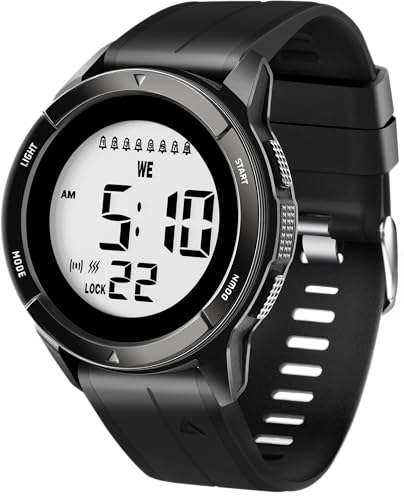
TICCI Vibrating Alarm Watch with 8 Daily Alarms
|
8.6/10 | Buy |
| Best Value |
 Hearkent Atomic Talking Watch for Seniors
|
8.0/10 | Buy |
TICCI Vibrating Alarm Watch with 8 Daily Alarms
The TICCI Vibrating Alarm Watch delivers direct-to-wrist silent wake-ups and routine reminders with eight independent daily alarms and three alert modes. It is a practical, phone-free solution for heavy sleepers, couples on different schedules, and seniors seeking clear digits and standalone reliability.
Pros
- Direct wrist vibration provides a discreet, silent wake-up option that avoids disturbing others in the room.
- Supports up to eight independent daily alarms for wake-up schedules, recurring reminders, and medication tracking.
- Completely standalone design operates without smartphone apps, Bluetooth syncing, or internet connectivity.
- Lockout feature prevents accidental button activation while tossing and turning in bed.
- Large digital digits and on-demand backlight make nighttime time checks straightforward.
Cons
- 3ATM water resistance protects against splashes and rain but is not suitable for showers, swimming, or hot water immersion.
- Wearable watch design rather than a traditional tabletop nightstand clock, requiring the user to wear it while sleeping.
- Alarm audio volume does not provide listed decibel ratings or multi-level tone customizations.
Hearkent Atomic Talking Watch for Seniors
The Hearkent Atomic Talking Watch provides clear American English voice announcements for time, date, and alarm settings alongside automatic WWVB radio synchronization. Designed with high-contrast bold dial numerals and dedicated push buttons, it is an ideal choice for seniors and visually impaired individuals needing reliable audible timekeeping.
Pros
- Automatic atomic radio sync keeps time precise without requiring ongoing manual time adjustments
- American male voice announcements are easy to understand for checking the time, date, and alarm status
- High-contrast white-and-black analog face assists users who retain partial vision
- Dedicated four-button layout assigns one function per button to minimize accidental mispresses
Cons
- Initial setup requires setting the correct U.S. time zone manually before automatic radio sync functions properly
- Radio WWVB signal reception can be blocked or delayed inside certain dense concrete or metal-framed buildings
- Men's case sizing and structured leather strap may feel somewhat large on smaller wrists
The Mechanics, Architecture, and Practical Utility of Radio-Controlled Watches
A radio-controlled watch is a precision timepiece containing an internal miniature radio antenna and microchip receiver tuned to governmental atomic clock broadcasts. Rather than relying solely on an internal quartz crystal oscillator that experiences slight physical frequency drift over time, the watch regularly captures exact calibration data transmitted across low-frequency radio waves. In the United States, this signal originates from the National Institute of Standards and Technology station WWVB situated in Fort Collins, Colorado. By synchronizing its internal registers with this atomic standard, the watch automatically corrects split-second variances and updates its calendar without manual human adjustment.
This technology bridges the gap between traditional mechanical chronometers and contemporary connected digital wearables. Unlike modern smartwatches that depend on constant wireless tethering, background cellular data, or third-party phone applications, an atomic radio timepiece functions entirely autonomously across its operational lifespan. The instrument listens to ambient atmospheric broadcast waves, decodes the timecode data packets, and steps its internal digital movement or physical hands into absolute alignment. For individuals who demand unflinching accuracy for medication tracking, shift work schedules, or visual assistance, these autonomous devices deliver unmatched reliability.
How Atomic Radio Transmissions Synchronize Daily Timekeeping
Governmental atomic timekeeping stations generate their reference signals using cesium beam fountain clocks that measure the hyper-fine transitions of atoms. These atomic clocks lose less than one second over millions of years, representing the global benchmark for Coordinated Universal Time. In North America, station WWVB modulates this reference standard onto a 60-kilohertz low-frequency carrier wave using high-powered transmitter arrays. This continuous broadcast carries binary timecodes containing the current minute, hour, day of the year, current year, and specific flags for daylight saving transitions.
Low-frequency radio signals travel vast geographical distances by reflecting between the surface of the earth and the ionospheric layers of the upper atmosphere. Because solar radiation charges the ionosphere during daylight hours and creates higher atmospheric signal attenuation, reception quality improves dramatically after nightfall. Most radio-controlled timepieces are programmed to initiate their active receiver circuits between midnight and four o’clock in the morning. This scheduled nocturnal synchronization routine conserves internal battery power while capitalizing on the calmest atmospheric conditions to capture an uncorrupted data stream.
Internal Receiver Hardware and Antenna Architecture
Fitting a low-frequency radio receiver into a compact wrist-worn housing requires specialized micro-electronic engineering. Designers utilize a microscopic ferrite rod antenna wound with ultra-thin copper wire nestled inside the watch casing, carefully oriented to maximize signal sensitivity. Because the 60-kilohertz carrier wave produces extremely small induced currents in such a diminutive antenna, an ultra-low-power amplifier stage boosts the signal before feeding it into a specialized decoder chip. This decoder extracts the binary pulse-width modulated pulses from ambient electromagnetic noise.
Once the decoder successfully validates a full timecode packet, the watch microcontroller recalibrates its internal standard quartz counter. In an analog-faced atomic timepiece, specialized stepping motors drive the physical black hands rapidly forward or backward until the dial matches the decoded broadcast. In digital models, the microchip updates the liquid crystal display registers instantaneously. If environmental interference prevents a clean signal lock during an overnight search, the watch seamlessly continues normal operation using its accurate internal quartz movement until the next scheduled synchronization attempt.
Automatic Daylight Saving Time and Multi-Zone Configuration
Managing the semi-annual transition between Standard Time and Daylight Saving Time is a perennial frustration with conventional clocks. Radio-controlled watches solve this challenge by reading specific indicator bits embedded directly into the governmental broadcast data stream. When national authorities toggle the daylight saving marker, the broadcast signal notifies the watch receiver days in advance of the pending shift. At the appointed hour, the watch automatically steps its hour register forward or backward without requiring the wearer to remember manual adjustments or decipher tiny caseback buttons.
Because the continental United States spans four primary time zones, setting up an atomic watch requires selecting the proper regional offset during initial activation. Broadcast signals from station WWVB convey universal reference time, meaning the watch relies on its internal configuration to display Pacific, Mountain, Central, or Eastern time correctly. Once this primary zone is chosen, the internal processor handles all subsequent seasonal and leap-year calendar updates autonomously. Wearers who frequently travel can switch zones via simple button sequences, allowing the receiver to re-anchor the display immediately upon arrival.
Accessibility Engineering: Voice Synthesis and High-Contrast Displays
Radio-controlled technology offers exceptional advantages when paired with assistive accessibility features designed for seniors and visually impaired wearers. Dedicated talking atomic timepieces, such as the specialized model from Hearkent, integrate digital speech synthesis engines with automatic radio synchronization. Instead of squinting at tiny numerals, the user simply presses an ergonomic button positioned at the two o’clock marker to hear the current hour and minute announced in clear American English. Additional dedicated tactile buttons announce the full date, current alarm status, and recent radio reception verification.
Visual accessibility relies heavily on optical contrast and uncluttered dial design. Timepieces engineered for low vision feature stark white dials with bold, oversized black numbers and heavy black hands that stand out crisply even in dim ambient lighting. Removing decorative complications and subdials eliminates visual distraction, ensuring immediate readability at a glance. For users who struggle with deteriorating eyesight or neurological conditions, combining audible voice readouts with automatic atomic calibration guarantees total independence without relying on sighted assistance to set the clock.
Tactile Awakening and Discreet Wrist Alarms for Heavy Sleepers
While broadcast-synchronized timekeeping ensures absolute schedule accuracy, waking reliably requires an effective personal alert mechanism. Traditional audio alarms can startle household members or fail to penetrate deep sleep cycles for individuals with partial hearing loss. Modern digital alarm watches address this challenge by incorporating high-efficiency eccentric rotating mass vibration motors directly inside the wrist casing. Delivering strong tactile pulses straight to the wrist pulse point activates sensory mechanoreceptors, rousing heavy sleepers smoothly without producing sudden auditory panic.
Specialized digital models like the multi-alarm watch from T TICCI offer three distinct alert options: sound combined with vibration, audible sound only, or silent vibration only. The silent vibration-only setting is particularly useful for shift workers, students, or partners on staggered morning schedules who must wake up without disturbing anyone nearby. If you are exploring gentle and natural morning transitions, pairing a silent wrist alarm with sunrise alarm clocks for deep sleep can further reduce morning grogginess by gradually stimulating your circadian rhythm through dawn-simulating illumination before the tactile pulse begins.
Managing multiple recurring tasks throughout the day requires flexible scheduling memory. Watches equipped with up to eight independent daily alarms allow users to configure dedicated reminders for morning wake-up calls, recurring prescription medications, hydration breaks, and scheduled appointments. Once programmed, these reminders repeat automatically every twenty-four hours without needing daily reactivation. An integrated countdown timer running from fifteen minutes up to twenty-four hours adds extra utility for structured routines, automatically resetting itself to streamline repeatable daily intervals.
Independent Standalone Operation Versus Smartwatch Connectivity
Modern consumer electronics increasingly demand constant network connectivity, requiring users to pair accessories with smartphones, manage mobile applications, and install firmware patches. In contrast, standalone digital and radio-controlled watches function as entirely self-contained instruments that never access Bluetooth, Wi-Fi, or cellular networks. This offline architecture completely removes cybersecurity vulnerabilities, software incompatibilities, and the frustrating battery depletion common to smart wearables that require daily recharging cords.
Eliminating smartphone dependency also supports healthier evening sleep hygiene and digital detox routines. Keeping internet-connected devices away from the nightstand prevents sleep-disrupting blue light exposure and late-night notification anxiety. If your bedside table is currently cluttered with charging cables, considering consolidated solutions like alarm clock and wireless charger combos can keep your essential devices organized and powered while your wristwear operates completely independent of mains power. A standalone watch continues its timekeeping duty silently on primary cell power, immune to unexpected operating system crashes or battery drain.
Signal Reception Variables, Shielding, and Nightstand Positioning
Achieving reliable radio synchronization depends on understanding physical signal propagation and environmental shielding factors. Reinforced concrete commercial buildings, steel framing, aluminum siding, and metallized window coatings can significantly attenuate incoming low-frequency radio waves. Furthermore, modern residential bedrooms contain numerous sources of electromagnetic interference, including switched-mode power supplies, computer monitors, television sets, and bedside charging adapters. Placing a radio watch directly adjacent to high-frequency electronic chargers can drown out the delicate atmospheric broadcast with local electrical noise.
To optimize overnight synchronization, place the watch near an exterior window, ideally oriented facing toward Fort Collins, Colorado, whenever practical. Laying the timepiece flat on a wooden nightstand or dresser away from dense clusters of power cords allows the internal ferrite antenna to capture incoming signals cleanly. Most radio timepieces include an explicit status check function, such as the dedicated eight o’clock button on the Hearkent atomic model, which audibly confirms whether the last synchronization attempt succeeded or failed. This feedback lets you test different bedroom locations to find the sweet spot for reliable reception.
Durability, Water Resistance, and Ergonomic Lock Controls
Daily wear exposes wrist instruments to accidental moisture, mechanical impacts, and unintended button presses. Water resistance ratings such as 3ATM indicate that the watch case, pushers, and gaskets are engineered to handle everyday splashes, light rainfall, and routine hand washing. However, 3ATM timepieces are not designed for swimming, hot showers, saunas, or prolonged submersion, as heated water and steam can expand rubber gaskets and allow vapor inside the delicate movement. Maintaining clean caseback seals ensures that the sensitive internal radio coils and quartz crystals remain completely dry and protected.
Ergonomic button design is equally critical for preventing accidental setting alterations. While sleeping, exercising, or performing household tasks, a wearer might inadvertently bump the control pushers against clothing or bed sheets. Watches like the TICCI digital vibrating model incorporate a dedicated button lockout function that freezes the active display and programming registers. This protective feature ensures that complex alarm arrays and countdown timers remain active and undisturbed, providing peace of mind that a critical wake-up call or medication alert will not be cancelled accidentally.
Selecting Between Atomic Synchronization and Dedicated Multi-Alarm Platforms
Choosing the ideal personal wrist instrument involves weighing absolute broadcast accuracy against specialized multi-schedule alerting capabilities. If your primary objective is effortless split-second precision, automated seasonal daylight saving adjustments, and accessible voice announcements for low-vision needs, an atomic talking model like the Hearkent watch is the superior choice. Its radio-controlled receiver eliminates all guesswork, keeping the watch synchronized to national standards while providing clear audible confirmations at the touch of a button.
Conversely, if your daily schedule demands intensive multi-event management, heavy-sleeper tactile awakening, or silent reminders that do not alert others, a standalone multi-alarm digital watch like the TICCI platform is an exceptional solution. Offering up to eight discrete daily alarms, multiple vibration alert modes, an illuminated calendar, and an automatic countdown timer, it functions as a comprehensive personal productivity and wake-up assistant. Both architectures prioritize autonomous reliability, freeing you from smartphone distractions while ensuring that your daily schedule stays completely on track.
Ultimately, whether you prioritize atomic radio broadcast synchronization or rich multi-alarm tactile functionality, dedicated wrist instruments remain among the most dependable personal tools available. By operating independently of mobile networks and smart applications, these specialized devices deliver consistent precision and effortless utility across everyday routines. Selecting the right hardware layout, alert modality, and display format creates a seamless timekeeping system that supports sound sleep hygiene, punctuality, and personal independence.
About the author
Daniel Noyed is a Certified Sleep Science Coach and experienced product editor with extensive knowledge of sleep health and sleep-related products. He has hands-on experience testing hundreds of products and translating technical features into practical guidance for everyday sleepers.