
How Much Electricity Does a Clock Radio Use: Practical Energy Guide for 2026
Learn how much electricity does a clock radio use in October 2026 along with standby power draw, display dimmer impact, and daily operating efficiency.
 By McKenzie Dillon
Updated October 6, 2026
By McKenzie Dillon
Updated October 6, 2026
Bedside tables often host an assortment of plugged-in electronics running continuously around the clock, from phone docks to digital timepieces. Many homeowners seeking to manage household utility bills or build an efficient bedroom setup wonder how much electricity does a clock radio use when left running every day. Standard bedside units operate on continuous AC power to maintain internal timekeeping circuits, drive illuminated displays, and power radio reception. Understanding the baseline power draw helps determine whether keeping a traditional nightstand clock plugged in causes meaningful vampire draw on your electrical meter.
Modern digital clock radios are engineered with solid-state circuitry that draws very little wattage compared to heavier household appliances or multi-port charging hubs. While legacy models from past decades relied on larger analog transformers, contemporary options combine efficient LED lighting with digital tuners. Exploring top-rated alarm clocks for bedrooms reveals that typical power consumption stays low across standby and active listening states. Examining how display dimming, audio volume, and internal components influence energy consumption ensures you make informed choices for a quiet, efficient sleep environment.
| Award | Product | ACR Score About ACR ScoreThe ACR Score is our own rating from 0 to 10, based on performance, design and build, ease of use, and value. It reflects independent research and is never influenced by manufacturers, retailers, or affiliate commissions. Learn more › | |
|---|---|---|---|
| Best Overall |
Emerson SmartSet Dual Alarm Clock Radio
|
8.1/10 | Buy |
Emerson SmartSet Dual Alarm Clock Radio
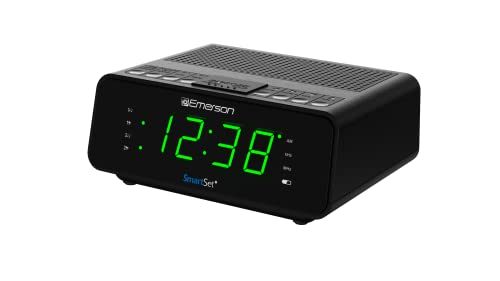
The Emerson SmartSet CKS1900 is an easy-to-use bedside clock radio featuring automated time setting, dual alarms, digital AM/FM radio, and a dimmable 0.9-inch jade green LED screen. It is an ideal pick for seniors, students, and minimalists looking for a dependable nightstand clock that eliminates setup headaches.
Pros
- SmartSet system sets the time and calendar automatically as soon as it is plugged in
- Jade green LED display is easy on the eyes and features four selectable brightness levels
- Dual independent alarms accommodate different wake times for couples or weekday routines
- Digital PLL tuning with 20 memory presets prevents station drifting compared to analog dials
- Included backup battery preserves internal clock settings during temporary power loss
Cons
- Backup battery maintains internal time and settings but does not power the display during blackouts
- Uses four stepped brightness settings rather than a continuous 0-100% stepless dimming dial
- Does not include integrated USB charging ports for mobile devices
Deep-Dive Analysis: Electrical Draw, Standby Power, and Efficiency of Clock Radios
A standard digital clock radio typically consumes between 1 and 3 watts of electricity when sitting idle in standby mode, and between 2 and 5 watts when the AM/FM radio is actively playing audio. Because these bedside devices remain plugged in 24 hours a day, their cumulative electrical draw is largely defined by constant background operation rather than occasional morning alarms. Over the course of a full calendar year, a steady 2-watt draw translates to roughly 17.5 kilowatt-hours of electrical consumption. This minimal energy requirement means that running a dedicated bedside clock radio has a negligible impact on a household electric utility bill while delivering reliable, distraction-free timekeeping.
Average Wattage and Baseline Power Consumption of Bedside Clock Radios
Standby power consumption represents the primary baseline for any electronic timepiece on a nightstand. Because the device must continuously track seconds, maintain calendar memory, and illuminate its digital screen, it never enters a completely unpowered state while connected to an electrical wall outlet. Most modern digital clock radios, including models equipped with basic LED displays and solid-state tuners, pull around 1.5 to 2.5 watts under normal conditions. This modest draw stands in sharp contrast to heavier home electronics, making the clock radio one of the lowest-demand appliances in the bedroom.
Calculating the practical energy footprint requires looking at continuous operation over months and years rather than hourly spikes. Even when operated continuously throughout all 8,760 hours of a standard calendar year, a clock radio drawing an average of 2 watts accounts for less than 18 kilowatt-hours of total electricity. In standard residential utility frameworks, this minor usage represents an almost unnoticeable expense over twelve continuous months. Understanding these figures gives peace of mind to budget-conscious households concerned about phantom energy leaks across their living spaces.
Component Breakdown: Where the Electrical Energy Goes
Every internal component inside a digital clock radio contributes a specific slice of the overall electrical draw. The primary consumer of continuous baseline electricity is the illuminated display module, which must remain readable in both daytime ambient light and midnight darkness. Behind the display, an internal quartz crystal oscillator and integrated microchip handle the low-power mathematical operations required to track the passage of time accurately. These fundamental timing circuits operate on tiny fractions of a watt, ensuring that basic time calculation remains extraordinarily efficient.
The audio subsystem and internal power conversion represent the remaining areas of electrical consumption. When the user powers on the AM/FM tuner, current flows to the phase-locked loop digital synthesizer and the internal audio amplifier. Driving the dynamic speaker cone requires additional power depending directly on listening volume and broadcast frequency complexity. Meanwhile, compact internal step-down transformers convert household alternating current into low-voltage direct current with minimal thermal loss, keeping overall efficiency steady whether the radio is playing or idle.
The Role of Display Brightness and Multi-Level Dimming
Display illumination is the single largest variable influencing the continuous baseline energy consumption of a bedside clock. Light-emitting diodes and backlit liquid crystal panels require steady electric current to maintain visible contrast against bedroom surroundings. When a display is operated at maximum daytime brightness, the LED elements draw their highest rated current to project vibrant digits across the room. Lowering the brightness level reduces current delivery to the light-emitting segments, creating an immediate and continuous drop in electrical consumption.
Adjustable dimmer controls provide significant sleep hygiene advantages alongside minor energy savings. Hardware like the Emerson SmartSet Dual Alarm Clock Radio incorporates multi-level dimming settings, such as a 4-level dimmer for its 0.9-inch jade green LED readout. Dimming the screen at bedtime prevents harsh light pollution from illuminating the sleeping area and interfering with natural melatonin production. Jade green and amber wavelengths offer clear contrast without the intense retinal glare commonly produced by cool blue-white backlights, promoting a restful sleep environment.
Standby Vampire Draw Versus Active Audio Playback
Electronic devices that remain plugged into wall outlets often exhibit vampire draw, also known as phantom load or quiescent current. In a clock radio, this standby power is not wasted energy because it performs vital tasks, such as maintaining real-time clock synchronization and powering alarm triggers. Unlike television sets or entertainment consoles that sit idle waiting for remote signals, a clock radio actively serves its core utility around the clock. The standby power draw of two watts maintains continuous readiness so you never miss an important morning schedule.
Active radio playback introduces dynamic power consumption that varies based on listener volume and audio content. At gentle listening levels suitable for falling asleep, the integrated amplifier draws approximately 2.5 to 3.5 watts from the wall. Cranking the digital volume to higher levels to fill a room with morning news or music can elevate total consumption toward 4 to 5 watts. Programmable sleep timers, such as the sleep-to-music feature on the Emerson SmartSet radio, automatically shut down the audio amplifier after a designated duration to prevent unnecessary overnight power usage.
AC Mains Power Delivery and Power Supply Efficiency
Connecting a bedside clock radio to a standard household AC electrical outlet requires reliable step-down power conversion. Older alarm clocks manufactured decades ago frequently incorporated heavy iron-core linear transformers that generated continuous heat and emitted an audible low-frequency hum. Modern sleep electronics instead utilize refined transformer stages or compact switch-mode conversion circuits designed for cool, silent operation. Eliminating high-pitched electrical coil whine and transformer buzzing is essential for light sleepers sensitive to quiet bedroom acoustics.
Electrical safety standards dictate that bedroom electronics maintain proper insulation and thermal stability. Bedside tables are frequently placed near bedding, curtains, and wooden furniture, making low thermal emission an important design consideration. A modern clock radio drawing two watts remains cool to the touch, releasing virtually no perceptible heat into the immediate nightstand area. Ensuring that power cords are routed smoothly without tight bends or heavy furniture pinching prevents electrical resistance buildup and protects household safety.
Backup Battery Architecture: Operational Sounders Versus Memory Retention
Understanding power consumption requires examining how clock radios behave when primary AC electrical power is suddenly interrupted. Many consumers assume that a backup battery allows an entire clock radio to function fully during an extended electrical blackout. In reality, most contemporary bedside models use an isolated battery architecture designed strictly for time-memory retention rather than active operational power. Systems such as Emerson SmartSet technology utilize backup cells to maintain internal calendar and clock data silently during temporary power outages without draining primary household electricity.
During a residential electrical power outage, the primary LED display and radio amplifier shut off completely to conserve battery reserves. The micro-amperage current drawn by the internal quartz chip allows a small backup cell to maintain accurate date and time settings without mains electricity. When municipal power is restored, the clock displays the exact correct time immediately without requiring manual resetting. This intelligent power division protects the backup cell from rapid exhaustion while eliminating the frustration of flashing midnight indicators after storms.
How Clock Radios Compare to Modern Multi-Function Bedside Hubs
Modern bedrooms have seen traditional single-purpose timepieces increasingly replaced by multi-functional charging stations. If you are comparing basic clock radios against an alarm clock and wireless charger, the difference in total electrical draw is significant. While a standalone clock radio pulls only 2 watts, a nightstand hub charging a smartphone via Qi inductive coils can draw 10 to 15 watts or more. The high-frequency electromagnetic transfer of wireless charging pads naturally introduces higher power consumption and modest heat generation compared to simple digital clocks.
Multi-port USB charging ports integrated into alarm clock chassis also alter the electrical demands placed on bedside outlets. Fast-charging smartphones and tablets draw continuous current through dedicated 5V or 9V power rails until their batteries reach full capacity. In contrast, a dedicated clock radio without auxiliary high-output charging ports remains strictly within its ultra-low wattage envelope. Sleepers seeking a focused digital detox often prefer keeping high-wattage charging hubs out of the bedroom entirely to minimize cord clutter and nighttime screen temptation.
Alternative Awakening Technologies and Energy Considerations
Sleepers evaluating bedroom energy use often explore alternatives to traditional buzzer or radio waking methods. Exploring modern sunrise alarm clocks for heavy sleepers reveals a distinctly different electrical profile than standard clock radios. Wake-up light devices incorporate high-lumen LED lamp assemblies engineered to simulate natural dawn transitions across thirty to sixty minutes. While these sunrise lamps consume between 10 and 20 watts when their illumination curves reach peak output, they revert to low standby levels once morning alarms finish.
Standard clock radios strike an ideal balance by delivering reliable auditory alerts without requiring high-output lighting lamps or mechanical shaker motors. Waking up to AM/FM radio stations or progressive buzzer tones requires only minimal speaker cone displacement, keeping energy demand modest even during wake cycles. For users whose primary waking need is an audible prompt rather than dawn illumination or tactile shaking, the clock radio remains one of the most electrically conservative sleep aids available. Matching your biological waking needs to the right alarm technology ensures you do not overcomplicate your nightstand.
Practical Tips to Maximize Bedside Energy Efficiency and Usability
Maximizing the efficiency and longevity of a bedside clock radio requires simple habits that align with healthy sleep practices. Activating the display dimmer to its lowest comfortable level at bedtime cuts LED current draw while maintaining a restful, dark sleep sanctuary. Setting the built-in sleep timer whenever you enjoy listening to evening radio ensures the amplifier automatically shuts down after you drift off. Keeping the clock away from direct heat sources and ensuring adequate air circulation around the chassis helps internal power components stay cool and efficient.
Proper cord management and electrical placement also protect both energy efficiency and physical safety. Always plug the clock radio directly into a secure wall receptacle or a reputable surge protector to guard sensitive digital circuitry against utility voltage spikes. Avoid wrapping excess power cords tightly around the unit, as coiled cables can trap heat and increase unnecessary electrical resistance. Periodically dusting the housing and tuner vents prevents particulate buildup that might insulate internal electronics or impede clear sound transmission from the speaker grille.
Routine checks on the backup battery ensure that your clock remains resilient through unexpected seasonal storms and grid disruptions. Inspect the battery compartment once or twice a year to confirm the contact terminals remain clean and free from chemical oxidation. When replacing coin cells or dry batteries, make sure to follow the polarity markings printed inside the battery door to maintain proper circuit alignment. Taking these simple maintenance steps ensures that your bedside clock radio continues delivering dependable timekeeping and minimal electrical draw for years to come.
Summary Takeaway for Energy-Conscious Sleepers
For sleepers concerned about household electrical usage and phantom loads, a bedside clock radio represents an exceptionally low-impact appliance. Drawing between 1 and 3 watts in baseline standby mode, it operates efficiently without creating noticeable increases on monthly utility statements. Devices like the Emerson SmartSet Dual Alarm Clock Radio combine this minimal electrical footprint with convenient features like automatic time setting, dual alarms, and dimmable jade green displays. Choosing a dedicated clock radio delivers dependable morning reliability, gentle wakeups, and peaceful bedroom simplicity while keeping your home energy consumption at an absolute minimum.
About the author
McKenzie Dillon is a Certified Sleep Science Coach and experienced sleep-product editor who has personally tested dozens of sleep products. Her expertise bridges sleep technology, product evaluation, and practical guidance for creating more comfortable sleep and wake-up routines.