
How to Wake up to Alarms Better: Practical Guide for 2026
Learn how to wake up to alarms better in October 2026 with gentle sunrise lighting, progressive vibration, and smart nightstand routines for alert mornings.
 By Daniel Noyed
Updated October 6, 2026
By Daniel Noyed
Updated October 6, 2026
Waking up with a pounding heart to an abrasive smartphone chime is one of the most frustrating ways to begin the day. Harsh morning alerts often trigger an immediate spike in stress hormones, leaving you feeling groggy, disoriented, and tempted to hit snooze repeatedly. Learning how to wake up to alarms better requires shifting away from sudden acoustic shocks and moving toward sensory-friendly wake-up methods that respect human sleep architecture. By introducing modern bedside electronics that stimulate your senses gradually, you can transform difficult mornings into calm, consistent routines.
Many individuals find that replacing chaotic mobile devices with dedicated bedside alarm clocks dramatically improves their morning alert levels. Specialized waking devices, such as progressive sunrise lamps, silent haptic wristbands, and structured visual sleep trainers, address the biological factors behind morning sluggishness. Understanding how to wake up to alarms better allows you to wake up feeling restored rather than startled, establishing reliable wake-up habits that keep your entire household on schedule throughout 2026.
| Award | Product | ACR Score About ACR ScoreThe ACR Score is our own rating from 0 to 10, based on performance, design and build, ease of use, and value. It reflects independent research and is never influenced by manufacturers, retailers, or affiliate commissions. Learn more › | |
|---|---|---|---|
| Best Overall |
Thybro Sunrise Alarm Clock with Sound Machine
|
9.2/10 | Buy |
| Best Budget |
 MooLarm Ok to Wake Sleep Trainer Toddler Alarm
|
8.9/10 | Buy |
 I-CODE Toddler Ok to Wake Clock
|
8.6/10 | Buy | |
| Best Premium |
 REACHER Vibrating Alarm Clock Watch
|
8.6/10 | Buy |
 Learn & Climb Toddler Sleep Training Clock
|
8.4/10 | Buy | |
 REACHER Travel Vibrating Alarm Clock
|
8.4/10 | Buy |
Thybro Sunrise Alarm Clock with Sound Machine
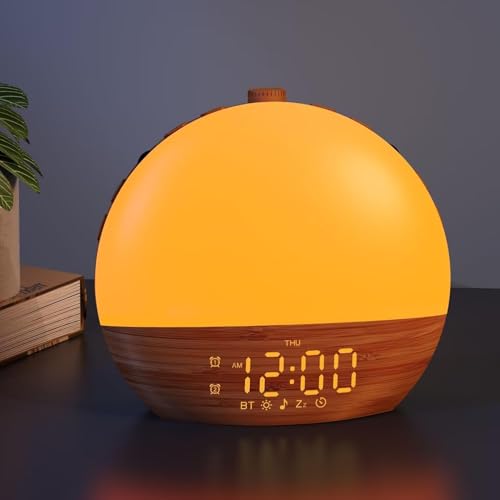
The Thybro Sunrise Alarm Clock combines a gradual 0.5 to 300 lumen dawn simulation light with a 30-sound sleep machine and independent dual alarms. It features physical knobs and top-mounted buttons for simple, app-free nightstand adjustments, making it a practical choice for sleepers seeking gentle morning lighting and evening relaxation.
Pros
- Gradual sunrise simulation transitioning from 0.5 to 300 lumens provides gentle visual wake-up lighting
- Physical control knobs and large top-mounted buttons make daily adjustments straightforward without confusing app setup
- Dual independent alarms support separate weekday and weekend wake schedules
- Extensive audio selection features 30 distinct nature sounds paired with 30 volume adjustment steps
- Evening sunset fade mode pairs warm amber light dimming with continuous looping sleep audio
Cons
- Product specifications do not list battery backup details for maintaining time or sounding alarms during AC electrical outages
- Primary digital clock display dimensions and numeral heights are not specified in the manufacturer data
- Measuring approximately 7.5 inches wide, the casing footprint requires ample surface room on smaller nightstands
MooLarm Ok to Wake Sleep Trainer Toddler Alarm
The MooLarm Sleep Training Alarm Clock uses clear sun, moon, and color cues alongside an integrated 17-sound noise machine to help toddlers build healthy sleep schedules. It is a practical bedside tool for parents seeking an effective way to teach early-rising children when to stay in bed and when it is okay to wake up.
Pros
- Clear sun and moon visual indicators teach early risers when to stay in bed without needing to read time digits
- Versatile 17-sound audio library eliminates the clutter of having a separate nursery sound machine
- Convenient independent nap timer prevents accidental resets of the daily morning wake schedule
- Four-level dimming with automatic nighttime reduction helps prevent excess bedside glare during sleep
Cons
- Stepped 4-level dimmer does not offer continuous stepless 0 to 100 percent brightness tuning
- Visual coaching cues may require consistent parental reinforcement before young toddlers follow them reliably
- Lightweight 0.7-pound build can be easily tipped over or displaced by curious children if kept within arm's reach
I-CODE Toddler Ok to Wake Clock
The I-CODE Ok to Wake Alarm Clock is a compact bedside sleep trainer that pairs clear red and green visual cues with friendly facial emojis to teach young children healthy morning boundaries. Equipped with an adjustable night light, flexible nap timer, and toddler-proof lock, it is an effective tool for parents helping kids establish independent sleep routines.
Pros
- Intuitive color-coded lighting and facial expressions help toddlers understand wake boundaries before they can read numbers
- Child safety lock prevents curious toddlers from resetting the clock or changing alarm times
- Versatile nap timer allows parents to set quick rest countdowns without altering regular morning wake schedules
- Small footprint and lightweight 0.65-pound ABS frame fit conveniently on any bedside surface
Cons
- Relies primarily on visual learning cues, which may require an initial adjustment period and parental coaching for younger toddlers
- Compact 4-inch square chassis houses multiple configuration buttons that require careful setup using the included directions
- Manufacturer specifications do not detail internal battery backup or prolonged cordless operating capabilities
REACHER Vibrating Alarm Clock Watch
The REACHER Vibrating Alarm Clock Watch provides a silent, personal wake-up via progressive wrist vibrations, making it an excellent choice for couples, dorm residents, and hearing-impaired users. With its phone-free setup, auto-off display, and comfortable woven strap, it delivers reliable morning alerts without disturbing anyone else in the room.
Pros
- Progressive vibration wakes you without blasting noise across a shared bedroom
- Completely standalone operation requires no smartphone pairing, apps, or Wi-Fi
- Auto-off screen keeps the bedroom dark by preventing continuous light emission
- Rechargeable battery lasts up to 7 days with quick magnetic cable attachment
- Lightweight zinc and fabric housing with an adjustable hook-and-loop strap fits 140 mm to 210 mm wrists
Cons
- Supports only one active alarm at a time, requiring daily resets for varying schedules
- Lacks audible sound options, which may not suit sleepers who prefer audio alerts
- Requires wearing a device on the wrist overnight, which some sleepers may find unfamiliar
Learn & Climb Toddler Sleep Training Clock
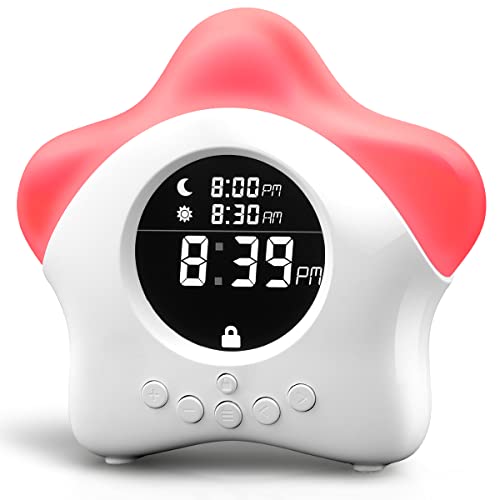
The Learn & Climb Stay-in-Bed Clock is an electronic toddler sleep trainer featuring a clear LCD display and a color-coded light system to help kids know when to stay in bed and when to wake up. It is an ideal bedside tool for parents seeking consistent morning routines and better sleep habits for toddlers and young children.
Pros
- Color-coded visual cues help non-time-reading toddlers easily understand when it is acceptable to leave bed
- Supplied with a sturdy DC power adapter and USB cord for immediate out-of-the-box operation
- Battery backup preserves essential alarm and time settings if wall power drops or cords are bumped
- Includes comprehensive sleep training materials like an eight-week reward chart and bedtime storybook
- Dedicated nap countdown mode simplifies daytime rest routines without overriding primary alarm times
Cons
- Backup batteries are not included and only preserve memory settings rather than powering active lights or audio
- Speaker volume is limited to two preset levels rather than a continuous variable adjustment slider
- Requires continuous connection to AC wall power to keep the nightlight and digital display active
REACHER Travel Vibrating Alarm Clock
The REACHER Travel Vibrating Alarm Clock is a compact, silent wake-up device that replaces audio chimes with an escalating under-pillow vibration pattern and provides up to seven days of cordless battery life. It is an ideal solution for heavy sleepers, shift workers, and frequent travelers who need reliable waking without disturbing a sleeping partner.
Pros
- Vibration-only operation provides dependable waking without disturbing light-sleeping partners or roommates.
- Rechargeable battery delivers up to seven days of continuous cordless travel and bedside performance.
- Smart ambient light sensor automatically lowers nighttime glare to support a dark, restful sleeping environment.
- Tactile raised-dot snooze button simplifies groggy morning navigation without fumbling for small switches.
Cons
- Completely lacks an audible speaker or chime mode, making it unsuitable for users who need sound-based alerts.
- Requires periodic weekly recharging via USB-C if operated away from a permanent bedside power source.
- Auto-dimming feature adjusts according to ambient room lighting rather than via a manual stepless rotary dial.
Mastering Morning Alertness: Strategies for Consistent Alarm Awakening
Achieving a reliable and energetic morning routine is rarely a matter of willpower alone. Human biology responds directly to environmental stimuli like light, sound, and tactile sensations during the final stages of sleep. When you align your bedside hardware with your natural circadian cycles, rising on time becomes a seamless habit rather than a daily struggle. Exploring how to wake up to alarms better requires examining the sensory mechanisms that govern alertness and selecting devices tailored to your specific sleep environment.
The Physiology of Awakening and Why Harsh Buzzers Fail
Sleep inertia represents the groggy, disoriented sensation experienced immediately after waking up from deep rest. When an alarm suddenly sounds while you are in slow-wave or REM sleep, your brain requires significant time to transition into full alertness. Abrasive, sudden buzzer tones snap the auditory system into immediate shock without allowing cognitive pathways to engage smoothly. This abrupt transition often leads to confusion, sluggish motor skills, and an instinctive urge to disarm the clock and return to slumber.
Sudden loud alarms also activate the sympathetic nervous system, triggering an immediate spike in morning cortisol and adrenaline. While this survival reaction will certainly break sleep, it places the cardiovascular system under immediate stress before your feet touch the floor. Experiencing a panic-induced wake-up call creates feelings of irritation and fatigue that can persist for several hours. Over time, waking to acute acoustic distress builds negative psychological resistance against morning schedules.
A more effective wake-up strategy relies on graduated sensory stimulation that nudges the brain from deep sleep into lighter stages before the final alert. Multi-sensory wake-up devices use progressive cues such as brightening light, gentle nature audio, or tactile pulses over a fifteen to thirty-minute window. This gradual buildup gives your body adequate time to clear adenosine from neural receptors naturally. By the time your designated wake-up minute arrives, your mind has already completed the primary physiological shift toward conscious awareness.
Implementing Sunrise Simulation for Biological Wakefulness
The human circadian timing system is strongly regulated by light exposure detected through specialized retinal cells. Even while your eyelids remain closed during the morning hours, light rays penetrate thin ocular tissues to signal the suprachiasmatic nucleus. This internal master clock responds by naturally suppressing the sleep-promoting hormone melatonin and elevating core body temperature. Waking up to calibrated light simulation mimics the evolutionary progression of natural dawn, producing a smoother morning transition.
Modern sunrise devices, such as the Thybro Sunrise Alarm Clock with Sound Machine, utilize gradual illumination curves that shift smoothly from 0.5 up to 300 lumens across twenty to thirty minutes. This broad luminous range begins with a deep, non-disruptive amber glow before slowly brightening into vibrant morning daylight. Having twenty discrete dimming levels gives you the ability to fine-tune the lamp output to your specific room layout and visual sensitivity. Light sleepers can select subtle illumination profiles, while heavy sleepers benefit from full room-filling brightness.
Pairing dawn illumination with progressive nature audio further enhances wakefulness without jarring the ears. Units engineered with crystal-clear speakers and low harmonic distortion deliver realistic audio tracks like forest birds, ocean waves, or forest streams across multiple volume levels. You can explore specialized sunrise alarm clock options for deep sleepers to determine how light and sound combinations overcome extreme morning drowsiness. When the room fills with warm light and gentle audio simultaneously, waking becomes an inviting sensory experience.
Haptic and Silent Vibration for Deep Sleepers and Shared Bedrooms
Acoustic alarms present significant drawbacks when individuals share bedrooms, live in dormitories, or work alternating shift patterns. A standard auditory buzzer sounds throughout the entire room, inevitably disrupting partners who may have hours left to sleep. Furthermore, individuals with auditory impairments or exceptionally deep sleep thresholds frequently sleep directly through high-frequency acoustic chimes. In these environments, physical haptic vibration provides an exceptionally focused and non-auditory wake-up alternative.
Under-pillow disc alarms offer concentrated physical movement directly beneath your head to break heavy sleep cycles without creating room noise. The REACHER Travel Vibrating Alarm Clock for Heavy Sleepers relies on a vibration-only mechanism featuring a progressive pulsing pattern that builds in strength. Because the disc rests securely under a mattress or pillow, the tactile motion travels through bedding materials directly to your body. This targeted physical alert reliably rouses heavy sleepers while preserving absolute silence across the remainder of the bedroom.
Wearable wristband alarms take personal haptic waking one step further by securing the vibration motor directly against pulse points. The REACHER Vibrating Alarm Clock Watch features an escalating haptic sequence that pulses for up to fifteen minutes on a soft woven strap. This localized vibration gently alerts the wearer without creating any sound disturbance for bed partners or roommates nearby. The slim zinc alloy chassis and breathable hook-and-loop strap remain comfortable throughout the night, ensuring consistent skin contact until the alarm triggers.
Cordless battery architecture is essential for haptic bedside devices to prevent cord entanglement while tossing and turning. Both the travel disc and wearable wristband models feature rechargeable internal batteries that provide up to seven days of autonomous operation between charges. The wristband utilizes magnetic charging cables, while the pillow disc incorporates universal USB-C ports that make travel packing effortless. Verifying regular battery replenishment ensures your silent vibration system remains functional through continuous work weeks.
Establishing Behavioral and Visual Morning Boundaries for Children
Young toddlers and early grade school children lack an abstract understanding of numerical time, making standard digital digits ineffective for morning boundaries. When young children wake during the early morning hours, they cannot determine whether it is time to rise or remain quietly in bed. This temporal confusion frequently leads to disrupted parental sleep and erratic family wake-up routines. Solving this problem requires translating timekeeping into concrete, intuitive visual cues that children can comprehend immediately upon opening their eyes.
Sleep-training clocks bridge this developmental gap by pairing recognizable icons and distinct color illumination systems. For instance, the MooLarm Ok to Wake Sleep Training Kids Sun Moon Alarm displays sun and moon symbols alongside ten vivid night-light colors to clearly signal daily milestones. Similarly, the I·CODE Ok to Wake Alarm Clock for Toddlers uses expressive facial emojis, showing a sleepy face with red light during rest hours and a smiling face with green illumination when morning begins. These visual distinctions teach young children self-regulation without requiring them to decipher numbers.
Structured color transitions help prevent early morning departures by giving children a clear heads-up before daytime permissions activate. The Learn & Climb Stay-in-Bed Clock for Kids utilizes a four-stage LED lighting sequence that shifts from red to yellow and finally to green. Parents can explore dedicated kids visual sleep training clocks to discover how multi-stage lighting schedules establish consistent morning patience. The intermediate yellow phase informs children that waking time is approaching, allowing them to rest quietly rather than crying out for parents.
Practical usability features ensure that children do not accidentally alter alarm schedules while exploring clock surfaces in bed. Clocks equipped with button child-locks, such as dual-press key combinations, prevent curious fingers from clearing scheduled wake times or disabling sound machines. In addition, built-in nap countdown timers spanning thirty to one hundred twenty minutes allow parents to enforce daytime rest intervals without disrupting the primary morning program. Combining visual time cues with tactile safety locks establishes enduring morning routines for the entire household.
Optimizing Nightstand Acoustics and Audio Fidelity
Acoustic alarm performance depends heavily on speaker construction, audio encoding, and volume delivery curves. Cheap bedside clocks typically rely on basic piezo buzzers that emit harsh, high-pitched square waves devoid of tonal depth. These piercing frequencies can be intensely grating to sensitive morning ears, creating an instantaneous sense of dread upon awakening. Upgrading to a clock equipped with a dynamic speaker transducer dramatically improves sound reproduction, transforming alarm audio into a tolerable, soothing experience.
Nature-inspired audio tracks provide a biologically harmonious alternative to synthetic alarms. Audio selections featuring bubbling forest streams, rhythmic ocean waves, or morning songbirds stimulate the auditory cortex gently rather than aggressively. High-fidelity audio engines, such as those with less than one percent harmonic distortion, prevent muffled or tinny audio artifacts that compromise acoustic realism. When waking tracks retain realistic dynamic range and balanced frequencies, your brain processes the audio as a natural environmental shift rather than an emergency alarm.
Volume customization across a wide dynamic range is equally vital for avoiding morning startle responses. Devices offering thirty discrete volume increments allow sleepers to dial in the precise sound pressure required to overcome background noise without causing auditory discomfort. Light sleepers may require only a faint chime, while individuals in noisy urban apartments benefit from slightly louder nature soundscapes. Finding your ideal acoustic comfort threshold prevents unnecessary adrenaline rushes while guaranteeing prompt morning arousal.
Physical Clock Placement, Button Ergonomics, and Snooze Habits
Repeatedly hitting the snooze button is one of the most detrimental habits for morning cognitive performance. When you silence an alarm and drift back to sleep for nine minutes, your brain initiates a brand-new sleep cycle that cannot possibly finish. Interrupted sleep cycles fragment rest architecture, worsening sleep inertia and leaving you significantly more exhausted than if you had risen immediately. Eliminating snooze dependency is a fundamental step toward mastering how to wake up to alarms better consistently.
Physical clock placement plays a pivotal role in preventing automatic, half-asleep snooze button presses. Placing your alarm clock across the room or on a dresser several paces away forces physical standing and ambulation before you can disarm the sound. The simple act of standing upright activates postural blood flow, elevating blood pressure and heart rate to conscious baseline levels. Once you have walked across the bedroom, the impulse to dive back under the covers is significantly diminished.
Physical button ergonomics also determine whether morning interactions are effortless or aggravating. High-quality bedside clocks feature prominent tactile snooze buttons, such as raised-dot surfaces or oversized top bars, that allow intuitive access in pitch-black rooms. Importantly, the permanent alarm disarm switch should be physically separated from the snooze bar to prevent accidental shutoffs while half-awake. Clocks that utilize dedicated rotating knobs or intuitive hardware toggles make programming simple, eliminating the frustration of navigating complex digital menus in the dark.
Nightstand Environment, Power Outage Protection, and Digital Detox
Removing smartphones from the bedside nightstand is an exceptionally impactful adjustment for overall sleep quality and morning alertness. Keeping connected mobile devices within arm reach invites late-night social scrolling, exposing retinas to blue light that suppresses evening melatonin synthesis. Furthermore, nocturnal notifications and morning email alerts foster an underlying state of hyper-arousal that undermines restorative rest. Transitioning to dedicated bedside clocks establishes healthy digital boundaries, allowing your brain to wind down and wake up peacefully.
Display dimming controls are essential for keeping the bedroom dark enough to support natural sleep architecture. Intense digital digit backlights can illuminate a bedroom like a nightlight, interfering with restful sleep and degrading visual comfort. Clocks featuring integrated ambient light sensors automatically soften display output when room lights turn off, preventing harsh bedside glare. Look for clocks that support full-range dimming or automatic blackout modes so your sleep space remains completely dark throughout the night.
Understanding backup power architecture prevents catastrophic missed alarms caused by unexpected electrical grid brownouts. Many standard clocks include battery compartments designed solely for time-memory retention via coin cells or AAA batteries, preserving internal clock digits but leaving the alarm sound completely inoperative during power loss. In contrast, portable travel clocks with internal lithium batteries provide active operational wake-up alerts even during total power outages. Verifying whether your clock features full operational battery capability provides vital peace of mind on critical workday mornings.
Building a successful morning wake-up system requires harmonizing thoughtful hardware selection with sound sleep habits. By combining progressive sunrise lighting, personal tactile vibration, intuitive visual cues, and deliberate clock placement, you create a supportive environment that works with your biology. As you refine your bedside setup throughout 2026, waking up on time will shift from an exhausting battle into a refreshing, dependable start to every single day.
About the author
Daniel Noyed is a Certified Sleep Science Coach and experienced product editor with extensive knowledge of sleep health and sleep-related products. He has hands-on experience testing hundreds of products and translating technical features into practical guidance for everyday sleepers.