
How to Use Ok to Wake Clock: Practical Guide for 2026
Learn how to use ok to wake clock strategies in October 2026 with practical setup steps, color cue rules, and toddler sleep training advice.
 By McKenzie Dillon
Updated October 6, 2026
By McKenzie Dillon
Updated October 6, 2026

Toddlers and young children naturally operate without an internal sense of abstract time, often waking up before dawn and assuming the day has begun. Parents struggling with predawn wakeups can establish predictable sleep routines by learning how to use ok to wake clock systems effectively. These specialized bedside devices replace complicated numerical time-telling with intuitive visual color cues that signal when to stay in bed and when it is acceptable to rise. A clear visual cue bridges the developmental gap for toddlers who cannot yet interpret numbers or clock hands.
Most sleep trainers utilize contrasting hues like soothing red for bedtime and bright green for morning wakeups, helping children build independent morning patience. When pairing these devices with consistent bedtime routines, selecting the right model from available kids sleep training clocks helps prevent nighttime confusion and reduces parent fatigue. Understanding proper setup, dimmer adjustments, and button lockout functions ensures the clock serves as a dependable bedtime cue rather than an interactive toy.
| Award | Product | ACR Score About ACR ScoreThe ACR Score is our own rating from 0 to 10, based on performance, design and build, ease of use, and value. It reflects independent research and is never influenced by manufacturers, retailers, or affiliate commissions. Learn more › | |
|---|---|---|---|
| Best Overall |
Azyh Kids Sleep Trainer Alarm Clock with Ok
|
9.1/10 | Buy |
| Best Premium |
 MooLarm Ok to Wake Sleep Trainer Toddler Alarm
|
8.9/10 | Buy |
| Best Value |
 I-CODE Toddler Ok to Wake Clock
|
8.6/10 | Buy |
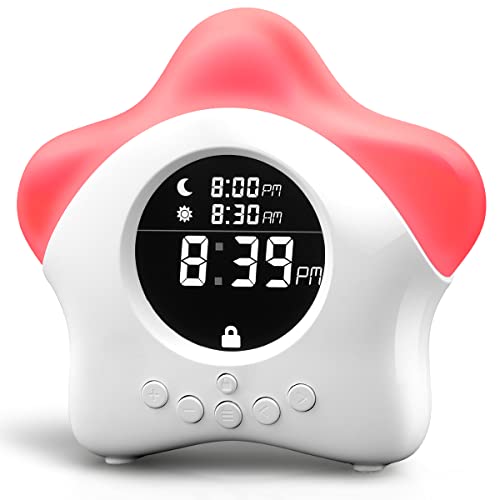 Learn & Climb Toddler Sleep Training Clock
|
8.4/10 | Buy | |
| Best Budget |
 ANNNGUL Kids Ok to Wake Clock
|
8.1/10 | Buy |
 ANALOI Kids Ok to Wake Clock
|
8.0/10 | Buy |
Azyh Kids Sleep Trainer Alarm Clock with Ok
The Azyh Kids Alarm Clock combines an ok-to-wake color training system with dual alarms, 10 wake-up ringtones, and customizable ambient night lighting. It is a practical, compact bedside solution for parents sleep-training toddlers and adults seeking versatile daily and weekday wake scheduling.
Pros
- Clear red and green visual cues simplify morning sleep training for toddlers and young children.
- Comprehensive scheduling options allow distinct weekday, weekend, daily, or single-day wake-ups.
- Includes both Type-C cable and wall power adapter directly in the box for immediate setup.
- Extra USB output port lets you power a secondary device directly from your nightstand.
- Child lock prevents kids from altering alarm times or light settings.
Cons
- Requires continuous connection to AC/Type-C power as there is no listed internal battery operation for cordless use.
- Touch-sensitive controls may require a short learning curve for sleepy morning operation.
- Compact 4.5-inch footprint may feel lightweight on a cluttered bedside table.
MooLarm Ok to Wake Sleep Trainer Toddler Alarm
The MooLarm Sleep Training Alarm Clock uses clear sun, moon, and color cues alongside an integrated 17-sound noise machine to help toddlers build healthy sleep schedules. It is a practical bedside tool for parents seeking an effective way to teach early-rising children when to stay in bed and when it is okay to wake up.
Pros
- Clear sun and moon visual indicators teach early risers when to stay in bed without needing to read time digits
- Versatile 17-sound audio library eliminates the clutter of having a separate nursery sound machine
- Convenient independent nap timer prevents accidental resets of the daily morning wake schedule
- Four-level dimming with automatic nighttime reduction helps prevent excess bedside glare during sleep
Cons
- Stepped 4-level dimmer does not offer continuous stepless 0 to 100 percent brightness tuning
- Visual coaching cues may require consistent parental reinforcement before young toddlers follow them reliably
- Lightweight 0.7-pound build can be easily tipped over or displaced by curious children if kept within arm's reach
I-CODE Toddler Ok to Wake Clock
The I-CODE Ok to Wake Alarm Clock is a compact bedside sleep trainer that pairs clear red and green visual cues with friendly facial emojis to teach young children healthy morning boundaries. Equipped with an adjustable night light, flexible nap timer, and toddler-proof lock, it is an effective tool for parents helping kids establish independent sleep routines.
Pros
- Intuitive color-coded lighting and facial expressions help toddlers understand wake boundaries before they can read numbers
- Child safety lock prevents curious toddlers from resetting the clock or changing alarm times
- Versatile nap timer allows parents to set quick rest countdowns without altering regular morning wake schedules
- Small footprint and lightweight 0.65-pound ABS frame fit conveniently on any bedside surface
Cons
- Relies primarily on visual learning cues, which may require an initial adjustment period and parental coaching for younger toddlers
- Compact 4-inch square chassis houses multiple configuration buttons that require careful setup using the included directions
- Manufacturer specifications do not detail internal battery backup or prolonged cordless operating capabilities
Learn & Climb Toddler Sleep Training Clock
The Learn & Climb Stay-in-Bed Clock is an electronic toddler sleep trainer featuring a clear LCD display and a color-coded light system to help kids know when to stay in bed and when to wake up. It is an ideal bedside tool for parents seeking consistent morning routines and better sleep habits for toddlers and young children.
Pros
- Color-coded visual cues help non-time-reading toddlers easily understand when it is acceptable to leave bed
- Supplied with a sturdy DC power adapter and USB cord for immediate out-of-the-box operation
- Battery backup preserves essential alarm and time settings if wall power drops or cords are bumped
- Includes comprehensive sleep training materials like an eight-week reward chart and bedtime storybook
- Dedicated nap countdown mode simplifies daytime rest routines without overriding primary alarm times
Cons
- Backup batteries are not included and only preserve memory settings rather than powering active lights or audio
- Speaker volume is limited to two preset levels rather than a continuous variable adjustment slider
- Requires continuous connection to AC wall power to keep the nightlight and digital display active
ANNNGUL Kids Ok to Wake Clock
The ANNNGUL Kids Alarm Clock is a compact bedside sleep trainer that uses clear red and green light indicators to teach toddlers when to stay in bed and when it is okay to get up. Featuring 10 night light colors, 5 brightness levels, and accessible front-facing buttons, it is well suited for parents seeking an intuitive morning routine helper.
Pros
- Red and green visual wake indicators help toddlers understand sleep boundaries before they can read numbers
- Front-mounted controls eliminate the frustration of navigating hidden buttons on the bottom of the clock
- 10 vibrant night light color options and 5 brightness settings allow customized bedtime lighting
- Comes complete with both the required power cable and AC wall adapter in the box
- Settings preservation prevents the need to reprogram routines after brief power disconnections
Cons
- Must remain plugged into an electrical outlet to function and cannot operate cordlessly on battery power alone
- Brightness adjustment uses 5 preset steps rather than a continuous 0-to-100 percent stepless dial
- Lacks separate weekday and weekend dual-alarm scheduling options
ANALOI Kids Ok to Wake Clock
The ANALOI Kids Sleep Training Alarm Clock combines an intuitive red-and-green visual wake system with gradual ascending tones and dual alarm scheduling to build consistent morning routines. Wrapped in a drop-resistant silicone shell with an integrated sound machine and night light, it is a practical choice for parents transitioning toddlers into independent sleeping habits.
Pros
- Intuitive red-to-green light and facial expression cues help toddlers identify wake-up time without reading numbers
- Dual independent alarms provide separate scheduling for weekdays and weekends
- Shock-absorbing silicone build paired with hidden buttons and a child lock prevents accidental setting changes
- Built-in sound machine offers 7 soothing audio tracks and a flexible 15-to-60 minute sleep timer
Cons
- Display and night light brightness is limited to 3 preset levels rather than a continuous stepless dimming dial
- USB-powered design requires an available USB outlet or standard USB wall adapter
- Compact 4.4-inch display size is optimized for close bedside viewing rather than large rooms
A Complete Practical Guide to Operating an Ok to Wake Clock
Operating a visual sleep trainer requires understanding both its technical hardware settings and the behavioral habits that make the cues effective for young children. By converting abstract hours and minutes into recognizable colors, icons, and sounds, these digital clocks teach toddlers to remain in bed until a prearranged hour. Success depends on calibrating the device correctly, positioning it safely, and teaching your child to follow its daily visual transitions.
Understanding Color Signals: Red, Yellow, and Green Visual Logic
Visual sleep training relies on universal color associations that young minds can grasp long before learning to read digital numerals. Most modern units, such as the ANNNGUL Kids Alarm Clock and the Azyh Alarm Clock for Kids, use red light as the universal cue to stay in bed. Red wavelengths naturally support evening rest because they do not suppress melatonin production like blue or white lights can. When the clock glows red, toddlers learn that nighttime rest is still underway, even if they wake up briefly in the dark.
Several advanced trainers introduce an interim yellow countdown light before shifting to the final morning cue. The Stay-in-Bed Clock for Kids utilizes a yellow signal that notifies children morning is approaching soon, teaching them to play quietly in their room. This transitional period prevents early morning frustration by acknowledging that the waking hour is near. Once the clock shifts to green, children receive immediate, unequivocal permission to leave their bedroom and start their day.
Some designs combine color changes with expressive graphic icons to reinforce the message for visual learners. Models like the Ok to Wake Sleep Training Kids Sun Moon Alarm feature alternating sun, star, and moon graphics, while the I·CODE Ok to Wake Alarm Clock for Toddlers incorporates sleeping and smiling emoji faces. These facial expressions give children an intuitive reference point that feels friendly and easy to interpret. Combining colored illumination with sleepy or smiling icons reinforces the behavioral rule across multiple developmental levels.
Physical Placement and Nightstand Safety Considerations
Placing a sleep training clock requires balancing clear visual sightlines with child safety precautions. The display should sit within your child’s direct line of sight from their mattress so they can check the status without standing up. However, the physical unit must remain out of immediate arm’s reach to prevent curious toddlers from pressing buttons or pulling cords. A high dresser, a sturdy wall shelf, or a distant bedside table usually provides the ideal vantage point.
Power cord management is equally critical when installing electronics in a toddler bedroom. Most sleep training models, including the ANNNGUL clock and the Azyh clock, operate via USB or dedicated AC wall adapters that must stay plugged in continuously. Loose power cables represent strangulation and tripping hazards that require secure anchoring with cord clips or outlet covers. Ensuring the cord remains taut and tucked behind heavy furniture prevents children from pulling the clock off high surfaces.
Nighttime display intensity must also be calibrated carefully during physical placement. Many devices feature multi-level dimming controls, such as the five-level dimmers on the ANNNGUL unit and the four-level settings on the MooLarm clock. If the backlight glows too brightly on a nearby nightstand, the ambient glare can disrupt deep sleep cycles or keep sensitive toddlers awake. Setting the dimmer to its lowest comfortable setting ensures the color remains clearly identifiable across the room without illuminating the entire ceiling.
Programming Core Schedules: Bedtime Windows and Wake Alarms
Initial setup begins with setting the internal quartz clock to the correct local time and verifying the twelve-hour format. One of the most frequent setup mistakes is reversing AM and PM settings, which causes the clock to shine bright green at midnight and glow red at noon. Most sleep trainers feature a small display icon indicating PM hours, so double-checking this indicator prevents disruptive nocturnal errors. Once the primary clock is accurate, you can proceed to programming the independent sleep and wake schedules.
Bedtime programming establishes the exact hour when the unit activates its red nightlight and displays closed-eye icons. For toddlers with rigid sleep routines, setting the red window to begin thirty minutes before lights-out creates a calming visual transition during pajamas and storytime. Models like the ANALOI Alarm Clock for Kids offer dual-alarm scheduling, allowing parents to program separate schedules for standard weekdays and leisurely weekend mornings. This scheduling flexibility prevents having to reprogram the device manually every Friday evening.
Configuring morning wake options involves deciding between silent visual signals and audible chimes. Parents often prefer silent green light activation on weekend mornings so the clock does not artificially wake a child who is happily sleeping past their target time. If your household relies on prompt morning departures, pairing gentle audible melodies or nature sounds with the green light helps wake heavy sleepers without sudden buzzer shocks. For adults managing their own bedrooms alongside children, exploring reliable bedside alarm clocks can help align household schedules across different rooms.
Utilizing Daytime Nap Timers Without Disrupting Daily Alarms
Toddler sleep routines frequently involve afternoon rest periods that occur outside standard morning alarm cycles. Sleep trainers address this challenge by incorporating dedicated nap countdown timers that operate independently of primary morning alarms. Models like the Ok to Wake Sleep Training Kids Sun Moon Alarm offer countdown intervals ranging from thirty to one hundred twenty minutes. Activating a temporary countdown avoids altering your carefully programmed morning wake-up settings.
During afternoon nap sessions, the device operates on the identical color logic used throughout nighttime hours. The clock illuminates red or shows resting symbols for the duration of the countdown, transitioning to green once the chosen rest period concludes. This continuity reinforces the behavioral rule that green means wake-up time regardless of whether the sun is shining outside. Toddlers learn that room rest continues until the clock gives permission, helping prevent premature afternoon room escapes.
Nap timers also assist parents whose older toddlers no longer fall asleep during afternoon hours but still require quiet rest. Setting a sixty-minute quiet time countdown provides a tangible boundary for independent book reading or toy play in the bedroom. Children can monitor the clock periodically to know when family activities will resume. Once the green light signals completion, parents can enter the room with positive verbal praise.
Activating Child Lock Controls to Protect Programmed Settings
Toddlers possess a natural instinct to press buttons, turn dials, and explore every accessible electronic feature. Without a functional lockout system, children can easily alter programmed wake times, trigger loud audible alarms, or invert color settings within seconds. Manufacturers incorporate child lock safeguards to ensure programmed schedules remain intact despite tactile experimentation. Engaging this lock immediately after configuration prevents unexpected early morning failures caused by wandering fingers.
Different manufacturers implement child locks using distinct physical control strategies. On the I·CODE Ok to Wake Alarm Clock for Toddlers, engaging the lock requires holding down both the sleep button and the time format button simultaneously for three seconds. In contrast, the ANALOI clock utilizes concealed buttons and durable silicone housing to keep controls protected from playful bumps. Learning your specific device lockout sequence ensures you can make adjustments quickly while keeping settings inaccessible to your child.
Button accessibility also varies between front-mounted interfaces and base-mounted panels. The ANNNGUL Kids Alarm Clock features buttons placed intuitively on the clock face for easy parental programming, making active lock engagement particularly important. Clocks with controls placed on the rear or underneath the base offer an additional layer of passive protection against curious toddlers. Regardless of interface design, confirming the active lock indicator on the digital screen ensures morning schedules remain secure.
Behavioral Training Techniques: Reinforcing Visual Boundaries
A sleep training clock is only as effective as the behavioral consistency supporting its visual cues. Before plugging the unit into the bedroom, introduce the clock during daytime play hours when your child is alert and receptive. Walk through the colors together, practicing quiet lying down when the light shines red and enthusiastic celebrating when it turns green. Role-playing these morning transitions during daylight demystifies the clock and builds positive anticipation.
Setting the initial wake time requires realistic expectations based on your child’s existing natural habits. If your toddler currently wakes at five in the morning, programming the green light for seven will lead to immediate failure and distress. Instead, set the initial morning cue for five-fifteen, ensuring your child experiences quick success and positive reinforcement. Over several weeks, gradually advance the wake target by ten to fifteen minutes until reaching your desired household waking hour.
Handling early room departures calmly is crucial to establishing long-term behavioral habits. If your toddler leaves their bedroom while the light is still glowing red, guide them back gently with minimal verbal engagement or stimulation. Point to the red light, remind them softly that it is still sleep time, and tuck them back into bed. Consistent, neutral enforcement teaches children that the clock determines the morning routine rather than parental negotiation.
Power Architecture, Adapters, and Battery Backup Functions
Understanding how your sleep trainer handles electrical power prevents unexpected setting resets and missed wakeups. The majority of modern ok to wake clocks rely on continuous AC wall power delivered via USB-C cables, DC barrel jacks, or standard wall adapters. Products like the Learn & Climb Stay-in-Bed Clock and the Azyh clock operate on continuous line power to maintain their colorful LED displays and audio engines. Without steady wall electricity, the illuminated color cues cannot function continuously throughout the night.
Many parents mistakenly assume that backup batteries will power the full visual display during residential electrical outages. In most designs, installed backup batteries operate solely as memory retention circuits for internal quartz timekeeping. While the backup cell saves your programmed alarms and current time during a brownout, the exterior LED display and nightlight remain dark until wall power returns. Testing your clock by briefly disconnecting the wall adapter clarifies exactly how your specific model behaves without mains electricity.
Certain models provide dedicated battery compartments designed to hold standard alkaline cells to prevent clock memory loss. The Stay-in-Bed Clock for Kids includes emergency battery backup functionality so parents do not need to reprogram complex schedules after brief power flickers. Ensuring fresh backup batteries are installed provides peace of mind during seasonal storm cycles. Always inspect battery compartments periodically to check for proper terminal contact and prevent chemical leakage over extended ownership.
Adjusting Nightlight Colors and Ambient Sound Profiles
Beyond visual wake signaling, multi-function sleep trainers often serve as dedicated bedroom nightlights and white noise sound machines. Devices such as the MooLarm clock feature ten vivid color selections alongside seventeen distinct acoustic sound profiles, including white noise and nature recordings. When choosing an evening nightlight hue, warm amber or soft red spectrums are far preferable to cool blue or bright white tones. Red wavelengths do not stimulate retinal photoreceptors that suppress melatonin, keeping the child’s natural circadian rhythm protected.
Acoustic features require careful volume calibration to promote restful sleep without masking critical household sounds. The ANALOI alarm clock incorporates seven soothing audio tracks with gentle volume ramps designed to lull children to sleep peacefully. Sound machine volume should never exceed safe conversational sound thresholds when placed near a toddler’s bed. Calibrating the sound machine to a moderate, steady level masks outdoor traffic and neighborhood noises without causing auditory strain.
Sleep light auto-off timers provide additional versatility for toddlers who only need illumination while falling asleep. The I·CODE clock allows parents to select sleep timer intervals of fifteen, thirty, sixty, or one hundred twenty minutes, after which the ambient light shuts off automatically. This feature suits children who feel secure drifting off with a soft glow but sleep more deeply in complete darkness later in the night. Customizing these sound and light parameters creates an optimal sleep environment tailored to your child’s specific developmental needs.
Troubleshooting Inverted Lights, Display Glare, and Glitches
When a sleep trainer fails to illuminate at the expected hour, the root cause is almost always an inverted twelve-hour clock configuration. If the primary time is set to eight AM instead of eight PM, the clock will initiate its bedtime routine in the morning and wake cues at night. To resolve this issue, enter the primary clock menu and verify whether the PM indicator icon is properly engaged for afternoon and evening hours. Running a quick two-minute manual test by setting the alarm time two minutes ahead helps verify proper operation before bedtime.
Excessive display glare is another frequent complaint among parents using bedside sleep trainers in dark bedrooms. If the clock illuminates the entire room like a lantern, consult the brightness dimmer settings on the control panel. Models like the ANNNGUL clock offer five adjustable brightness levels, allowing users to soften the digits and halo glow significantly. If the lowest factory brightness setting still feels too radiant, angling the clock slightly away from the bed reduces direct optical glare while keeping colors visible.
Unresponsive button inputs often indicate that the child lock was inadvertently engaged during prior handling. If pressing menu buttons produces no response or displays a padlock icon, perform the manufacturer unlock sequence, such as holding designated buttons for three to five seconds. Additionally, inspect the physical power connection at the back of the housing to ensure the USB or DC barrel plug has not wiggled loose. Verifying physical connections and lock states resolves most operational difficulties without requiring full factory resets.
A Final Practical Routine for Bedtime Success
Consistent daily execution transforms a simple electronic clock into a powerful household sleep habit. Before saying goodnight, perform a quick visual sweep to verify that the clock is actively plugged in, the child lock is engaged, and the red light is illuminated. Acknowledge the glowing cue with your child by reminding them that everyone stays quiet until green morning light appears. This brief two-second reminder reinforces behavioral expectations right before sleep onset.
When the morning transition arrives, celebrate your toddler’s cooperation whenever they wait patiently for the green light. Positive verbal reinforcement, combined with reward charts like the eight-week progress trackers included with some sleep trainers, builds long-term confidence and morning independence. Over time, visual wake clocks give young children the security of knowing exactly when rest ends and the morning begins. With steady patience and proper device calibration, the entire household can enjoy more peaceful, uninterrupted mornings.
About the author
McKenzie Dillon is a Certified Sleep Science Coach and experienced sleep-product editor who has personally tested dozens of sleep products. Her expertise bridges sleep technology, product evaluation, and practical guidance for creating more comfortable sleep and wake-up routines.