
How to Make a Clock Silent: Practical Guide for 2026
Learn how to make a clock silent with easy sweep motor upgrades and sound-dampening techniques for a peaceful bedroom in October 2026.
 By Daniel Noyed
Updated October 6, 2026
By Daniel Noyed
Updated October 6, 2026

Nighttime quiet is essential for restorative sleep, yet an audible clock ticking on a nightstand or wall can create persistent sleep disruption. Understanding how to make a clock silent allows light sleepers to eliminate intrusive clicking noises without discarding favorite decorative frames or family heirlooms. Many individuals find that continuous rhythmic clicks elevate nighttime alertness, making it difficult for the brain to transition into deeper stages of rest. Choosing a silent replacement movement or a completely noiseless bedside option restores the peaceful atmosphere required for sound recovery and consistent sleep quality.
Transforming an irritating timepiece into a quiet bedside companion usually involves swapping an old stepped motor for an ultra-silent sweep quartz mechanism. Upgrading your bedroom with reliable bedside clocks for quiet bedrooms ensures you never lose sleep over repetitive mechanical clicks. Whether you choose to replace internal mechanical components, install sound-absorbing materials, or switch entirely to silent solid-state digital units, siloing sound from your sleeping quarters protects your overall sleep hygiene. Investing a few minutes into this straightforward upgrade can permanently transform your bedroom into a quiet resting sanctuary.
| Award | Product | ACR Score About ACR ScoreThe ACR Score is our own rating from 0 to 10, based on performance, design and build, ease of use, and value. It reflects independent research and is never influenced by manufacturers, retailers, or affiliate commissions. Learn more › | |
|---|---|---|---|
| Best Overall |
Aloneaka 2-Pack Silent Clock Movement Kit
|
8.6/10 | Buy |
 Mudder High Torque Quartz Clock Movement Mechanism
|
8.4/10 | Buy | |
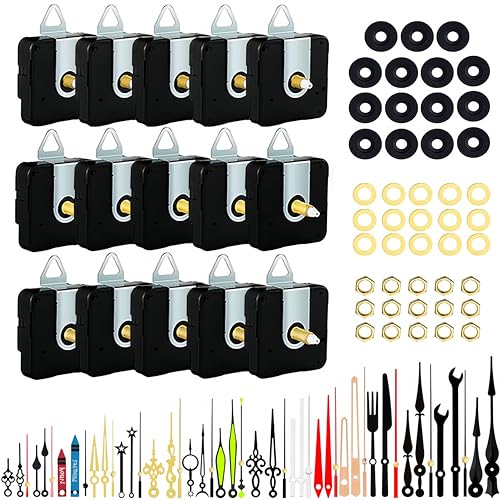 whcusmm 15-Pack Silent Quartz Clock Mechanism
|
8.1/10 | Buy |
Aloneaka 2-Pack Silent Clock Movement Kit
Designed for silent operation, this DIY replacement set pairs two quartz movements with six interchangeable hand sets. It provides flexible hardware options for repairing or building clocks across varied dial thicknesses.
Pros
- Silent sweep mechanism prevents disruptive ticking noise
- Includes two distinct shaft lengths for varied clock dials
- Comes with six decorative pairs of clock hands
- Accommodates dial thicknesses up to 13 millimeters
Cons
- Delicate aluminum hands bend easily under installation pressure
- Product instructions and labeling may differ due to international sourcing
Mudder High Torque Quartz Clock Movement Mechanism
The Mudder High Torque Clock Movement Kit provides a dependable quartz mechanism designed to drive extra-long hands across dials up to 23.1 inches in diameter. It is an ideal pick for DIY crafters and homeowners looking to repair or build large decorative wall clocks.
Pros
- Strong high-torque motor engineered to support large, long-reach hands without slipping or stalling
- Compatible with thicker panels between 9 mm and 13 mm, including wood, canvas, and craft boards
- Generous hand lengths provide clear time visibility across large wall clocks up to 23.1 inches
- Straightforward hardware kit for DIY clockmakers and home decor restoration projects
Cons
- Two-hand configuration uses a closed second cap nut rather than an active sweeping second hand
- Fixed shaft length requires panel thickness between 9 mm and 13 mm, necessitating shims for thinner boards
- Jump second step-motion mechanism may produce a subtle audible mechanical pulse in very quiet rooms
whcusmm 15-Pack Silent Quartz Clock Mechanism
This 15-pack quartz movement kit from whcusmm delivers silent sweep timekeeping with 16 interchangeable hand sets, eliminating disruptive ticking for peaceful bedroom and home spaces. It is an ideal bulk solution for crafters, homeowners repairing wall clocks, and light sleepers who demand tick-free timepieces.
Pros
- Completely silent sweep action eliminates disruptive mechanical ticking in quiet bedrooms and living spaces.
- Generous 15-piece bulk pack with 16 hand styles provides exceptional value for multiple repairs or crafting projects.
- Three distinct shaft lengths adapt easily to varied clock panel thicknesses between 4 mm and 12 mm.
- Simple rear thumbwheel makes setting the time quick and intuitive without specialized tools.
Cons
- Requires one AA battery per movement that is not included in the package.
- Does not include built-in alarm audio, snooze features, or illuminated digital displays.
- Delicate aluminum hands require careful alignment during installation to avoid bending.
Practical Solutions to Make Any Clock Silent for Restful Sleep
Learning how to make a clock silent transforms an irritating bedroom environment into a tranquil sanctuary. Most people assume that an audible tick is an unavoidable characteristic of analog timekeeping, but modern engineering offers simple solutions. By replacing an outdated stepped movement with a quiet sweep motor or isolating the chassis, you can quiet down any noisy dial. This guide explains how to identify your clock hardware, install silent replacement parts, and ensure sound sleep.
Why Standard Clocks Make Noise: Stepping Motors vs. Continuous Sweep Movements
Standard battery clocks produce sound because of their internal stepping motor design. A small quartz crystal pulses an electrical signal exactly sixty times each minute, triggering a gear train to advance the second hand in abrupt increments. That sudden start-and-stop action releases mechanical energy that vibrates through the plastic casing. Over time, loose internal gears can make this rhythmic clicking even more noticeable during quiet nights.
Silent quartz mechanisms function on a continuous scanning or sweep principle. Instead of halting every second, the internal motor delivers a smooth, unbroken rotation that glides the second hand around the face. Because the gears turn without sudden stops, the physical impact that produces acoustic ticking is virtually eliminated. This smooth motion provides an ultra-quiet bedroom environment that allows sensitive sleepers to fall asleep without distraction.
The physical clock dial often acts as an acoustic amplifier for mechanical vibrations. Thin wooden panels, acrylic sheets, and hollow plastic cases resonate like soundboards when coupled with a noisy motor. Even a faint mechanical pulse inside the motor housing can reverberate across an entire bedroom wall. Upgrading the internal motor stops the vibration directly at the source before the clock frame can amplify it.
Selecting the Right Silent Movement: Shaft Length and Dial Thickness
Selecting the right replacement motor requires measuring the thickness of your clock panel before ordering parts. Silent movement mechanisms are manufactured with different shaft lengths to fit various materials, ranging from thin craft boards to thick wooden planks. A shaft that is too short cannot pass through the dial to receive the mounting nut and hands. Conversely, a shaft that is excessively long will project too far forward, potentially hitting protective glass covers.
Standard short-shaft mechanisms generally feature a total shaft length of roughly 16 mm (0.63 inches) with a threaded length around 8 mm (0.315 inches). These compact dimensions suit clock panels measuring between 3 mm and 6 mm in thickness, making them ideal for lightweight wall clocks and thin craft projects. Long-shaft mechanisms provide a total length of approximately 23 mm (0.9 inches) and a threaded section of 15.4 mm (0.6 inches). That extra clearance allows secure installation through robust clock panels between 9 mm and 13 mm thick.
Multi-pack kits from manufacturers like whcusmm often supply assorted shaft lengths, including 16 mm, 18 mm, and 23 mm variations. Having several shaft sizes on hand helps when restoring multiple timepieces or working on custom home decor projects. Before purchasing, use a standard ruler or caliper to determine the exact depth of your clock case. Checking these dimensions prevents installation delays and guarantees a stable mechanical fit.
Understanding Torque Requirements for Long and Heavy Clock Hands
Motor torque determines whether a silent movement can handle large decorative hands without stalling. Standard quartz motors are built to drive compact, lightweight hands measuring under six inches. If you install oversized hands on a standard movement, the internal gears may struggle against gravity as the minute hand ascends from the six to the twelve position. This mechanical strain can cause erratic timekeeping, gear binding, and faint clicking noises.
High-torque sweep movements, such as the Mudder high-torque movement, feature reinforced gearboxes designed for larger dials. These heavy-duty motors can reliably power minute hands up to 243 mm (9.6 inches) and hour hands around 170 mm (6.7 inches). They provide the rotational force needed to drive wide dials measuring up to 58.6 cm (23.1 inches) in diameter. Choosing a high-torque motor ensures that large statement clocks maintain precise time without putting excessive friction on the motor spindle.
Balance also plays a vital role when mounting substantial clock hands. Heavy aluminum or wooden hands often incorporate counterweights at their mounting base to distribute rotational load evenly. If a long minute hand lacks proper counterbalance, the downward gravitational pull can stress the delicate plastic gears inside the movement. Opting for matched hand sets engineered for high-torque motors protects the movement and keeps operation silent.
Step-by-Step Guide to Replacing a Noisy Clock Mechanism
Disassembling the old clock is the first physical step in your silencing project. Remove the battery from the rear compartment to cut power and prevent sudden gear movement. Lay the clock face-up on a soft microfiber towel to protect decorative surfaces from scratches. If the clock features a front glass lens or bezel, carefully unclip or unscrew the perimeter fasteners to expose the central dial.
Removing the existing hands requires gentle, even pressure to avoid bending the mounting posts. Start by pulling the small second hand or central pin straight off the spindle. Next, grip the minute hand near its central hub and lift it upward away from the dial face. Finally, remove the hour hand from its press-fit friction collar using your fingertips or small pry tools.
Loosen the central mounting hardware located on the front of the dial using needle-nose pliers or a small wrench. Most units utilize a thin brass hex nut paired with a flat washer to clamp the movement to the backplate. Once the nut is free, slide the old noisy movement out from the rear of the clock case. Clean the mounting hole area to eliminate accumulated dust before setting the new silent mechanism in place.
Install the silent sweep movement from behind, ensuring the rubber washer sits between the motor housing and the clock backplate. This rubber gasket dampens internal motor vibrations and prevents the plastic housing from rotating out of alignment. Thread the brass washer and retaining hex nut onto the threaded shaft from the front side. Tighten the nut securely with your fingers, followed by a slight quarter-turn with pliers to anchor the motor without cracking the dial.
Handling Delicate Aluminum Clock Hands Without Causing Mechanical Friction
Installing the new hands requires precision because modern replacement parts are commonly pressed from thin aluminum. As noted in the Aloneaka product specifications, excessive downward force will easily bend these lightweight aluminum hands. A bent hand will scrape against the clock dial or drag against adjacent hands as they rotate. That metal-on-metal friction generates scraping noises and drains battery power rapidly.
Begin by pressing the hour hand onto the widest bottom collar of the spindle while pointing it directly at the twelve o’clock position. Next, install the minute hand onto the middle collar, aligning it precisely over the hour hand at twelve. If your silent kit includes a sweep second hand or decorative second cap, gently press it onto the tiny central copper pin. Aligning all hands at the twelve position ensures synchronized timekeeping throughout the full twenty-four hour cycle.
Inspect the clock from a side profile to verify that all hands sit completely parallel to each other and the dial. There should be an even gap of at least one to two millimeters separating each rotating layer. If you notice any upward or downward curvature, gently straighten the aluminum blades using light fingertip pressure near the hub. Ensuring proper clearance stops hands from catching on one another, preventing unexpected stopping and audible friction.
Non-Invasive Noise Reduction Methods When Replacement Is Not Feasible
Sometimes replacing an internal mechanism is not immediately practical, particularly with vintage or antique clocks. In these situations, simple sound-dampening methods can reduce the acoustic projection of a stepping movement. One quick trick involves removing the second hand entirely if the movement allows it. Without the weight and visual indicator of the second hand, some quartz motors click with significantly reduced volume.
Decoupling the clock from hard bedroom surfaces also diminishes perceived sound levels. When a clock hangs directly against drywall, the hollow wall cavity acts as a sounding board that amplifies mechanical ticking. Placing small felt pads, rubber bumpers, or adhesive silicone dots on the rear corners of the clock case creates an acoustic barrier. This separation prevents mechanical vibrations from transferring into wall studs and echoing across your room.
Enclosing a small desktop clock inside a glass display dome or acrylic vitrine provides another layer of noise attenuation. The solid glass barrier blocks high-frequency clicking sounds while preserving your view of the decorative face. However, sound dampening will never achieve the true absolute quiet of a dedicated sweep motor. Sensitive sleepers will usually find that swapping the motor or transitioning to a digital option provides the only permanent solution.
Transitioning to Solid-State Digital Alarm Clocks for Bedside Silence
Many homeowners discover that replacing mechanical wall clocks solves room acoustics, yet bedside nightstands require an even higher standard of quietness. In close sleeping proximity, even the faintest sweep motor can produce a low mechanical hum if placed on a hollow nightstand. Choosing a modern digital alarm clock eliminates all mechanical moving parts, ensuring truly zero decibels of ambient noise. Solid-state electronic circuits keep flawless time without spinning gears, vibrating armatures, or clicking components.
Upgrading to contemporary bedside electronics also brings convenient nightstand consolidation features for daily living. For instance, exploring multi-function bedside clocks with charging capabilities helps streamline nightstand cord clutter while maintaining quiet sleep. These modern digital units replace ticking gears with clear LED displays, adjustable dimming controls, and integrated device charging. You gain reliable morning wake-up alerts without suffering through repetitive mechanical sounds throughout the night.
When selecting a digital clock for a quiet bedroom, pay close attention to display dimming controls and power supply quality. Look for models featuring continuous rotary dimmers that dial down to complete blackout for light-sensitive sleepers. In addition, quality power adapters prevent high-frequency electrical coil whine that sometimes plagues cheaper electronics. A quiet solid-state bedside clock paired with a silent wall sweep movement creates the ultimate distraction-free sleeping quarters.
Troubleshooting Hand Friction, Power Delivery, and Time Drift
If your newly installed silent movement stops running or loses time, the issue usually stems from physical hand contact. Because silent sweep motors produce gentle rotational force, any minor drag against adjacent hands or the dial glass will halt the mechanism. Examine the hands closely under bright light to verify that the minute hand clears the hour hand at every point in its rotation. Straightening bent aluminum parts usually restores smooth, uninterrupted movement.
Battery selection plays a major role in the longevity and quiet operation of quartz movements. Most replacement kits, including those from Aloneaka and whcusmm, recommend standard 1.5V AA alkaline or zinc-carbon batteries. Avoid using high-drain lithium cells or rechargeable batteries unless the manufacturer explicitly approves them. High-output lithium cells can deliver excessive initial voltage, potentially damaging sensitive quartz timing circuits or accelerating gear wear.
Setting the time using the hands directly from the front can strip the tiny plastic gears inside the movement. Always use the rotary thumbwheel located on the back of the motor housing to adjust the hour and minute indicators. Rotating the hands manually by pushing the aluminum blades can loosen the friction fit on the spindle and introduce gear slack. Proper adjustment habits protect the gear teeth and keep your sweep mechanism operating noiselessly for years.
Creating a Completely Noise-Free Bedroom Environment for Deeper Rest
Eliminating an audible clock tick is often the catalyst for optimizing an entire bedroom sleep environment. Once the intrusive mechanical click is gone, other subtle sleep disruptions like glowing standby LEDs or street noise become more noticeable. Pair your silent clock upgrade with blackout curtains, white noise machines, and warm amber bedside lighting. Addressing auditory and visual triggers together supports your natural circadian rhythm and encourages deeper rapid eye movement sleep.
Taking the time to silence your home timepieces preserves the visual charm of classic decor while respecting your personal rest. DIY replacement kits make the upgrade straightforward and accessible for anyone with basic household tools. Whether you install a high-torque Mudder movement on a large wall piece or a compact Aloneaka sweep motor on a desktop frame, quiet nights are easily achievable. Restful sleep begins with a tranquil room, and silencing a ticking clock is one of the most effective improvements you can make.
About the author
Daniel Noyed is a Certified Sleep Science Coach and experienced product editor with extensive knowledge of sleep health and sleep-related products. He has hands-on experience testing hundreds of products and translating technical features into practical guidance for everyday sleepers.