
How Do Clocks Automatically Set Time: Practical Guide for 2026
Learn how do clocks automatically set time using atomic radio signals and memory chips to keep accurate bedside time in November 2026.
 By McKenzie Dillon
Updated November 17, 2026
Waking up after a severe electrical thunderstorm only to find your nightstand display flashing midnight is an all-too-familiar frustration. Wondering how do clocks automatically set time without constant human effort becomes a practical consideration when upgrading your bedroom setup. Automated synchronization eliminates the tedious chore of dialing minute wheels, correcting drift, or manually recalculating spring and fall daylight adjustments. Many sleepers explore top-rated alarm clocks for bedrooms to remove morning friction and ensure their daily schedules remain dependable without endless maintenance.
Self-adjusting timepieces rely on distinct engineering methods to maintain split-second precision throughout the calendar year. Some models capture low-frequency radio transmissions directly from government atomic reference stations, while others use pre-programmed microcontrollers that calculate seasonal shifts and preserve memory registers with dedicated backup batteries. Understanding how these timing circuits operate helps you choose the best configuration for your bedroom layout and regional location. Whether you prefer an analog wall timepiece or an accessible digital bedside console, modern automated clocks deliver hands-free precision every single morning.
| Award | Product | ACR Score About ACR ScoreThe ACR Score is our own rating from 0 to 10, based on performance, design and build, ease of use, and value. It reflects independent research and is never influenced by manufacturers, retailers, or affiliate commissions. Learn more › | |
|---|---|---|---|
| Best Overall |
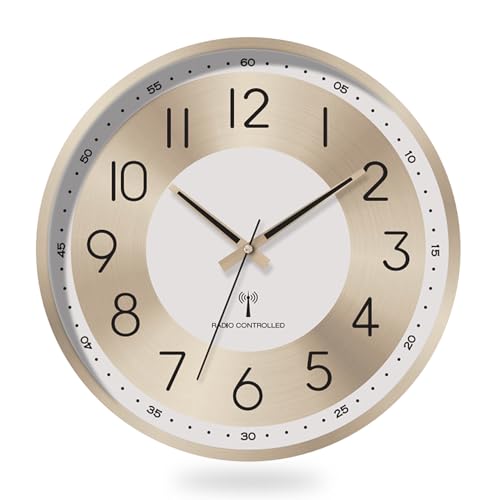 Aurowit 14-Inch Atomic Wall Clock |
8.6/10 | Buy |
| Best Value |
 MASSII 7-Inch Digital Calendar Day Clock |
8.3/10 | Buy |
Aurowit 14-Inch Atomic Wall Clock
The Aurowit 14-Inch Atomic Wall Clock provides effortless precision by synchronizing daily with Colorado WWVB radio signals, featuring an aluminum frame and large numerals. It is a dependable choice for seniors, home offices, and light-sensitive sleepers seeking a zero-glare, screen-free timepiece.
Pros
- Radio-controlled WWVB reception automatically maintains exact time and handles DST adjustments
- Large 14-inch face with bold numerals and HD glass provides clear legibility from across the room
- Solid aluminum frame and rose gold finish deliver durable, modern construction
- Completely cordless battery operation eliminates unsightly nightstand or wall cords
- Emits zero electronic screen glow, making it suitable for pitch-black sleep environments
Cons
- Requires one AA battery that is not included in the package
- Analog dial has no luminous glow or backlighting for checking time in pitch-black rooms
- WWVB radio signal reception and initial synchronization can take up to six hours depending on location
MASSII 7-Inch Digital Calendar Day Clock
The MASSII Digital Talking Calendar Clock combines a high-resolution 1280x800 display with spoken time announcements, automated Daylight Saving Time, and 27 programmable alerts. It is an ideal bedside or wall-mounted reminder station for seniors, individuals with memory loss, or anyone needing structured daily task tracking.
Pros
- Clear voice announcements allow seniors and low-vision individuals to check the time without straining their eyes
- Extensive reminder capacity accommodates complex daily medication schedules and routine hydration cues
- Included handheld remote provides effortless menu navigation and alert cancellation without reaching behind the unit
- Built-in memory battery prevents lost schedules during seasonal thunderstorms and power interruptions
- Seven designated daily cycle descriptions help prevent time confusion for memory-care users
Cons
- Requires constant connection to an AC wall outlet; the internal backup battery only preserves memory and will not run the screen or sound alarms during an outage
- Dimmer relies on 10 preset brightness steps rather than a continuous 0 to 100 percent stepless dial
- Does not feature USB pass-through ports or wireless charging surfaces for bedside mobile devices

The Engineering and Synchronization Systems Behind Self-Setting Clocks
Self-setting timepieces maintain precision by combining quartz circuitry with external wireless references or internal calendar algorithms. Instead of requiring manual button presses to advance time, these clocks interpret reference data to synchronize seconds, minutes, hours, and calendar dates automatically. The two most common consumer technologies are longwave radio receivers that tune into atomic broadcasts and firmware-driven microcontrollers pre-programmed with perpetual calendars. Both engineering architectures eliminate manual adjustments while protecting sleepers from missed schedules caused by quartz drift or seasonal time shifts.
Radio-Controlled Atomic Signals and the WWVB Transmission Network
Radio-controlled atomic clocks, such as the Aurowit 14 Inch Atomic Wall Clock, synchronize by receiving wireless broadcasts from national standard time stations. In North America, the National Institute of Standards and Technology operates the primary civilian transmitter, known as station WWVB, located near Fort Collins, Colorado. This facility broadcasts a continuous 60-kilohertz signal linked directly to a cluster of cesium atomic fountains. Cesium atomic standards measure the resonant frequency of cesium-133 atoms, creating an extraordinarily stable benchmark that loses less than one second over millions of years.
Inside an atomic clock, a specialized ferrite rod antenna captures this 60-kilohertz carrier frequency from hundreds of miles away. The WWVB transmission encodes a complete digital time code using binary coded decimal pulses transmitted at a rate of one bit per second. Over sixty seconds, the signal delivers information covering the minute, hour, day of the year, current year, and Daylight Saving Time status flags. An onboard radio frequency receiver chip amplifies the faint electromagnetic pulse, filters atmospheric noise, and decodes the incoming bitstream into usable timing registers.
Atmospheric conditions strongly influence how consistently radio-controlled clocks capture this data. Longwave radio signals at 60 kilohertz propagate primarily as ground waves and skywaves that bounce between the earth and the ionosphere. During daylight hours, solar radiation creates an ionospheric D-layer that absorbs low-frequency radio waves and reduces broadcast range. At night, this layer dissipates, allowing the signal to reflect cleanly and travel across vast geographic distances, which is why atomic clocks typically synchronize between midnight and dawn.
Pre-Programmed Microcontrollers and Automated Calendar Firmware
Not every self-setting clock requires an external radio antenna to maintain accurate time across seasonal changes. Digital consoles such as the MASSII 27 Alarms Digital Talking Clock with Time Date Announcement use pre-programmed microcontrollers loaded with perpetual calendar firmware. These integrated circuits contain mathematical tables that track months, leap years, and specific legislative calendar rules. Once the initial baseline year, month, and day are saved, the internal logic automatically calculates the progression of days without needing an outside wireless transmission.
Automatic Daylight Saving Time adjustment in these firmware-driven clocks relies on algorithmic scheduling rather than real-time radio triggers. In regions adhering to standard daylight rules, the internal chip advances the hour register by sixty minutes at 2:00 AM on the second Sunday of March. Similarly, the chip turns the register back by one hour at 2:00 AM on the first Sunday of November. Manufacturers also provide dedicated toggle switches or menu settings that disable the feature for users living in areas that do not observe daylight shifts.
Underpinning this calendar logic is a standard quartz crystal oscillator vibrating at 32,768 cycles per second. The microchip uses an integrated digital frequency divider that halves this frequency fifteen consecutive times, producing a single pulse per second. Because modern real-time clock chips consume negligible power, they count seconds continuously while executing complex calendar routines in the background. This design allows desktop and wall units to manage multiple reminders, seven daily cycle announcements, and scheduled dimming modes without relying on clear radio reception.
Power Architectures: Operational Backup Versus Memory Retention
A frequent point of confusion among consumers is how digital clocks retain their settings during sudden residential power outages. There is a fundamental engineering difference between active operational battery backup and passive memory-retention backup. Active operational backup utilizes secondary battery banks to keep the display illuminated, the internal oscillator running, and audible alarms functioning when mains power fails. This architecture requires higher battery capacity and is commonly found in specialized emergency travel alarms or heavy-duty alert stations.
Passive memory retention isolates the primary display and high-draw speaker components during an outage while maintaining power to the internal clock microchip. Clocks equipped with built-in button cells or durable internal memory batteries divert just a few microamps of current to preserve stored time registers and alarm preferences. The screen goes dark to prevent rapid battery depletion, but the clock never stops counting seconds. When line electricity returns, the clock display wakes up instantly showing the exact correct time, eliminating the classic flashing midnight error.
For standalone analog atomic clocks, the power architecture operates entirely on primary dry cells such as standard alkaline batteries. Because mechanical gear trains and stepper motors consume significant physical energy, engineers design the radio receiver to power on only for brief synchronization windows. Power management firmware typically wakes the receiver circuit once or twice every twenty-four hours to verify alignment against Fort Collins. If the battery voltage drops below an operational threshold, the movement may halt the second hand while advancing the minute hand to signal low power.
Interference Sources and Radio Signal Obstacles

Radio-controlled clocks depend on faint longwave signals, making them sensitive to electromagnetic interference within residential environments. Modern bedrooms and home offices contain electronic noise generated by switch-mode power supplies, computer monitors, and household appliances. Unshielded transformers and poorly grounded power bricks emit broadband radio frequency noise that can drown out a delicate 60-kilohertz atomic carrier wave. Placing an atomic clock directly beside a desktop tower or wireless router often prevents the receiver from achieving signal lock.
Bedside charging stations can also introduce local electromagnetic disruption if components are positioned too close together. For example, if you place an atomic receiver immediately adjacent to an alarm clock and wireless charger, the inductive magnetic fields generated by the wireless charging coils can saturate the sensitive ferrite antenna. Dense building materials present an additional physical obstacle. Modern energy-efficient windows with metallic low-emissivity coatings, reinforced concrete walls, and metal siding reflect or attenuate radio waves, creating localized reception dead zones.
Optimizing atomic clock reception requires strategic physical placement and proper directional orientation. Because internal ferrite antennas possess directional reception patterns, positioning the clock body parallel to the general direction of Colorado maximizes signal capture. Placing the clock near an exterior window facing toward Fort Collins significantly improves reception quality. In challenging urban or industrial buildings, positioning the clock away from interior walls and metallic ductwork helps the antenna acquire the midnight atomic sync window cleanly.
Mechanical Stepper Motors and Analog Reset Routines
Analog atomic clocks bridge traditional mechanical clockwork with modern wireless electronics through miniaturized stepper motors and optical alignment sensors. When you insert a fresh battery into an atomic analog clock, the movement does not immediately begin tracking the current hour. Instead, the internal microprocessor drives the gear train rapidly forward until all hands point directly to the 12:00 index. Many designs incorporate tiny optical apertures or mechanical contact pins on the gear wheels to confirm that the hands have physically reached this baseline zero position.
Once baseline mechanical alignment is established, the clock activates its receiver circuit to search for WWVB airwaves. In models like the Aurowit wall clock, dedicated hardware buttons allow manual management of this setup sequence. Pressing a manual reset button halts all hands at the twelve o’clock marker, while an advance button can jog the minute hand forward to verify gear engagement. Holding down the dedicated reception button prompts the internal circuit into an extended search mode that scans the atmospheric spectrum for synchronization data.
After acquiring a validated time code, the microprocessor calculates the difference between the zero reference position and the current target time. The stepper motor then advances the hands at accelerated speed until the physical display matches the atomic broadcast. The clock subsequently applies the user-selected time zone offset, shifting the hour hand to Pacific, Mountain, Central, or Eastern time. This dual-layer architecture ensures that even though mechanical gears move the hands, precision remains governed by atomic standards.
Nightstand Ergonomics, Visual Legibility, and Circadian Sleep Health
While automated time setting guarantees accurate timekeeping, how that time is presented to sleepers heavily influences bedroom sleep hygiene. Bright digital displays with harsh blue-white backlights can disrupt circadian rhythms by suppressing melatonin secretion during critical nocturnal sleep cycles. Quality digital consoles provide granular brightness adjustments, ranging from multi-level stepped settings to fully blacked-out screens. Scheduled dimming routines allow clocks to automatically reduce display illumination during evening hours and brighten gradually in the morning to match ambient light conditions.
Display technology also influences visual legibility across different viewing angles and room environments. High-definition liquid crystal displays and light-emitting diode screens with bold, high-contrast digits enable individuals to read the time from across the room without squinting. For seniors, individuals managing cognitive decline, or those with visual impairments, specialized clocks like the MASSII console incorporate spoken voice announcements and prominent day-and-date layouts. These features eliminate temporal confusion by clearly spelling out the day of the week, calendar date, and time of day alongside custom reminder schedules.
Physical controls and remote interfaces further enhance daily usability by preventing accidental setting changes. Placing primary programming keys on a dedicated remote or behind a recessed rear access panel stops groggy sleepers from inadvertently clearing alarm times or disabling automated calendar sync. Tactile, separated snooze bars prevent sleepers from accidentally turning off an alert when they merely intended to delay it. Integrating automated time synchronization with thoughtful bedside ergonomics creates a functional bedroom environment where precision timekeeping supports restful sleep.
Maintenance, Calibration Checks, and Verification Protocols
Maintaining self-setting clocks requires minimal effort, but occasional verification ensures internal circuits and backup power systems remain in working order. To verify that a digital clock retains its settings during an electrical cut, perform a simple disconnect test during daylight hours. Unplug the main alternating-current adapter from the wall outlet for two to three minutes while observing the unit. Upon reconnecting wall power, verify whether the display immediately presents the exact time and retained alarm settings, or whether the registers reset to factory defaults.
For battery-powered radio clocks, inspecting terminal contacts and monitoring battery voltage prevents unprompted drift. Alkaline batteries naturally lose voltage over twelve to eighteen months, which can degrade the sensitivity of internal radio receiver antennas before the mechanical gear train fully stops. If an atomic clock appears to lag by several minutes or fails to adjust during a scheduled Daylight Saving Time transition, replace the dry cell with a fresh battery matching the correct polarity markings. Once fresh power is supplied, initiate a manual signal capture cycle to resynchronize the internal quartz crystal against the reference broadcast.
Understanding the internal engineering of self-setting clocks transforms how you manage home timekeeping. Whether your household relies on longwave atomic radio broadcasts from Colorado or pre-programmed microcontroller calendars supported by memory backup batteries, these automated systems deliver dependable timing without human frustration. By selecting the right technology for your bedroom environment, mitigating household electromagnetic interference, and conducting occasional power verification checks, you can enjoy perfectly synchronized mornings and uninterrupted rest throughout every season.
About the author
McKenzie Dillon is a Certified Sleep Science Coach and experienced sleep-product editor who has personally tested dozens of sleep products. Her expertise bridges sleep technology, product evaluation, and practical guidance for creating more comfortable sleep and wake-up routines.