
What Is the Loudest Alarm Clock: A Practical Guide for 2026
Explore What Is The Loudest Alarm Clock options for October 2026, comparing high-decibel buzzers, mechanical twin bells, and tactile bed shakers for deep sleepers.
 By Jeremy Klein
Updated October 6, 2026
By Jeremy Klein
Updated October 6, 2026

Sleeping through a morning alert is one of the most stressful ways to begin a workday, especially when gentle smartphone tones fail to penetrate deep sleep cycles. For chronic heavy sleepers and hearing-impaired individuals, standard electronic chimes simply lack the acoustic power and sensory urgency needed to break through sleep inertia. That is why determining what is the loudest alarm clock requires looking past everyday bedside devices toward specialized audio engineering, mechanical striking bells, and multi-sensory physical alerts. Exploring top-rated alarm clocks for bedrooms shows how distinct waking mechanisms cater to different sleep depths and acoustic sensitivities.
Maximum decibel output represents only part of the equation when selecting an uncompromising wake-up tool for tough mornings. Modern heavy-duty alert systems often pair piercing sound levels ranging between 112 and 115 decibels with tactile bed-shaker pucks and flashing strobe indicators. These multi-sensory designs bypass auditory fatigue entirely by physically vibrating the mattress or pillow while sounding high-output buzzers. Balancing acoustic volume, tactile vibration strength, and reliable power backup ensures you rise promptly without worrying about missed shifts or silent electrical cutoffs.
| Award | Product | ACR Score About ACR ScoreThe ACR Score is our own rating from 0 to 10, based on performance, design and build, ease of use, and value. It reflects independent research and is never influenced by manufacturers, retailers, or affiliate commissions. Learn more › | |
|---|---|---|---|
| Best Overall |
Acedeck 115dB Super Loud Alarm Clock with 4.2-Inch
|
8.6/10 | Buy |
| Best Premium |
 ANJANK Extra Loud Alarm Clock with Wireless Bed
|
8.6/10 | Buy |
| Best Budget |
 Peakeep Loud Twin Bell Alarm Clock for Heavy
|
8.4/10 | Buy |
 Netzu Loud Alarm Clock for Heavy Sleepers with Bed
|
8.1/10 | Buy | |
| Best Value |
 uscce Loud Bedside Alarm Clock with Powerful Bed
|
8.1/10 | Buy |
 Sonic Alert Sonic Bomb Dual Extra Loud Alarm Clock
|
8.1/10 | Buy |
Acedeck 115dB Super Loud Alarm Clock with 4.2-Inch
The Acedeck Super Loud Alarm Clock delivers a commanding 115dB wake-up alert, a 4.2-inch dimmable LED display, and bedside USB charging in a compact nightstand footprint. Ideal for heavy sleepers, students, and shift workers, it provides dual alarm scheduling and AAA battery backup for dependable morning routines.
Pros
- High-output 115dB volume provides serious wake-up alerts for heavy sleepers
- Choice of six alarm sounds offers flexibility over standard single-tone buzzers
- Dual alarms and built-in snooze easily accommodate multiple morning schedules
- Integrated USB port eliminates the need for an extra wall charger beside the bed
- Battery backup maintains time and alarm memory during household power disruptions
Cons
- Does not include a vibrating bed-shaker puck for those who prefer tactile waking
- Requires external power for daily operation and does not recharge installed backup batteries
- Lacks stepless rotary dial dimming, relying instead on set brightness levels
ANJANK Extra Loud Alarm Clock with Wireless Bed
The ANJANK Extra Loud Alarm Clock combines a powerful 112dB front-facing speaker, a rechargeable wireless bed shaker, and a multi-color display with 0-100% stepless dimming. It is an effective wake-up option for heavy sleepers, deaf or hard-of-hearing users, and deep-sleeping students who need customizable tactile and audio alerts.
Pros
- Rechargeable wireless bed shaker eliminates tangling cords across the bed while providing three vibration intensity settings.
- High-output front-facing speaker reaches up to 112dB across 10 adjustable volume levels for deep sleepers.
- Granular 0% to 100% display dimmer allows users to adjust time readability to their exact bedroom light preference.
- Dual alarm capability accommodates different waking schedules for couples, shift workers, or students.
- Integrated Type-C output port lets you charge a smartphone overnight without taking up another wall outlet.
Cons
- The main alarm clock unit lacks a battery backup and requires continuous connection to an electrical outlet via the included adapter.
- At maximum volume (112dB), the front-facing speaker can be startlingly loud for light sleepers sharing the same bedroom.
- The wireless shaker requires periodic recharging via its magnetic or Type-C port to maintain tactile alarm functionality.
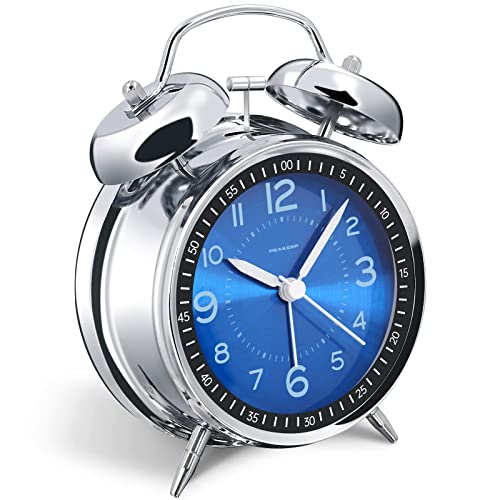
Peakeep Loud Twin Bell Alarm Clock for Heavy
Featuring an authentic twin-bell design with a physical striking hammer, this battery-operated Peakeep clock provides an extra-loud ring built to wake heavy sleepers without smartphone distractions. Its silent quartz sweep movement prevents distracting ticking noises, while a rear on-demand light button offers quick time checks without continuous bedroom glare.
Pros
- Physical twin-bell striking hammer delivers a very loud ring well suited for heavy sleepers and teenagers
- Quartz sweep movement operates completely silently without rhythmic ticking distractions
- On-demand backlight keeps the bedroom dark at night by lighting the face only when pressed
- Solid metal casing and front face provide durable craftsmanship and a distinctive jewel blue appearance
- Operates independently of wall outlets using a single AA battery for reliable bedside placement
Cons
- Lacks an electronic snooze button, requiring the user to flip the rear switch to silence the bell
- Analog fourth-hand alarm dial requires manual alignment rather than exact digital minute programming
- Requires one AA battery that is not included in the package
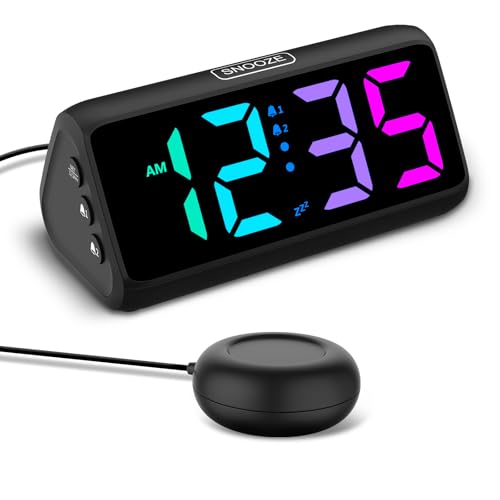
Netzu Loud Alarm Clock for Heavy Sleepers with Bed
The Netzu Loud Alarm Clock delivers a powerful wake-up solution featuring an included bed-shaking vibrator and an audible alert reaching up to 115 decibels. With an RGB customizable color display, five dimming levels including display-off, and dual alarms, it is a practical bedside choice for heavy sleepers, hearing-impaired users, and couples.
Pros
- Three versatile wake modes provide audible, physical tactile, or combined alert options.
- Listed 115 dB volume capability provides robust sound pressure for very heavy sleepers.
- Display can be turned completely off to eliminate nightstand glow in dark bedrooms.
- RGB customizable screen lets you change digit colors to match your personal preference.
- Dual alarm programming supports two distinct wake-up schedules simultaneously.
Cons
- Uses five fixed brightness steps rather than a continuous 0-100% stepless dimming dial.
- Maximum 115 dB alarm output can be quite jarring if placed immediately next to ear level on a compact nightstand.
- Product specifications do not list backup battery details or integrated USB phone charging ports.
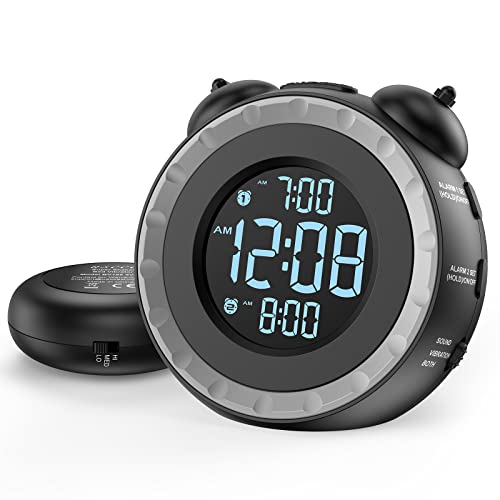
uscce Loud Bedside Alarm Clock with Powerful Bed
The uscce Dual Alarm Clock pairs a customizable 3-level vibrating bed shaker with versatile wake-up tones and a 0-100% brightness dial, making it a reliable, compact bedside choice for heavy sleepers, couples, and the hearing-impaired.
Pros
- External 3-level bed shaker provides a strong tactile alternative or supplement to audible alarms
- Stepless 0 to 100% rotary dimmer allows precise brightness control down to complete display shut-off
- Dual rotary ear knobs make adjusting clock and alarm times intuitive right out of the box
- Battery backup sounds the audible alarm and retains internal settings during AC power interruptions
- Integrated USB port charges mobile devices directly from the clock to save wall outlet space
Cons
- Vibrating bed shaker puck and USB charging port do not operate when running solely on AAA backup battery power
- Requires two AAA backup batteries that are not included in the standard retail package
- Lacks dedicated weekday-only or weekend-only programming modes, requiring manual toggling on days off
Sonic Alert Sonic Bomb Dual Extra Loud Alarm Clock
The Sonic Alert Sonic Bomb is an intense bedside alarm clock pairing an adjustable 113dB siren with a physical bed-shaking vibration puck and red flashing alert lights. It is an ideal pick for deep sleepers, students, shift workers, and hearing-impaired individuals who consistently sleep through standard phone alarms.
Pros
- Massive 113dB maximum volume output easily cuts through heavy sleep cycles
- Included bed shaker puck offers a reliable tactile wake-up alternative for hard-of-hearing sleepers
- Three versatile notification modes (vibrate, buzz, or combo) provide customizable morning alerts
- Flexible controls let users fine-tune alarm duration (1-59 mins) and snooze duration (1-30 mins)
- Pulsing red alert lights add an extra layer of visual urgency in dark bedrooms
Cons
- The high volume and vigorous mattress shaker will likely disturb sleeping partners or light-sleeping roommates
- Does not include modern convenience features like built-in USB charging ports or wireless charging pads
- Aggressive industrial design with bold accents may not blend with subtle or traditional bedroom decor
Understanding Extreme Alarm Volume, Decibel Thresholds, and Waking Power
Finding the definitive answer to what creates the most powerful bedside wake-up call requires evaluating both raw acoustic sound pressure and complementary physical waking stimuli. High-output bedside clocks reach acoustic levels between 112 and 115 decibels, which rivals the intensity of power tools or emergency sirens heard from close range. However, pure volume alone does not always guarantee a reliable morning awakening for deep sleepers or individuals with significant hearing loss. The most effective systems combine high-decibel transducers with physical bed-shaking pucks and visual alerts to stimulate multiple sensory pathways simultaneously.
Decibel Ratings and Acoustic Sound Pressure at Bedside Distance
Decibel ratings for digital alarm clocks are measured by sound pressure level, typically assessed at a standard distance of one meter from the front-facing speaker. Standard bedside clocks and smartphone speakers usually produce sound levels between 60 and 75 decibels, which easily gets absorbed by pillows or filtered out by a soundly sleeping brain. High-performance models like the Acedeck Super Loud Alarm Clock and the Netzu Loud Alarm Clock push output up to 115 decibels, while the Sonic Bomb reaches an intense 113 decibels. This massive leap in acoustic energy cuts through heavy sleep phases, ambient room noise, and even physical earplugs.
Sound intensity scales logarithmically rather than linearly, meaning every ten-decibel increase represents a perceived doubling of volume. A clock operating at 110 decibels sounds roughly eight times louder than a conventional 80-decibel household buzzer. Models such as the ANJANK Extra Loud Alarm Clock reach up to 112 decibels across a ten-level volume adjustment scale, allowing users to calibrate the alert intensity to their specific bedroom acoustics. Placing a sound source of this magnitude directly on a nightstand demands respect for auditory comfort, making adjustable output levels vital for long-term daily use.
High-frequency acoustic tones are engineered specifically to trigger an immediate neurological arousal response in the human brain. Piezoelectric buzzers generate sharp, penetrating square-wave frequencies that resist acoustic dampening from bedding and soft mattresses. The Sonic Bomb pairs its 113-decibel buzzer with red flashing alert lights, ensuring that the auditory blast is reinforced by visual stimulation through closed eyelids. Understanding these acoustic dynamics helps sleepers choose an appropriate sound profile without subjecting their ears to unnecessary strain.
Electronic Sounders Versus Mechanical Twin Bell Ringing
Bedside alert mechanisms generally fall into two broad categories: solid-state electronic sounders and traditional mechanical bell strikers. Electronic digital clocks use microcontrollers and dedicated audio drivers to broadcast continuous sirens, pulsed horn tones, or escalating melodies. For instance, the Acedeck Super Loud Alarm Clock includes six distinct selectable alarm sounds, giving sleepers options ranging from sharp chirps to aggressive horns. These electronic systems provide precise volume tuning and dual-alarm flexibility that mechanical alternatives cannot match.
Mechanical twin-bell alarm clocks take a fundamentally different physical approach to generating high-decibel acoustic noise. The Peakeep Loud Alarm Clock for Heavy Sleepers utilizes an all-metal exterior housing and a robust physical hammer positioned between twin metal bells. When triggered, the motorized hammer rapidly strikes the exterior metal casings, creating an organic, resonant clatter that reaches exceptional volume levels without any digital speaker circuitry. This mechanical clatter continues for up to 50 continuous minutes if not manually switched off, leaving virtually no opportunity for a sleeper to drift back into unconsciousness.
Choosing between mechanical strikes and electronic drivers involves distinct functional tradeoffs for bedside usability. Electronic models offer granular controls such as snooze intervals, brightness dimming, and auxiliary USB device charging. In contrast, mechanical twin bells like the Peakeep model operate entirely on a single AA battery, completely eliminating nightstand power cords and wall outlet dependence. The non-ticking quartz sweep movement in the Peakeep clock guarantees absolute nighttime silence until the physical bells ring, making it attractive for sleepers who despise electronic hums.
Multi-Sensory Waking: Tactile Bed Shakers and Haptic Alerts
Auditory habituation presents a common hurdle for chronic heavy sleepers who gradually learn to sleep through even the loudest buzzers. Tactile bed shakers solve this dilemma by physically transferring mechanical vibration directly to the sleeper through the mattress or pillow. Units like the Sonic Bomb include a wired super shaker puck that delivers intense physical jolts the moment the alarm triggers. By engaging the somatosensory system rather than relying exclusively on the ears, bed shakers create an unavoidable awakening stimulus that bypasses auditory fatigue.
Vibration puck design has evolved significantly, offering both tethered and wireless hardware configurations for modern bedrooms. The ANJANK Extra Loud Alarm Clock features an advanced wireless bed shaker with a 10-meter operating range and an integrated 1500mAh rechargeable battery. This wireless freedom eliminates cumbersome cords draped across the bed frame while providing three customizable intensity levels to match mattress thickness. Magnetic and USB-C recharging ensures the puck remains operational for extended periods between charging cycles.
Adjustable vibration intensity is essential because bed placement drastically alters how mechanical force travels through foam, spring, or hybrid mattresses. The uscce Loud Dual Alarm Clock provides a three-level adjustable shaker puck, allowing users to dial in gentle morning pulses or aggressive mattress-shaking vibrations. Sleepers can also choose whether to deploy vibration alone, acoustic sound alone, or both modalities simultaneously. For hard-of-hearing users or individuals sharing a room with a sleeping partner, vibration-only modes deliver dependable wake-ups without disturbing the entire household.
Integrating tactile shakers alongside auditory alerts represents one of the most reliable strategies for deep sleepers overcoming severe morning grogginess. While some users combine audio alerts with gradual dawn illumination from sunrise alarm clocks for heavy sleepers, physical haptic force remains the fastest route to direct physical arousal. The Netzu Loud Alarm Clock supports three distinct operational modes, letting users switch between ringing, vibration, or combination alerts with simple button presses. This multi-sensory redundancy guarantees that if one sensory channel fails to penetrate deep sleep, another immediately takes over.
Power Supply Architecture and Outage Backup Behavior
A dependable alarm clock must maintain consistent operation even when municipal power grids experience sudden overnight drops or electrical storms. Modern digital clocks handle power interruptions through two fundamentally different internal architectures: memory-only retention and true operational battery backup. Memory-only systems use backup batteries to preserve internal time and user alarms silently, but the display and speaker remain dead until mains power returns. Understanding this distinction prevents sleepers from assuming their bedside clock will sound audibly when the electrical power goes out.
Operational battery backup designs actually drive physical alarm alerts during a power failure, providing genuine safety for critical morning appointments. The uscce Loud Dual Alarm Clock operates on mains AC power but supports dual AAA battery backup to sound its internal buzzer during outages. However, high-drain features such as the bed-shaker puck and rear USB charging port automatically disable during battery operation to conserve limited cell capacity. Similarly, the Acedeck Super Loud Alarm Clock retains user settings and powers outage alarms via AAA cells, though primary operation requires the external power adapter.
Certain advanced bedside models rely strictly on AC power without incorporating secondary battery compartments. The ANJANK Extra Loud Alarm Clock must remain plugged into its included wall adapter at all times, meaning an overnight outage will temporarily interrupt timekeeping. Conversely, fully mechanical designs like the Peakeep twin bell run exclusively on a single AA battery for eight months or longer, operating completely immune to grid disruptions. Evaluating your local power stability helps determine whether battery-backed digital circuitry or standalone mechanical power provides the highest morning reliability.
Interface Ergonomics, Snooze Mechanics, and Daily Controls
Ergonomic physical controls are critical when interacting with an alarm clock in a groggy or half-awake state. Clustered rear-panel buttons often lead to accidental setting adjustments or premature alarm cancellations when reaching blindly across the nightstand. The uscce Loud Dual Alarm Clock solves this usability hurdle with intuitive rotary dial controls shaped like exterior clock ears for quick time and alarm configuration. Clearly separated control surfaces ensure that setting adjustments can be performed effortlessly without deciphering dense instruction manuals in dim lighting.
Snooze bar design directly impacts whether an alarm serves as an effective wake-up tool or an enabler of chronic morning lateness. The Sonic Bomb features highly customizable snooze parameters, allowing users to adjust snooze intervals anywhere from 1 to 30 minutes alongside an alarm duration setting of 1 to 59 minutes. This flexibility lets heavy sleepers program short, persistent snooze cycles that prevent drifting back into deep slow-wave sleep. Prominent top-mounted snooze buttons provide tactile confirmation so users can temporarily pause the noise without accidentally disarming the daily schedule.
Dual alarm configurations provide tremendous utility for households managing split work shifts or varying weekday and weekend routines. The Netzu Loud Alarm Clock offers two completely independent alarm channels, allowing two individuals sharing a bed to set distinct morning wake-up times. Likewise, the Acedeck Super Loud Alarm Clock supports dual schedules with dedicated activation switches, eliminating the need to reconfigure clock settings every evening. Physical switches that clearly indicate whether an alarm is armed give sleepers peace of mind before turning off bedside lamps.
Display Dimming, Light Control, and Bedroom Sleep Hygiene
An extra-loud alarm clock must not compromise your nighttime rest by flooding the bedroom with excessive display glare. Harsh blue or cool-white LED digits can suppress nocturnal melatonin production, making it difficult to fall into restorative deep sleep stages. Models such as the uscce Loud Dual Alarm Clock feature continuous dial-controlled dimming that smoothly adjusts from 100 percent brightness down to complete blackout. Stepless rotary dimmers allow sleepers to match ambient room conditions perfectly without being locked into rigid factory brightness presets.
Display customization extends to color options and ambient illumination features on modern heavy-sleeper clocks. The ANJANK Extra Loud Alarm Clock includes a dimmable nine-color nightlight along with an RGB time display that can be dialed down to absolute zero brightness. For sleepers who prefer pitch-black sleeping environments, completely disabling the time display prevents distracting room glow while keeping alarm triggers fully armed. The Netzu Loud Alarm Clock similarly offers five brightness levels and an option to shut off the display entirely for light-sensitive individuals.
Nightstand consolidation represents another major practical consideration when selecting bedside sleep electronics. Incorporating USB charging ports directly into the clock housing eliminates cluttered wall sockets and extra power adapters. The ANJANK clock provides a dedicated USB-C charging output, while the Acedeck and uscce models feature standard USB ports to power mobile devices overnight. When exploring multifunctional nightstand stations, comparing dedicated alarm designs against alarm clock and wireless charger options reveals helpful tradeoffs between bedside footprint, charging speed, and acoustic volume capabilities.
Selecting the Ideal Wake-Up Modality for Deep Sleepers
Selecting the best waking mechanism ultimately depends on individual physiological arousal thresholds and living environments. Deep sleepers with normal hearing often thrive on high-decibel electronic sirens or mechanical twin bells that generate immediate acoustic shock. Conversely, individuals with high-frequency hearing loss benefit substantially more from low-frequency tactile bed shakers that vibrate bone and muscle tissue directly. Matching your specific sensory responsiveness to the clock hardware prevents morning anxiety while guaranteeing timely wake-ups.
Safety and acoustic health should always guide how high-output alarm equipment is deployed in residential bedrooms. Operating any alarm at maximum 115-decibel output directly beside the head can cause acute auditory discomfort, so angling speakers slightly away from the pillow is advisable. Utilizing progressive volume ramps or pairing moderate sound levels with bed-shaker vibration provides dependable arousal without sudden auditory shock. Taking a balanced, multi-sensory approach ensures you rise promptly every morning while preserving your hearing and long-term sleep wellness.
Evaluating your personal wake-up challenges clarifies whether you need raw acoustic decibels, physical mattress vibration, or total battery independence. Combining a piercing sound profile with a responsive bed shaker remains the gold standard for breaking through stubborn sleep inertia. Testing alarm volume levels and backup power behavior before your first critical morning ensures total confidence in your bedside setup. Investing in the right alert hardware transforms stressful mornings into dependable, on-time starts every day.
About the author
Jeremy Klein is an experienced sleep-product tester with a strong focus on testing methodology, data collection, and real-world product performance. His expertise includes evaluating sleep essentials and wake-up devices through structured testing and practical consumer-focused criteria.