
What Is a Projection Alarm Clock: A Practical Guide for 2026
Learn what is a projection alarm clock and explore how ceiling beam displays improve nighttime convenience for bedrooms in October 2026.
 By Daniel Noyed
Updated October 8, 2026
By Daniel Noyed
Updated October 8, 2026

Gazing across a pitch-black bedroom to check the time often leads to disruptive glare or awkward neck strain. Standard nightstand displays force sleepers to roll over, squint against harsh digital backlights, or reach blindly for a smartphone that floods the room with melatonin-disrupting blue frequencies. Learning what is a projection alarm clock provides an elegant answer for anyone seeking effortless nocturnal timekeeping without waking a sleeping partner. Instead of confining illuminated digits to a fixed bedside panel, these specialized devices cast optical digital readouts directly onto your ceiling or wall. Exploring modern top-rated bedside alarm clocks reveals how optical projection transforms standard nightstands into streamlined, glare-free sleep environments.
A dedicated projection digital alarm clock integrates an optical projector module into a traditional bedside console. This secondary optical projector allows sleepers to glance up at the ceiling from a resting position and check the hour immediately. Reliable models feature adjustable swivel lenses, dynamic focus rings, image-reversing orientation switches, and dedicated dimming controls to keep ambient light low. Sleepers also gain access to practical bedside tools like dual independent alarms, ambient temperature readouts, and USB device charging without cluttering the nightstand. Understanding these integrated features helps buyers select an optimal setup tailored to their specific bedroom layout and visual comfort preferences.
| Award | Product | ACR Score About ACR ScoreThe ACR Score is our own rating from 0 to 10, based on performance, design and build, ease of use, and value. It reflects independent research and is never influenced by manufacturers, retailers, or affiliate commissions. Learn more › | |
|---|---|---|---|
| Best Overall |
Mesqool 7-Inch Projection Alarm Clock with 180°
|
9.2/10 | Buy |
| Best Premium |
 SMARTRO SC91 Projection Alarm Clock with Weather
|
8.8/10 | Buy |
| Best Budget |
 Netzu Projection Alarm Clock for Bedroom Ceiling
|
8.4/10 | Buy |
 Mesqool Digital Projection Alarm Clock
|
8.4/10 | Buy | |
| Best Value |
 Magnasonic Projection Alarm Clock with AM/FM
|
8.4/10 | Buy |
 La Crosse Technology Atomic Projection Alarm Clock
|
8.1/10 | Buy |
Mesqool 7-Inch Projection Alarm Clock with 180°
The Mesqool Digital Projection Alarm Clock projects clear red numerals onto your ceiling while featuring a 7-inch dimmable LED display, dual alarms, and an integrated USB charging port. It is a dependable, budget-friendly nightstand clock for couples, seniors, and anyone wanting to check the time without turning over in bed.
Pros
- 180-degree adjustable ceiling projection with manual focus ring and image reversal button
- Bold 7-inch red LED screen is easy to read across the bedroom for seniors and low-vision users
- Dual alarms with 5 volume settings and an ascending tone profile to suit both light and heavy sleepers
- Built-in 5V/1.0A USB port allows convenient phone charging directly from the nightstand
- Convenient top buttons include a dedicated DST toggle and a quick 12/24-hour time format switch
Cons
- Battery backup (2x AAA, not included) preserves time memory only and will not illuminate the display or sound alarms during a power outage
- Integrated USB port delivers a standard 1.0A output, resulting in slower charging compared to high-wattage fast chargers
- Brightness adjustment uses 5 preset stepped levels rather than a continuous 0-100% stepless dial
SMARTRO SC91 Projection Alarm Clock with Weather
The SMARTRO SC91 combines a bedside digital alarm clock with a wireless indoor-outdoor weather station and an adjustable ceiling projector. Featuring dual weekday and weekend scheduling plus customizable snooze intervals, it is a versatile choice for anyone wanting bedroom climate tracking and easy nighttime time checks.
Pros
- Red ceiling projection allows groggy time checks without craning your neck or staring directly at the main screen
- Highly flexible alarm scheduling supports dedicated weekday-only or weekend-only wake times
- Snooze interval is customizable from 5 to 60 minutes rather than locked to a standard fixed duration
- Four-level LCD dimmer includes a complete display-off mode for light-sensitive sleepers
- Wireless outdoor sensor delivers remote temperature and humidity data straight to your nightstand
Cons
- Manual time setup is required as this unit does not support atomic radio clock synchronization
- Additional wireless sensors for channels 2 and 3 must be purchased separately
- Stepped four-level display dimmer lacks continuous 0-to-100 percent stepless dial control
Netzu Projection Alarm Clock for Bedroom Ceiling
The Netzu Projection Alarm Clock projects clear time digits onto your ceiling or wall with a 350-degree rotating arm while providing time, date, day, and room temperature on its main display. It is a practical, budget-friendly nightstand addition for sleepers who want instant overhead time checks without straining or reaching for a smartphone.
Pros
- 350-degree rotating projector with 180-degree image flip allows flexible positioning on ceilings or walls
- Clear 4-in-1 console consolidates time, date, day of the week, and indoor temperature in one glance
- Independent brightness controls for both the primary display (5 levels) and the projection beam (4 levels)
- Manual DST shortcut button eliminates complex menu navigation during seasonal time changes
- 10 alarm sound options and 4 volume settings provide personalized wake-up choices
Cons
- Requires continuous connection to an electrical outlet to function
- Uses stepped brightness levels rather than a continuous 0 to 100 percent stepless dimming wheel
- Lacks independent dual-alarm programming for separating weekday and weekend schedules
Mesqool Digital Projection Alarm Clock
The Mesqool Digital Projection Alarm Clock combines a 180-degree rotatable ceiling projector with a clear 7-inch display, dual alarms, and a built-in USB charging port. It is an ideal nightstand addition for couples and sleepers who want to read the time overhead without lifting their heads.
Pros
- 180-degree swivel projection with focal tuning ring and image flip for flexible bedroom placement
- Independent 5-step dimming controls on both the main screen and ceiling projector to manage nighttime glow
- Dual independent alarms with an ascending volume beep and a generous 9-minute central snooze button
- Integrated 5V/1A USB-A charging port saves wall outlet space on crowded nightstands
- AAA battery memory backup protects programmed time and schedules through blackout events
Cons
- Battery backup preserves internal clock memory only and will not illuminate the display or sound the alarm without AC power
- The 5V/1A USB charging port provides standard charging speeds and is not suitable for high-draw tablets
- Offers five fixed brightness levels rather than a continuous 0-100% stepless dial
Magnasonic Projection Alarm Clock with AM/FM
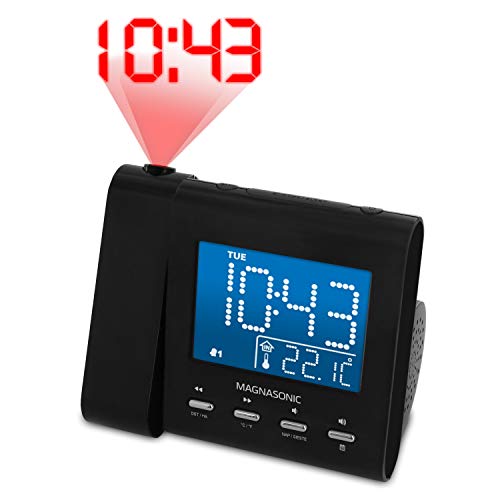
The Magnasonic EAAC601 is a versatile projection alarm clock radio featuring a 3.6-inch dimmable blue LCD, 180-degree ceiling projection, and dual alarms with weekend cancellation. It is well-suited for couples and commuters who want an easy-to-read time projection without turning toward their nightstand.
Pros
- 180-degree adjustable swivel projector lets you check the time without rolling over toward the nightstand
- SelfSet automated time configuration and automatic Daylight Saving Time adjustments minimize setup hassle
- Dual alarm feature with weekend cancellation caters to couples with differing morning schedules
- Built-in lithium backup ensures alarm and time settings are preserved during household power outages
Cons
- Blue LCD screen wavelength can be noticeable in pitch-black bedrooms even with the dimming feature enabled
- Built-in battery backup preserves internal memory and restores settings rather than offering full cordless alarm operation
- Does not feature integrated USB charging ports for bedside smartphones or personal electronic devices
La Crosse Technology Atomic Projection Alarm Clock
The La Crosse Technology 616-41667-INT combines self-setting atomic timekeeping with a 270-degree articulating projection arm that displays time and temperature on your wall or ceiling. With four-level auto-dimming and wireless outdoor weather tracking, it offers convenient, phone-free nightstand utility for light-sensitive sleepers and early commuters.
Pros
- Adjustable 270-degree projector lets you check the time and outdoor temperature from bed without moving or rolling over
- Atomic radio synchronization automatically sets exact time and manages Daylight Saving Time shifts across 7 time zones
- Includes a wireless outdoor sensor to monitor backyard or patio temperatures directly from your nightstand
- Multiple backlight dimming steps, auto-dim capability, and full display-off mode cater to light-sensitive sleepers
- Battery backup compartment preserves your calendar, time, and alarm settings during unexpected power outages
Cons
- Requires five total alkaline batteries (3 AAA for clock backup, 2 AA for the outdoor sensor) that are not included in the box
- Display brightness adjusts via four fixed tiers rather than a continuous stepless rotary dimmer dial
- The 10-minute snooze duration is preset and cannot be programmed to shorter or longer intervals
Understanding Projection Alarm Clocks and Modern Bedside Optics
A projection alarm clock is an electronic bedside timekeeper equipped with an integrated optical projector that casts the current time onto a ceiling or wall. Rather than requiring you to twist your torso toward a nightstand or stare directly into a glowing bedside console, this device places clear numeric digits directly within your natural line of sight. The optical projection uses focused light beams that create visible numbers without bathing the entire bedroom in ambient glow. For anyone managing disrupted sleep cycles or physical mobility constraints, this visual approach simplifies overnight time checks and minimizes wakeful tossing.
The Optical Engineering Behind Bedside Ceiling Projections
At the heart of every projection clock lies an internal optical assembly comprising a dedicated light source, a transmissive numeric display, and a focusing objective lens. In most modern bedside units, an energy-efficient light-emitting diode (LED) projects through a miniature segmented liquid crystal panel to create high-contrast numerals. This concentrated beam then travels through an optical lens chamber that expands the image across bedroom distances. Because the light path expands linearly as distance increases, the projected digits grow larger the farther they travel from the nightstand.
Optimum projection throw distances typically range from 1.6 feet up to roughly 10 or 11.4 feet depending on the optical build. Clock manufacturers incorporate a manual mechanical focus ring around the lens housing to sharpen the edge clarity of the projected numerals. Rotating this focus barrel adjusts the focal length between the lens element and the internal display pane, eliminating optical blur across varying ceiling heights. When configured correctly, the projected numbers appear crisp and legible from mattress level without requiring prescription eyeglasses.
Swivel Articulation and 180-Degree Image Inversion Controls
Ceiling architectures and bedside furniture configurations vary substantially across different homes, making mechanical lens adjustability essential. Most projection clocks feature a dedicated pivot arm or rotating swivel cylinder offering 180 to 350 degrees of physical rotation. This wide articulation allows users to cast the optical beam onto a low flat ceiling, a vaulted drywall angle, or an opposing bedroom wall. A stable pivot hinge ensures the optical head maintains its target position overnight without slipping downward.
A common complication with optical projection involves image inversion, where numbers appear upside down depending on which side of the bed the clock sits. Quality bedside projectors solve this issue by incorporating a dedicated 180-degree image flip or orientation button on the main chassis. Pressing this toggle electronically reverses the scanning direction of the internal display panel. This feature ensures that whether the clock rests on your left nightstand or your partner’s right table, the numbers always appear right-side-up from your sleeping position.
Optical Spectrum and Display Glare: Preserving Melatonin in Dark Bedrooms
Bedside lighting plays a profound role in nocturnal sleep architecture and melatonin secretion. Standard consumer electronics often produce short-wavelength blue or cool-white light, which suppresses natural melatonin production and signals wakefulness to the brain. In contrast, many projection alarm clocks utilize narrow-band red or soft amber projection wavelengths that minimize circadian disruption. Red light has the least stimulating effect on human photoreceptors, making it an ideal optical choice for pitch-black sleep environments.
Independent dimming controls represent another vital optical asset for bedroom sleep hygiene. High-performance models provide multi-tier dimming switches for both the main console display and the optical projection beam independently. While a user might require a dimmed or completely darkened console to prevent ambient nightstand glow, they can maintain a faint, readable projection on the ceiling above. Selecting a device with multi-level projection brightness ensures the ceiling digits remain visible without generating ambient light pollution that disturbs light-sensitive sleepers.
Power Architecture: Mains AC Adapters Versus Memory Battery Backup
Understanding the electrical engineering behind bedside clocks prevents unpleasant morning surprises and missed wake-up calls. The vast majority of projection alarm clocks operate primarily through an alternating current (AC) wall adapter or dedicated USB power line. Generating a continuous optical projection beam demands steady electrical current that would deplete standard alkaline cells in a matter of hours. Consequently, the optical projector, large LED backlights, and secondary sensor radios remain active only while the clock receives continuous line voltage.
Nearly all models feature a secondary battery compartment accommodating AAA batteries or a lithium coin cell, but buyers must understand its exact functional role. In most consumer units, this secondary battery functions strictly as a time-memory retention circuit rather than an active operational power supply. During a residential power outage, the backup battery keeps the internal quartz crystal oscillating and preserves programmed alarm schedules silently. However, the optical beam and main display screen shut off completely until mains electricity returns to the wall outlet.
Testing your clock after installation by briefly disconnecting the AC adapter clarifies exactly how its internal circuitry handles power interruptions. If the clock restores the exact time, calendar, and alarm parameters immediately upon reconnection, the memory retention system operates properly. Maintaining fresh backup cells protects your daily wake-up schedule against overnight storm brownouts and voltage dips. This simple verification ensures your morning schedule remains intact even after sudden grid interruptions.
Dual-Alarm Scheduling and Ascending Acoustic Escalation
Modern households frequently accommodate partners who follow different morning work schedules, morning gym routines, or weekend itineraries. To address these split schedules, projection clocks regularly incorporate dual independent alarm modules with customizable alert triggers. Users can assign distinct wake-up times for separate routines, with several models offering weekday-only, weekend-only, or daily repetition settings. This scheduling flexibility eliminates the tedious chore of reconfiguring your wake-up time every Sunday evening.
Acoustic wake-up profiles vary widely across bedside electronics, ranging from aggressive buzzers to gentle progressive chimes. Jarring, high-decibel alarms can trigger sudden morning adrenaline spikes and cardiovascular startle responses. To mitigate morning grogginess, many projection units feature progressive volume curves that start quietly and incrementally escalate to your chosen loudness setting. Combining a gentle acoustic ramp with ceiling time projection provides an alert, stress-free morning transition. Sleepers interested in multi-sensory morning transitions often pair these optical units with sunrise alarm clocks for heavy sleepers to support natural cortisol awakening rhythms.
Integrated Sensors: Indoor and Wireless Outdoor Telemetry
Projection alarm clocks increasingly function as comprehensive bedside weather stations rather than simple digital chronometers. Integrated thermistor sensors on the console chassis monitor ambient indoor room temperature and relative humidity levels in real time. Maintaining an optimal sleeping temperature between 60 and 67 degrees Fahrenheit supports restorative sleep cycles, and immediate bedside readouts help you adjust your thermostat or ceiling fans accordingly.
Advanced units expand this capability by bundling an external wireless radio frequency (RF) sensor designed for outdoor placement. Transmitting data over dedicated wireless channels with transmission ranges up to 200 feet, these remote sensors measure weather conditions directly outside your home. The bedside projection head can then alternate between displaying the current time and cycling through real-time outdoor temperature readings on your ceiling. Glancing upward while still in bed informs you instantly whether to dress for freezing mornings or humid heat.
Time Synchronization: Atomic Radio Signals Versus Quartz Accuracy
Timekeeping accuracy is another crucial design differentiator among bedside projection units. Standard digital clocks rely on internal quartz crystal oscillators, which are generally reliable but can gradually drift by several seconds or minutes over months of operation. Basic quartz clocks require periodic manual adjustments, particularly during seasonal transitions when Daylight Saving Time (DST) begins or ends. Many basic projection units simplify this seasonal shift by providing a dedicated, one-touch DST toggle button that shifts the clock display forward or backward by one hour.
Higher-end atomic projection clocks eliminate manual calibration entirely by incorporating internal radio receivers tuned to NIST radio station WWVB. These atomic receivers synchronize automatically overnight with the official United States atomic time standard. The internal receiver decodes time codes, calendar dates, and automatic DST shifts across multiple time zones without any user intervention. Waking up to an atomic-synchronized clock ensures absolute precision for critical commutes, early flight departures, and busy daily routines.
Nightstand Ergonomics, Device Charging, and Clutter Reduction
Bedside tables often become cluttered battlegrounds covered in power cords, smartphone bricks, reading lamps, and loose accessories. Projection clocks address this nightstand chaos by serving as consolidated power and charging hubs. Many units feature integrated 5V USB output ports on the rear or side casing, allowing sleepers to power cell phones directly from the clock chassis. Consolidating your nightstand cables reduces electrical tangles and frees up wall outlets behind heavy headboards.
Sleepers pursuing modern bedroom minimalism often contrast these corded projection hubs with integrated wireless charging alarm clocks that eliminate charging cables altogether. Regardless of the charging interface you select, physical control ergonomics remain paramount for peaceful nighttime operation. Quality projection clocks feature prominent, centrally positioned snooze bars that are easy to locate by touch in the dark. Clear tactile separation between the oversized snooze paddle and the permanent alarm disarm switch prevents accidental shutoffs when you are half-asleep.
Diagnosing and Correcting Common Projection Display Issues
While projection clocks offer exceptional convenience, improper positioning or incorrect optical calibration can degrade image legibility. A common issue is image blurriness, which occurs when the optical focal length does not match the physical distance between the nightstand and the ceiling. To resolve this problem, locate the manual focus ring situated around the projector lens barrel and slowly rotate it while observing the ceiling digits. Fine-tuning this optical ring sharpens the numeral borders until individual digits display clean, crisp edges.
Another frequent source of confusion involves inverted or reversed numbers projected on opposite walls. If the numerals appear backward from your sleeping vantage point, locate the dedicated flip or projection mode button on your clock console. Pressing this button rotates the electronic image 180 degrees, aligning the digits naturally with your line of sight. If the projected image appears faint or washed out, verify that the projection dimmer is set to maximum and check that the optical throw distance does not exceed the recommended manufacturer limit.
Keystone distortion can also occur when the optical beam strikes a sloped ceiling or angled drywall surface at an oblique angle. While projection clocks lack digital keystone correction software, adjusting the physical pivot arm minimizes geometric stretching. Positioning the clock console so the optical beam travels perpendicular to your target surface yields the most uniform numeric proportions. Ensuring the outer glass lens remains free of household dust and fingerprint smudges further preserves optical contrast and brightness.
Key Selection Criteria Grounded in Bedside Hardware Distinctions
Choosing an appropriate projection clock requires evaluating your physical bedroom layout alongside your personal sleep habits. First, examine the mechanical swivel range and lens throw distance to verify the beam can reach your preferred ceiling or wall location comfortably. Rooms with high ceilings or distant opposing walls benefit from units offering extended focal ranges up to 11 feet and multi-angle swivel arms. Compact bedrooms with low ceilings, by contrast, operate reliably with standard 180-degree pivot cylinders.
Second, evaluate the visual spectrum and dimming flexibility of both the primary console screen and the optical projection beam. Sensitive sleepers who require a pitch-black sleeping environment should prioritize models with multi-step or full-blackout dimming on the console display. A soft red projection beam paired with an independently dimmable 7-inch LED or LCD front face provides excellent flexibility for dark bedrooms. Balancing optical brightness prevents unnecessary nocturnal sleep disruption while preserving effortless time checks.
Finally, consider whether auxiliary environmental sensors and atomic synchronization align with your morning routine. Commuters and early risers who demand flawless accuracy benefit from atomic radio reception and wireless outdoor temperature telemetry. Partners on alternating work schedules should prioritize dual independent alarms with gradual acoustic volume ramping to ensure peaceful, reliable wake-ups. Selecting a clock built around your practical lifestyle ensures seamless nightstand utility, dependable timekeeping, and improved sleep hygiene for years to come.
Incorporating an optical projection clock into your sleep sanctuary resolves the nocturnal friction of checking the time in pitch-black bedrooms. By casting gentle, focused numerals directly onto the ceiling, these specialized devices eliminate bedside glare and reduce middle-of-the-night screen distractions. Prioritizing adjustable optical focus, flexible swivel angles, melatonin-friendly red wavelengths, and robust power backup systems ensures a dependable wake-up routine. Matching these hardware specifications to your personal bedroom dynamics creates a streamlined, restful sleep environment that helps you start each morning feeling completely refreshed.
About the author
Daniel Noyed is a Certified Sleep Science Coach and experienced product editor with extensive knowledge of sleep health and sleep-related products. He has hands-on experience testing hundreds of products and translating technical features into practical guidance for everyday sleepers.