
How to Wake up on Time for Heavy Sleepers: A Practical Guide for 2026
Learn how to wake up on time for heavy sleepers with high-decibel audio alerts, tactile bed shakers, and reliable bedside strategies updated for October 2026.
 By Nena Farrell
Updated October 6, 2026
By Nena Farrell
Updated October 6, 2026
Waking up to the faint ping of a smartphone chime rarely works when your brain is locked in deep rapid eye movement sleep. For individuals who routinely sleep through standard notifications, groggy mornings often result in rushed routines and missed appointments. Understanding how to wake up on time for heavy sleepers requires moving beyond basic phone alerts toward specialized bedside hardware that engages multiple sensory pathways. Exploring dedicated solutions found among top-rated bedroom alarm clocks provides a much more dependable foundation than relying on unpredictable mobile devices.
Deep sleepers face biological hurdles like intense sleep inertia, making sudden auditory arousal difficult without proper sensory stimulation. Hardware specifically engineered for difficult wakeups combines penetrating decibel outputs, physical bed-shaking vibrations, and interactive disarm mechanics to cut through heavy slumber. By replacing gentle melodies with targeted alerts and physical stimulation, you can establish an unwavering morning routine that pulls you out of bed reliably every day.
| Award | Product | ACR Score About ACR ScoreThe ACR Score is our own rating from 0 to 10, based on performance, design and build, ease of use, and value. It reflects independent research and is never influenced by manufacturers, retailers, or affiliate commissions. Learn more › | |
|---|---|---|---|
| Best Overall |
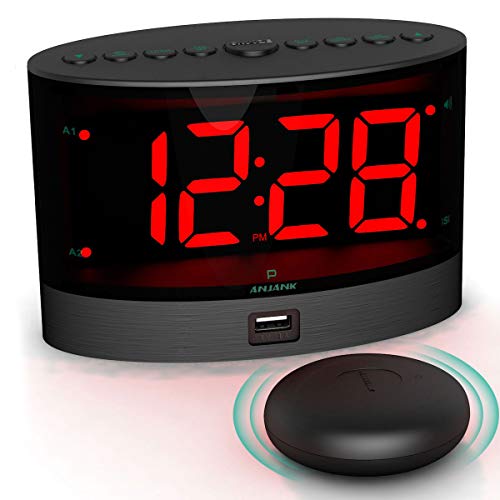
ANJANK Extra Loud Alarm Clock with Wireless Bed
|
8.9/10 | Buy |
| Best Budget |
 La Crosse Technology Buzz Vibrating Digital Alarm
|
8.8/10 | Buy |
| Best Value |
 Maqulae Target Digital Alarm Clock with Infrared
|
8.1/10 | Buy |
| Best Premium |
 Sonic Alert Sonic Bomb Dual Alarm Clock with Bed
|
8.0/10 | Buy |
ANJANK Extra Loud Alarm Clock with Wireless Bed
Featuring a cable-free bed shaker with a 32-foot range, this ANJANK alarm clock provides tactile vibration and extra-loud audio alerts for heavy sleepers and hearing-impaired users. A curved 5.5-inch red LED display with 0-100 dimming and an integrated USB charging port make it a practical nightstand upgrade.
Pros
- Wireless bed shaker works up to 32 feet away, removing the hassle of corded vibration pads
- Three flexible wake modes (shaker only, sound only, or sound and shaker) accommodate diverse sleep depths
- Continuous 0-100 dimming allows sleepers to customize the brightness of the 5.5-inch red LED display
- Dual alarm functionality supports two independent wake times on the same day
- Built-in smart USB port helps consolidate bedside charging cables
Cons
- Volume options are limited to two preset levels (loud or normal beep) rather than a stepless volume dial
- Alarm sound is restricted to a standard beeper tone rather than melodic chimes or nature tracks
- Product specifications do not detail battery backup chemistry or power outage behavior
La Crosse Technology Buzz Vibrating Digital Alarm
The La Crosse Technology Buzz 617-147 is an ultra-compact digital alarm clock featuring intense vibration alerts, audible beeps, and a dual-purpose protective cover that doubles as a sturdy silicone-based stand. It is a dependable choice for travelers, heavy sleepers, and minimalists looking for a portable, phone-free wake-up solution.
Pros
- Tactile vibration mode allows waking without loud audible noise or can combine with beeps for deep sleepers
- Protective cover prevents accidental button presses during transit and doubles as an angled desk stand
- Non-slip silicone base keeps the small timepiece anchored on nightstands and slick surfaces
- On-demand backlight automatically turns off quickly to preserve a completely dark sleeping environment
- Pocket-sized footprint takes up minimal nightstand space and adds virtually no weight to carry-on bags
Cons
- Compact display size is designed for close bedside viewing rather than reading from across a large room
- Backlight does not remain continuously lit for sleepers who prefer a constant nighttime clock display
- Lacks integrated phone-charging ports or FM radio capabilities found on larger stationary nightstand clocks
Maqulae Target Digital Alarm Clock with Infrared
The Maqulae Target Alarm Clock pairs a large LED digital display with an interactive infrared target game to help heavy sleepers wake up actively. Featuring voice-recording customization and two alarm difficulty settings, it provides an engaging wake-up solution for students, teenagers, and deep sleepers.
Pros
- Interactive infrared target mechanic forces mental focus to stop or snooze alerts
- Voice recording feature allows replacement of standard buzzers with custom audio clips
- Two alarm modes (Normal and Hard) cater to different morning wake-up needs
- Large LED time display is easy to read from across the room at a glance
- Included Timing and Count game modes add fun utility beyond standard timekeeping
Cons
- Manufacturer specifications do not document display dimming controls for pitch-black rooms
- Aiming an infrared emitter while half-awake may feel cumbersome for sleepers wanting a quick shutoff
- Listing details do not specify power source requirements or backup battery fail-safe operation
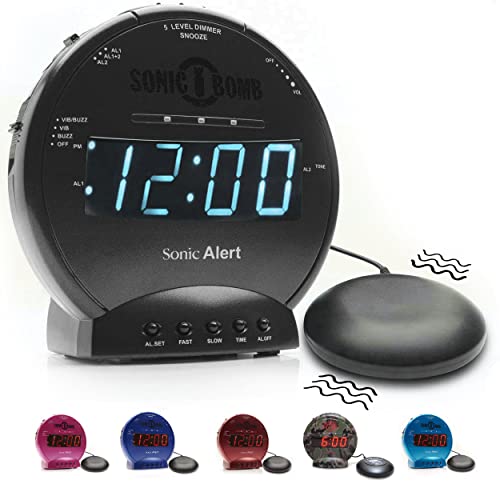
Sonic Alert Sonic Bomb Dual Alarm Clock with Bed
The Sonic Alert Sonic Bomb Dual Alarm Clock pairs a high-output 113 dB siren with a bed-shaking puck and flashing red lights to wake heavy sleepers. With dual alarms and customizable snooze intervals, it is a practical bedside solution for deep sleepers, students, and hard-of-hearing individuals.
Pros
- Reaches up to 113 dB with adjustable volume controls tailored for heavy sleepers and hard-of-hearing users
- Powerful bed shaker puck offers a tactile wake-up alternative without disturbing roommates when set to vibration-only
- Pulsing red alert lights provide unmistakable visual wake-up prompts in dark bedrooms
- Adjustable snooze time (1 to 30 minutes) and custom alarm duration (1 to 59 minutes)
- Dual alarm settings accommodate differing schedules for couples or varying morning routines
Cons
- Lacks integrated USB or wireless charging ports for bedside smartphones
- The intense 113 dB buzzer and flashing red lights can startle light-sleeping partners or pets in shared spaces
- Tethered bed shaker cable requires mindful cord routing between the nightstand and mattress
Essential Strategies and Bedside Hardware for Waking Heavy Sleepers
Overcoming morning grogginess requires shifting away from gentle phone chimes toward hardware engineered for physical arousal. When standard alarms sound, deep sleepers experience prolonged sleep inertia, a state where cognitive processing remains sluggish and reflexes silence alerts. Stimulating the nervous system through multiple sensory pathways is essential. Combining high-output acoustics, direct physical vibration, and cognitive engagement allows heavy sleepers to break the cycle of oversleeping.
Understanding Sensory Thresholds and Sleep Inertia in Deep Sleepers
Deep slow-wave sleep creates an exceptionally high arousal threshold that soft smartphone chimes cannot penetrate. During these restorative sleep stages, brain wave activity slows down, and the nervous system suppresses sensory information to protect rest. When an alarm activates, a heavy sleeper may incorporate the tone into dreams or shut it off without forming a memory. Overcoming this barrier requires stimulation strong enough to alert the brainstem and initiate wakefulness.
Sleep inertia often persists for several minutes if the morning awakening process is incomplete. The brain requires distinct sensory inputs to disperse sleep-inducing chemicals like adenosine and stimulate natural cortisol production. Relying solely on repetitive auditory chimes frequently fails because the auditory cortex adapts to familiar tones over time. Incorporating tactile vibration alongside variable acoustic pitches prevents this auditory habituation and encourages prompt morning alertness.
Acoustic Volume and Frequency: Why High Decibels Penetrate Deep Slumber
Standard bedside alarm clocks typically produce sounds between sixty and seventy decibels, a level easily muffled by bedding or ambient noise. For individuals with high arousal thresholds, specialized models like the Sonic Alert Sonic Bomb generate alert levels reaching up to 113 decibels. This intense sound pressure ensures acoustic waves travel through blankets to stimulate the auditory system. The sudden acoustic impact triggers an immediate adrenaline response that rapidly clears grogginess.
Frequency modulation also plays an important role in cutting through deep slumber. Continuous monotonic buzzing often gets tuned out by a sleeping brain, whereas pulsing tones and variable frequencies demand immediate attention. Many high-output devices offer adjustable tone controls alongside volume modulation, allowing users to find the pitch range that triggers their arousal reflex. Adjusting the alarm duration from single-minute bursts up to an hour provides a persistent alert that prevents falling back to sleep.
Acoustic safety requires careful positioning when using units capable of exceeding one hundred decibels. Placing an ultra-loud speaker directly next to your ear can cause auditory discomfort or long-term hearing strain. Positioning the device across the room on a sturdy dresser protects your ears while forcing physical movement to disarm the alert. This spatial separation ensures that high-decibel alerts serve their purpose without presenting excessive acoustic stress at close bedside range.
Tactile Arousal: Wired Versus Wireless Bed-Shaker Pucks
Physical tactile stimulation represents one of the most effective wake-up methods for deep sleepers and hard-of-hearing individuals. Bed-shaker pucks contain motorized eccentric weights that generate rapid, powerful mechanical vibrations directly against your mattress or pillow. This physical movement stimulates somatic mechanoreceptors throughout the body, bypassing the auditory canal entirely. For individuals who have developed a tolerance to loud sounds, a vigorous physical shake delivers an unmistakable cue that sleep has ended.
Connecting mechanisms differ significantly between wired and wireless vibrating units. Traditional models like the Sonic Bomb utilize a heavy-duty tethered cable linking the base directly to a vibrating puck tucked under the mattress. In contrast, modern designs such as the ANJANK Extra Loud Alarm Clock feature a wireless bed shaker operating over distances up to thirty-two feet. A wireless puck eliminates tangled cords around bed frames and allows flexible placement under fitted sheets or pillows.
Placement depth significantly influences how intensely you perceive tactile vibration. Placing the shaker directly beneath a lightweight pillow delivers immediate, sharp vibrations straight to the head and neck. Alternatively, tucking the unit beneath a firm mattress topper diffuses the movement across a broader area, creating a deep rumble that shakes the entire upper body. Experimenting with both positions allows heavy sleepers to discover the exact tactile intensity needed to break through their sleep cycle.
Visual Wake Cues: Flashing Indicators and Display Dimming Balance
Visual stimulation provides another vital sensory pathway to reinforce acoustic and tactile alerts. Specialized units often integrate bright red flashing alert lights that pulse in synchronization with auditory sirens. Even when eyelids are closed, intense pulsating light filters through the eyelids to signal the brain that morning has arrived. This visual strobing creates an uncomfortable environment for lingering in bed, prompting rapid physical awakening.
While morning brightness is essential for waking, nighttime display glare can ruin sleep quality before the alarm even sounds. High-intensity LED displays can illuminate a pitch-black bedroom, suppressing natural nocturnal melatonin synthesis and delaying sleep onset. Models like the ANJANK clock resolve this dilemma by featuring a curved LED display with a continuous dial dimmer ranging from zero to one hundred percent. Dialing the display down to near blackout keeps the bedroom dark, ensuring restorative deep sleep until the alarm triggers.
Combining light-based wake cues with sound produces a gentler transition when high decibels feel too jarring. Sleepers interested in exploring gradual illumination alongside sound can read our guide on sunrise alarm clock options for heavy sleepers to see how simulated dawn transitions assist morning hormone regulation. Light therapy helps anchor circadian rhythms, making waking up on time a consistent biological habit rather than an exhausting daily battle.
Cognitive Engagement and Interactive Disarm Mechanics
Reaching over to swat a standard snooze button is an automatic reflex that many heavy sleepers perform entirely while half-asleep. This unconscious action sabotages mornings because it silences the alarm without requiring any actual cognitive effort. Interactive alarm clocks solve this problem by demanding intentional coordination before the siren will shut off. Forcing the prefrontal cortex to wake up and solve a task effectively dismantles morning grogginess before you can crawl back under the covers.
Novel wake-up devices introduce target games and physical challenges to break the snooze habit. The Maqulae Gun Alarm Clock combines timekeeping with an infrared target game, offering a mode that requires hitting the bullseye five times with a handheld emitter to silence the chime. Aiming an infrared beam across a bedroom demands visual tracking, hand-eye coordination, and mental focus. By the time you hit the target five consecutive times, your brain has transitioned out of sleep inertia.
Customizable audio recordings offer another cognitive tool to personalize the morning wake-up routine. Standard electronic buzzers often trigger annoyance and irritation, whereas personalized voice messages or motivational audio clips can engage attention in a more positive way. Recording an urgent reminder, an encouraging message, or an energetic voice memo adds variety to the morning routine. Rotating these audio clips prevents auditory habituation, ensuring that your brain stays responsive to the morning signal.
Dual Alarm Scheduling and Morning Redundancy Protocols
Relying on a single alarm setting creates an unnecessary single point of failure for deep sleepers. A sudden power fluctuation, accidental shutoff, or subconscious snooze tap can leave you sleeping straight through your morning schedule. Setting dual alarms on the same bedside device provides a critical secondary safety net that activates if the initial wake-up attempt fails. Dedicated dual-schedule controls allow you to program an initial waking sequence followed by an aggressive backup alert ten minutes later.
Compact travel units provide dependable redundancy whether at home or on the road. The La Crosse Technology 617-147 Buzz Digital Alarm packs intense vibration and loud beeping into a durable housing with a protective silicone base. Its intuitive one-touch backlight and simple setup make it an outstanding secondary alarm across the room or inside travel luggage. Having an independent battery-supported unit ensures you never miss an early schedule due to unexpected room power cuts.
Coordinating schedules in shared bedrooms requires smart alarm mode selection. Units featuring separate vibration and buzzer toggles allow shift workers to wake up via silent pillow vibrations without blaring loud sirens that disturb a sleeping partner. Independent dual alarms can be customized so that one partner wakes to gentle vibration while the second partner uses combined sound and shaking later in the morning. This versatility accommodates mismatched work shifts without sacrificing waking reliability.
Nightstand Organization and Smartphone Banishing Strategies
Using a mobile phone as your primary alarm clock invites late-night scrolling, notification disruptions, and sleep fragmentation. Blue light emitted by smartphone screens delays circadian melatonin production, keeping you awake later and deepening morning exhaustion. Removing the smartphone from your nightstand is one of the most effective habits for building a healthy sleep environment. Replacing your phone with a dedicated bedside clock creates a clean digital boundary that protects your evening rest.
Bedside clocks with integrated charging options maintain convenience without requiring mobile devices directly beside your pillow. Models equipped with smart USB ports allow you to charge secondary accessories safely on your dresser or nightstand. For sleepers who want to streamline their table setup, exploring alarm clocks with wireless charging stations can help consolidate power cords into a single clean hub. Keeping your nightstand organized reduces visual clutter and promotes a calm mental state before sleep.
Cord management also protects your alarm from accidental disconnection. Heavy bed-shaker cables and AC power cords should be routed securely behind nightstand furniture to prevent snagging when moving blankets or reaching for water. Using cable clips or silicone ties keeps transformer bricks firmly seated in wall outlets. A stable electrical setup guarantees that your wake-up hardware remains fully powered and operational every morning.
Safe Volume Calibration and Practical Alarm Verification
Testing your alarm settings during daytime hours prevents startling surprises and ensures proper operation. When setting up an ultra-loud clock, start by adjusting the volume to a moderate level before testing the full high-output setting. Check that the vibrating puck is correctly positioned beneath your pillow or mattress and confirm that physical connections or wireless pairings are working properly. Conducting a brief two-minute trial while awake helps you verify that tactile and acoustic alerts trigger as expected.
Adjustable snooze duration is an essential feature to configure properly before relying on the clock. Units like the Sonic Bomb allow users to adjust snooze intervals between one and thirty minutes, as well as customize alarm duration from one to fifty-nine minutes. Setting a short snooze interval of four or five minutes prevents you from slipping back into deep slow-wave sleep between alerts. A persistent, short-interval alert cycle keeps pressure on your nervous system until you finally rise.
Verifying battery backup architecture protects your schedule against unexpected residential power cuts. While AC mains power drives high-output speakers, bright LED displays, and motorized bed shakers, backup batteries preserve internal timekeeping quartz memory during brownouts. Check backup battery compartments periodically to ensure fresh cells are installed and terminals remain free of corrosion. Maintaining dependable backup power gives you complete peace of mind that a brief storm will not erase your wake-up settings.
Designing a Foolproof Morning Routine for Long-Term Success
Physical placement of your bedside clock remains the single most powerful behavioral adjustment you can make. Placing an extra-loud alarm or interactive target clock across the room forces you to swing your legs out of bed and walk across the floor to disarm it. Once your feet touch the floor and your body assumes an upright posture, blood circulation increases and sleep inertia begins to lift. Combining physical distance with intense alerts makes it virtually impossible to fall back asleep accidentally.
Consistent morning lighting and immediate hydration solidify the awakening process once your alarm sounds. Open your window shades or turn on overhead room lights immediately after disarming the clock to suppress remaining melatonin levels. Drinking a tall glass of cold water replenishes fluids lost overnight and signals your digestive system that the active day has begun. Over time, these combined sensory habits build a resilient circadian rhythm that makes waking up on time effortless and predictable.
About the author
Nena Farrell is a product writer and reviewer specializing in sleep products, sunrise alarm clocks, smart-home technology, and everyday household devices. Her hands-on approach focuses on real-world usability, practical features, and how products fit naturally into daily routines.