
How to Use a Wind up Alarm Clock: Practical Guide for 2026
Learn how to use a wind up alarm clock with this practical bedside guide for October 2026, covering winding techniques, time setting, and alarm accuracy.
 By Daniel Noyed
Updated October 8, 2026
By Daniel Noyed
Updated October 8, 2026

Smartphones and illuminated digital displays frequently introduce bedtime distraction, blue-light exposure, and notification anxiety right beside the pillow. Switching to a traditional mechanical timepiece eliminates screen glare entirely while establishing a tactile, dependable waking routine that operates independently of home electrical power or wall outlets. Learning how to use a wind up alarm clock allows sleepers to step away from modern digital screens without sacrificing punctuality or waking reliability. When comparing bedside instruments with top-rated alarm clocks for bedrooms, mechanical wind-up models offer unmatched simplicity and tactile satisfaction.
Unlike modern electronic docks that rely on mains adapters or volatile internal memory chips, a mechanical clock is driven solely by coiled steel mainsprings and rhythmic gear escapements. Operating these instruments requires understanding the physical winding keys, directional knobs, and rear controls that govern the dual mainsprings. Mastering proper key tension prevents spring damage while ensuring the clock maintains steady time and delivers an energetic bell ring every single morning.
| Award | Product | ACR Score About ACR ScoreThe ACR Score is our own rating from 0 to 10, based on performance, design and build, ease of use, and value. It reflects independent research and is never influenced by manufacturers, retailers, or affiliate commissions. Learn more › | |
|---|---|---|---|
| Best Overall |
MARATHON Mechanical Wind-Up Alarm Clock
|
9.2/10 | Buy |
| Best Budget |
 Equity by La Crosse 14075 Analog Wind-Up Alarm
|
8.9/10 | Buy |
 Equity by La Crosse 24014 Loud Bell Analog Alarm
|
8.9/10 | Buy | |
| Best Value |
 whcusmm Vintage Wind-Up Twin Bell Alarm Clock
|
8.9/10 | Buy |
| Best Premium |
 KEYPOWER Small Mechanical Wind-Up Twin Bell Alarm
|
8.9/10 | Buy |
 Netzu Loud Alarm Clock for Heavy Sleepers with Bed
|
8.1/10 | Buy |
MARATHON Mechanical Wind-Up Alarm Clock
The Marathon Mechanical Wind-Up Alarm Clock delivers dependable morning wake-ups using a loud progressive interval ring and a high-contrast analog dial with 12- and 24-hour markings. Requiring no batteries or electricity, it is an excellent zero-glare bedside choice for digital detoxers, heavy sleepers, and emergency outage kits.
Pros
- Zero reliance on batteries or electrical outlets ensures waking reliability even during severe storms or blackouts
- Loud progressive interval ring provides an assertive wake-up without electronic audio distortion
- Integrated accuracy adjuster switch enables straightforward calibration if time drifts
- Dual 12- and 24-hour dial markings are legible and simple to interpret
- Luminescent hand accents offer low-light readability without casting an ambient room glow
Cons
- Requires routine manual winding to keep the clock movement and alarm mechanism active
- Mechanical clockwork produces an audible ticking sound that may bother noise-sensitive sleepers
- Luminescent hands require light exposure to charge and lack an electric on-demand backlight
Equity by La Crosse 14075 Analog Wind-Up Alarm
The Equity by La Crosse 14075 is a classic 3.65-inch analog wind-up alarm clock featuring a loud wake-up alarm and luminous dial markings that require zero batteries or electricity. It offers dependable bedside timekeeping and emergency power-outage reliability for heavy sleepers, minimalist bedrooms, and digital detoxers.
Pros
- Requires zero batteries or electrical wall outlets, providing dependable operation during overnight power outages.
- Loud alarm sound helps ensure deep and heavy sleepers wake up promptly.
- Luminous hands and markings allow time-telling in dark rooms without casting ambient electric light across the bedroom.
- Lightweight, compact 4 x 2 x 4.25-inch build fits easily on small bedside tables or travel bags.
Cons
- Runs up to 30 hours per wind, requiring routine daily winding to maintain accurate time.
- Lacks electronic digital features like customizable snooze intervals, dual alarm schedules, or USB charging ports.
- Luminous markings rely on ambient light exposure to charge and do not provide an active electric backlight.
Equity by La Crosse 24014 Loud Bell Analog Alarm
The Equity by La Crosse 24014 is a compact analog alarm clock featuring a loud bell wake-up mechanism, luminous hands, and a polished silver metal finish. It is ideal for heavy sleepers, students, and digital detoxers seeking simple, cord-free bedside timekeeping without distracting digital screens.
Pros
- Loud physical bell alarm provides an assertive wake-up call for heavy and deep sleepers
- Luminous hands offer nighttime visibility without emitting continuous ambient glow or blue light into dark bedrooms
- Protective base pad shields nightstand surfaces from scratches and scuffs
- Durable build combining a polished silver metal chrome case with a clear dome glass lens
- Compact 4.5 x 2.5 x 5.5 inch profile takes up minimal space on crowded nightstands
Cons
- Analog design lacks programmable multi-stage snooze intervals and weekday/weekend scheduling found on digital clocks
- Luminous hands require ambient light exposure during the day to glow and lack an on-demand electric backlight
- Physical bell alarm volume is fixed and cannot be adjusted down for sleepers who prefer gentle wake-up tones
whcusmm Vintage Wind-Up Twin Bell Alarm Clock
The whcusmm Vintage Wind-Up Twin Bell Alarm Clock provides loud, battery-free mechanical timekeeping with an authentic twin-bell chime that reliably wakes heavy sleepers. It is an ideal, screen-free choice for digital detoxers and minimalists who want dependable nightstand timekeeping without cords or glowing displays.
Pros
- Mechanical spring mechanism requires no batteries, power cords, or electrical outlets
- Traditional twin bell striker creates a loud, unignorable acoustic wake-up call for deep sleepers
- Zero electronic display glow ensures a pitch-black sleeping environment for light-sensitive users
- Solid metal casing provides dependable stability and durability on bedside tables
- Ultra-compact footprint takes up minimal space on small nightstands or travel tables
Cons
- Requires regular manual winding to maintain accurate timekeeping and alarm spring tension
- Lacks modern digital features such as programmable snooze, dual schedules, or USB charging ports
- Glow-in-the-dark hands rely on phosphorescent coating that requires prior ambient light exposure
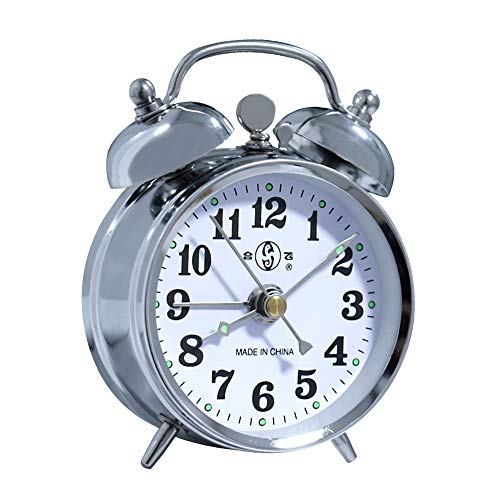
KEYPOWER Small Mechanical Wind-Up Twin Bell Alarm
The KEYPOWER mechanical wind-up alarm clock delivers a completely battery-free wake-up solution featuring physical twin bells and glow-in-the-dark hands. It is an ideal bedside choice for heavy sleepers, minimalists, and digital detoxers who want a loud, reliable ring without nightstand cords or screen glare.
Pros
- 100% mechanical wind-up design eliminates the need for batteries, power adapters, or charging cables
- Physical twin-bell ringing mechanism produces a loud, unmistakable acoustic chime to wake deep sleepers
- Glow-in-the-dark hands and hour markers provide nighttime reading without casting disruptive electronic glow
- Compact 4-inch frame takes up minimal nightstand real estate and packs easily for travel
- Classic silver aesthetic complements vintage, minimalist, and traditional bedroom decor
Cons
- Requires regular manual winding to prevent the clockwork movement from stopping
- Lacks electronic convenience features such as an automatic snooze timer, dual schedules, or adjustable volume
- Traditional mechanical escapement produces an audible ticking sound that may bother light sleepers in quiet rooms
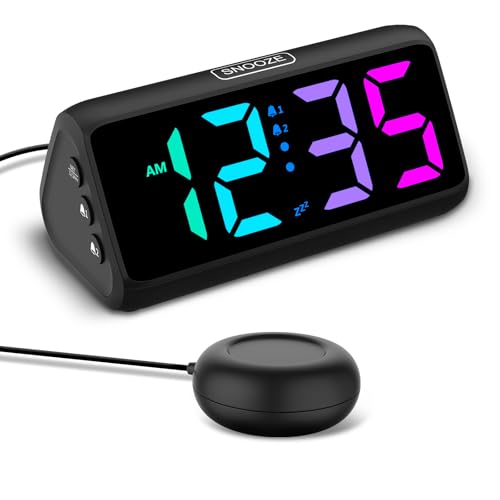
Netzu Loud Alarm Clock for Heavy Sleepers with Bed
The Netzu Loud Alarm Clock delivers a powerful wake-up solution featuring an included bed-shaking vibrator and an audible alert reaching up to 115 decibels. With an RGB customizable color display, five dimming levels including display-off, and dual alarms, it is a practical bedside choice for heavy sleepers, hearing-impaired users, and couples.
Pros
- Three versatile wake modes provide audible, physical tactile, or combined alert options.
- Listed 115 dB volume capability provides robust sound pressure for very heavy sleepers.
- Display can be turned completely off to eliminate nightstand glow in dark bedrooms.
- RGB customizable screen lets you change digit colors to match your personal preference.
- Dual alarm programming supports two distinct wake-up schedules simultaneously.
Cons
- Uses five fixed brightness steps rather than a continuous 0-100% stepless dimming dial.
- Maximum 115 dB alarm output can be quite jarring if placed immediately next to ear level on a compact nightstand.
- Product specifications do not list backup battery details or integrated USB phone charging ports.
Essential Steps and Techniques for Operating a Wind Up Alarm Clock
Operating a mechanical alarm clock marks a return to tangible mechanics and tactile precision. Rather than navigating menus on an illuminated screen, sleepers interact directly with coiled steel springs, gear trains, and physical bell hammers. Following the proper procedure preserves internal wheelwork, maintains steady timekeeping, and ensures a dependable acoustic wake-up call every morning.
Identifying the Controls and Mechanical Anatomy
Examining the rear panel of a traditional wind-up clock reveals several tactile controls. Most models feature two primary winding keys shaped like butterfly wings. One key winds the timekeeping mechanism that drives the hands, while the second key tensions the separate spring powering the alarm bell. Confusing these keys is a frequent oversight that can leave you with a silent clock at dawn.
Alongside the keys, you will find two knurled adjustment knobs. One knob sets the main hour and minute hands, while the other positions the alarm indicator. Models such as the KEYPOWER Alarm Clock Mechanical Wind Twin Bell feature dedicated offset dials for tracking seconds and alarm timing independently. Identifying each control before adjusting it prevents mechanical strain on internal gear teeth.
The remaining control is the alarm shutoff mechanism, usually positioned on the top casing or upper rear panel. This control functions as a sliding lever, a pull pin, or a latch that physically arrests the bell hammer. Keeping this lever in the locked position allows you to set the time without triggering premature ringing. Learning this layout ensures smooth daily operation without fumbling.
The Proper Winding Technique to Protect the Mainspring
Winding a mechanical clock requires a measured, steady grip to protect the internal steel coils. Grasp the timekeeping winding key firmly and turn it in the designated direction, which is typically clockwise. You will feel firm resistance accompanied by the clicking sound of the ratchet pawl securing each turn. Counting your half-turns helps you gauge tension as the spring tightens.
Many clock owners worry about overwinding, though modern steel mainsprings are remarkably durable. In mechanical horology, overwinding actually refers to forcing the key past its natural mechanical stop, which can snap the spring arbor. The key becomes noticeably firmer as the coil tightens. Stop turning immediately once you encounter solid resistance without forcing an extra turn.
Clocks like the Equity 14075 Black Analog Wind-Up Alarm Clock run for up to 30 hours on a single full wind. However, establishing a daily winding habit each evening yields the best accuracy. Winding the clock once every 24 hours keeps the mainspring in the sweet spot of its torque curve, preventing the balance wheel from slowing down prematurely.
How to Wind and Arm the Alarm Bell Spring
The alarm mechanism operates on an independent power reserve from the timekeeping train. Winding the time key does not store power for the morning bells, so the alarm spring must be wound separately. Locate the second winding key marked with a bell symbol and turn it until resistance increases. Leaving this spring unwound allows the clock to run quietly through the wake-up hour.
Physical twin bell designs rely on a small metal striker oscillating between two resonant metal bells. Because this rapid hammering expends substantial energy, the alarm spring discharges its tension quickly compared to the timekeeping spring. A fully wound alarm spring typically rings forcefully for ten to thirty seconds before expending its stored torque.
To avoid sudden ringing while winding the alarm spring, ensure the alarm shutoff latch is engaged first. If the switch remains open and the alarm hand is near the current hour, the hammer may strike immediately. Once the spring is fully wound, place the clock on your nightstand and engage the alarm latch as your final bedtime step.
Setting the Time and Protecting Internal Gearing
Adjusting the display hands on an analog clock requires gentle handling of the time knob. Push or pull the knob lightly if your model features an engagement clutch, though most basic mechanical clocks use direct friction gearing. Turn the knob slowly to advance the hands toward the correct hour. Always rotate the hands in a clockwise direction to preserve gear teeth alignment.
Rotating hands backward over multiple hours places stress on the escapement arbor and can loosen hand friction collars. While nudging the minute hand backward slightly for minor corrections is usually harmless, sweeping backward across full hours can jam internal strike cams. If the clock is several hours ahead, advancing the hands forward through twelve hours is the safer method.
Keep in mind the twelve-hour dial configuration during initial setup. Analog mechanical movements cannot differentiate between day and night, meaning the alarm triggers twice every 24 hours if left armed. For example, setting an alarm for seven o’clock will ring in both morning and evening unless disarmed after waking. Managing this 12-hour cycle is part of the mechanical routine.
Calibrating the Alarm Hand for Wake-Up Punctuality
Setting your wake-up time involves turning the dedicated alarm knob, which guides a distinct pointer on the dial. This indicator is often painted in a contrasting color, such as red or silver, to stand out from the main hands. Turn the knob slowly until the tip aligns with your desired wake-up time.
Mechanical alarm dials rely on visual estimation between hour marks rather than exact digital numerals. On a compact dial face, five-minute gaps are narrow, so setting an exact time like 6:40 requires careful visual judgment. If strict punctuality is necessary for critical work shifts, testing when your clock triggers relative to dial markings is advisable.
You can discover the trigger offset of your clock through a quick daytime test. With the alarm switch open, slowly advance the time hands until you hear the release cam drop. Note the minute hand position when the hammer releases relative to the alarm pointer. This small observation lets you compensate accurately when setting the alarm each evening.
Regulating Mechanical Timekeeping Accuracy
Mechanical clocks naturally experience slight variations in daily precision due to ambient temperature changes and spring torque curves. Instruments such as the MARATHON Mechanical Wind-Up Alarm Clock feature an accuracy adjuster switch on the rear housing. This sliding lever alters the active length of the balance hairspring, speeding up or slowing down the oscillation rate.
The regulator is typically marked with plus and minus symbols, or the letters F and S for fast and slow. If your clock loses two minutes over 24 hours, nudge the lever slightly toward the plus marking. If the clock runs ahead of the true hour, shift the control toward the minus symbol.
Always make tiny adjustments when regulating a mechanical movement. Moving the lever too aggressively can cause the clock to gain or lose significant time each day. Make a slight adjustment, monitor the clock against a synchronized digital reference for a full day, and repeat until timekeeping remains steady.
Managing Bedroom Acoustics and the Rhythmic Ticking Sound
The acoustic ticking of a mechanical lever escapement can be either soothing or noticeable depending on your auditory sensitivity. Every tick corresponds to the balance wheel swinging and the pallet jewels engaging the escape wheel teeth. For sleepers accustomed to silent digital devices, this rhythmic sound can initially feel prominent in a quiet bedroom.
Placing the clock on a hollow wooden nightstand can amplify ticking by turning the surface into an acoustic resonator. Resting the clock on a felt pad or cloth coaster dampens this physical vibration significantly. The Equity 24014 Wind-Up Loud Bell Metal Alarm Clock includes a protective scratch-resistant base pad that helps diminish acoustic transfer to hard nightstand surfaces.
If mechanical ticking disrupts your sleep onset despite dampening pads, silent electronic options may prove more suitable. Sleepers seeking total nighttime silence often evaluate sunrise alarm clock options that provide visual awakening cues without producing acoustic clicks during the night. Matching acoustic properties to your sleep preferences ensures restful nights.
Bedroom Sleep Hygiene and Pitch-Black Nighttime Visibility
A major benefit of a wind-up clock is the complete absence of electronic light pollution. Digital screens and LED numerals emit light that can disrupt nocturnal melatonin production and delay natural sleep onset. A traditional analog dial produces zero ambient glare, preserving pitch-black conditions across the entire bedroom.
Nighttime legibility is handled through passive phosphorescent luminous paint on the hands and markers. Models like the Vintage Wind Up Alarm Clock Twin Bell Mechanical feature glow-in-the-dark numerals that absorb room light during the day. This provides a soft, low-intensity glow that allows you to read the hour at night without disturbing dark-adapted vision.
Because phosphorescent paint fades naturally over several hours in darkness, it avoids illuminating the surrounding room. Unlike digital displays that remain brightly lit all night, passive luminous hands are visible only when looking directly at the dial. This subtle optical trait makes mechanical timepieces an excellent choice for strict sleep hygiene.
Mechanical Durability, Cleaning, and Spring Maintenance
Caring for a mechanical clock guarantees decades of reliable operation without electronic circuit degradation. Keep the timepiece in a dry room with stable temperatures, since excessive humidity can cause surface rust on steel pivots and hairsprings. Wiping the exterior case periodically with a clean microfiber cloth removes dust and finger oils safely.
Avoid spraying household cleaners or penetrating spray lubricants into the rear adjustment slots. Commercial spray oils attract dust and dry into a sticky residue that binds gear teeth, eventually halting the movement. If an older mechanical clock becomes sluggish over time, professional disassembly and horological oiling is the proper remedy.
Handle the clock carefully to protect the delicate balance staff pivots from mechanical shock. Dropping a metal clock onto a hard floor can bend balance pivots or distort the hairspring, stopping the movement permanently. Positioning the clock securely away from nightstand edges prevents accidental knocks when reaching for the shutoff switch.
Comparing Wind-Up Clocks with Modern Digital Alternatives
Mechanical clocks offer battery-free reliability and an escape from digital screens, but modern digital devices serve distinct needs. Sleepers managing alternating schedules often prefer dual-alarm electronic clocks with independent weekday settings. Additionally, multi-functional docks such as bedside wireless charging clocks consolidate smartphone power with bedside timekeeping to eliminate nightstand cord clutter.
For heavy sleepers, the piercing resonance of physical bells delivers an immediate acoustic wake-up call. However, digital options like the Netzu Loud Alarm Clock for Heavy Sleepers Black reach output levels up to 115 decibels and feature vibrating bed-shaker pucks for hard-of-hearing users. Evaluating your waking threshold helps decide whether physical bells or high-output electronic alerts are best.
Choosing a wind-up clock ultimately reflects an intentional preference for tactile simplicity and mechanical independence. Without software glitches, battery corrosion, or power outages to silence your morning alarm, a well-tended mechanical timepiece remains completely dependable. Practicing proper winding, setting, and regulation ensures your bedside clock will serve faithfully for years to come.
About the author
Daniel Noyed is a Certified Sleep Science Coach and experienced product editor with extensive knowledge of sleep health and sleep-related products. He has hands-on experience testing hundreds of products and translating technical features into practical guidance for everyday sleepers.