
How to Make a Clock Quieter: Practical Guide for 2026
Learn how to make a clock quieter with practical damping steps and silent replacement parts for a truly peaceful bedroom in October 2026.
 By Dan Caffrey
Updated October 6, 2026
By Dan Caffrey
Updated October 6, 2026

Nighttime silence often magnifies the smallest rhythmic sounds, turning a standard bedside timepiece into a persistent distraction that keeps light sleepers awake. When an intrusive, repetitive tick echoes across a quiet bedroom, learning how to make a clock quieter becomes essential for reclaiming restful sleep. Unwanted clock sounds generally stem from mechanical gears stepping forward every second or internal vibrations resonating against hollow clock housings.
While mechanical timepieces produce acoustic clicks, electronic timepieces can also produce subtle transformer buzzes or high-pitched coil whine. Many sleepers find relief by upgrading their bedside gear with top-rated alarm clocks for bedrooms or exploring dedicated sunrise alarm clocks for deep sleep that produce no rhythmic mechanical pulses. Alternatively, simple dampening techniques or swapping out a noisy ticking movement for a continuous silent sweep motor can immediately quiet an existing favorite timepiece.
| Award | Product | ACR Score About ACR ScoreThe ACR Score is our own rating from 0 to 10, based on performance, design and build, ease of use, and value. It reflects independent research and is never influenced by manufacturers, retailers, or affiliate commissions. Learn more › | |
|---|---|---|---|
| Best Overall |
Mudder High Torque Quartz Clock Movement Mechanism
|
8.4/10 | Buy |
| Best Value |
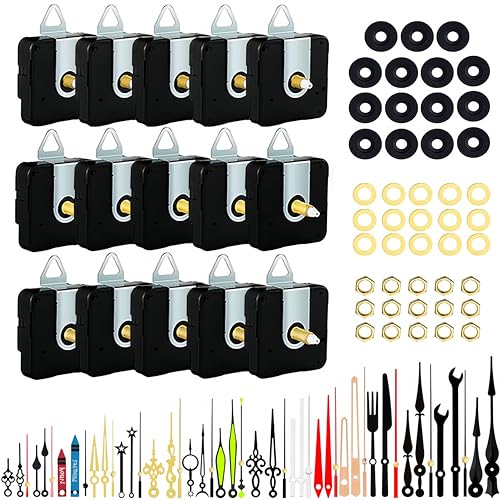 whcusmm 15-Pack Silent Quartz Clock Mechanism
|
8.1/10 | Buy |
Mudder High Torque Quartz Clock Movement Mechanism
The Mudder High Torque Clock Movement Kit provides a dependable quartz mechanism designed to drive extra-long hands across dials up to 23.1 inches in diameter. It is an ideal pick for DIY crafters and homeowners looking to repair or build large decorative wall clocks.
Pros
- Strong high-torque motor engineered to support large, long-reach hands without slipping or stalling
- Compatible with thicker panels between 9 mm and 13 mm, including wood, canvas, and craft boards
- Generous hand lengths provide clear time visibility across large wall clocks up to 23.1 inches
- Straightforward hardware kit for DIY clockmakers and home decor restoration projects
Cons
- Two-hand configuration uses a closed second cap nut rather than an active sweeping second hand
- Fixed shaft length requires panel thickness between 9 mm and 13 mm, necessitating shims for thinner boards
- Jump second step-motion mechanism may produce a subtle audible mechanical pulse in very quiet rooms
whcusmm 15-Pack Silent Quartz Clock Mechanism
This 15-pack quartz movement kit from whcusmm delivers silent sweep timekeeping with 16 interchangeable hand sets, eliminating disruptive ticking for peaceful bedroom and home spaces. It is an ideal bulk solution for crafters, homeowners repairing wall clocks, and light sleepers who demand tick-free timepieces.
Pros
- Completely silent sweep action eliminates disruptive mechanical ticking in quiet bedrooms and living spaces.
- Generous 15-piece bulk pack with 16 hand styles provides exceptional value for multiple repairs or crafting projects.
- Three distinct shaft lengths adapt easily to varied clock panel thicknesses between 4 mm and 12 mm.
- Simple rear thumbwheel makes setting the time quick and intuitive without specialized tools.
Cons
- Requires one AA battery per movement that is not included in the package.
- Does not include built-in alarm audio, snooze features, or illuminated digital displays.
- Delicate aluminum hands require careful alignment during installation to avoid bending.
Practical Methods and Hardware Retrofits to Silence Any Clock
Eliminating rhythmic noise from a bedroom clock requires understanding whether the sound originates from mechanical stepper gears, acoustic resonance within the housing, or electrical components inside digital units. By applying targeted isolation techniques or replacing mechanical internals with silent sweep mechanisms, you can preserve the visual style of your clock while achieving total acoustic quiet.
Diagnosing the Cause of Clock Ticking and Humming
Most traditional analog clocks generate sound through an internal stepping motor that advances the second hand once every second. In a standard battery-powered quartz clock, an integrated circuit sends a brief electrical pulse to an electromagnet, causing a tiny permanent magnet rotor to rotate half a turn. This sudden rotational impulse drives plastic reduction gears, producing an audible click as the gear teeth snap together.
The sound often seems disproportionately loud at night because human hearing becomes more sensitive as ambient household noise drops. Furthermore, hollow clock bodies act as natural acoustic soundboards that amplify internal gear chatter. If a clock rests on a hard nightstand or hangs flush against a drywall stud, mechanical vibrations transfer directly into the mounting surface, turning the entire wall or tabletop into an acoustic resonator.
Digital alarm clocks do not possess moving gears, yet they can still generate irritating high-frequency sounds. Electronic hum or coil whine typically stems from ceramic capacitors or switch-mode transformers vibrating inside the power supply. Identifying whether your bedside sleep disruption comes from mechanical gear impulses or electrical vibration is the first step toward restoring nighttime silence.
Quick Non-Invasive Damping Methods for Ticking Clocks
If you need an immediate solution before replacing internal components, physical sound dampening can reduce the acoustic projection of a noisy clock. Placing a dense silicone coaster, thick felt pad, or micro-cellular polyurethane foam beneath a desktop clock isolates the base from hard furniture surfaces. This simple barrier breaks the physical transmission path that turns wooden nightstands into sounding boards.
For wall-mounted clocks, placing adhesive rubber bumpers or self-adhesive felt dots behind the rear rim prevents the casing from rattling against drywall. Leaving an air gap of just a few millimeters between the frame and the wall interrupts mechanical conduction. You can also hang the clock using a padded picture hook wrapped in electrical tape to isolate the mounting nail from the clock bracket.
Dampening the internal cavity of an open-back clock housing also cuts down reverberation. Lightly filling empty compartments behind the movement with open-cell acoustic foam or synthetic batting absorbs airborne sound waves before they escape the enclosure. Be careful never to let padding touch exposed gears, balance wheels, or rotating hands, as any physical friction will cause the clock to lose time or stall completely.
Understanding Continuous Sweep Versus Jump-Second Quartz Movements
When physical dampening is not enough, swapping the internal motor is the most reliable way to silence a clock permanently. Standard battery-powered quartz mechanisms feature jump-second movements that click forward in discrete sixty-beat-per-minute pulses. The Mudder High Torque Clock Movement with 2 Hands utilizes a high torque jump second movement designed to swing substantial hands across dials up to 23.1 inches in diameter. While high torque jump movements deliver the rotational muscle needed for heavy hands and thick panels, their stepper motors still produce a faint mechanical step.
In contrast, silent sweep movements utilize an altered electrical pulse frequency and smooth gear progression that moves the second hand in an uninterrupted, fluid glide. Because the gear train glides forward continuously rather than halting violently each second, there is no abrupt impact between gear teeth. As a result, sweep movements operate virtually without acoustic noise, making them ideal for bedroom environments where even faint clicks disrupt sleep.
The 15 Pack Quartz Clock Mechanism Replacement Kit from whcusmm provides battery-operated silent sweep movements designed specifically to eliminate disruptive ticking. Running on a single AA battery, these sweep units deliver consistent timekeeping without emitting rhythmic pulses. Replacing a noisy ticking unit with a silent sweep motor lets you keep your favorite decorative clock face without sacrificing sleep quality.
Selecting Compatible Replacement Clock Movements and Hands
Before purchasing a replacement quartz movement, measuring your clock panel thickness and center hole diameter is critical. Clock movements feature distinct threaded shaft lengths, and selecting an incorrect size will prevent proper assembly. For instance, the whcusmm mechanism replacement kit accommodates panel thicknesses between 4 mm and 12 mm across three distinct shaft lengths of 16 mm, 18 mm, and 23 mm.
If your clock panel is exceptionally thick, such as a carved hardwood face or dense decorative tile, you will need extended thread clearance. The Mudder movement features a 23 mm total shaft length with 15.4 mm of threaded brass, making it suitable for panel thicknesses between 9 mm and 13 mm. Measuring both the total shaft length and the threaded portion ensures that the retaining nut can thread securely without binding against the dial face.
Dial diameter also dictates the appropriate hand length and motor torque required for smooth operation. Standard replacement sets, like the multi-style options in the whcusmm kit, provide hands suited for clock faces spanning 2 to 16 inches. However, large architectural clocks require high-torque units capable of pushing long, balanced hands, such as the Mudder kit’s 170 mm hour hand and 243 mm minute hand. Using undersized motors on oversized hands causes motor strain, erratic timekeeping, and premature battery depletion.
Check the shaft diameter profiles to verify hand compatibility before mounting new hardware. Most quartz mechanisms use friction-fit press-on brass bushings for the hour and minute shafts, finished with a small second cap or sweep second hand. Always match the hand mounting holes to the motor arbor dimensions to ensure a snug fit that will not slip over time.
Step-by-Step Guide to Installing a Silent Sweep Movement
Replacing a mechanical movement requires only basic hand tools, such as small pliers and a wrench, along with a clean, flat working surface. Begin by removing the clock battery to prevent accidental gear damage while handling the movement. Carefully lift off the second hand or protective brass cap by pulling straight up, avoiding any lateral bending that could warp the center arbor.
Next, gently pry off the minute hand and hour hand using even upward pressure beneath the brass collar. Once the hands are removed, locate the central brass hex nut securing the threaded shaft to the clock face. Unscrew the nut counterclockwise, remove the brass washer and rubber isolation gasket, and slide the old mechanism out through the back of the dial.
Insert the new silent sweep movement from the rear, ensuring the rubber washer sits flush between the movement housing and the back of the clock panel. This rubber gasket acts as an essential vibration isolator that absorbs residual motor hum while providing friction to keep the housing straight. Thread the brass washer and hex nut onto the front shaft, tightening the nut firmly with pliers without overtightening and cracking the dial.
Reinstall the clock hands sequentially by pressing the hour hand onto the lower shaft first, pointing it precisely toward the twelve o’clock position. Press the minute hand onto the middle arbor at twelve o’clock, and finish by pushing the second hand or decorative end cap into place. Aligning all hands at twelve o’clock ensures correct mechanical synchronization as the gears advance throughout the day.
Troubleshooting Hand Binding and Mechanical Friction
After installing a new sweep mechanism, inspect the clock hands from a side profile to ensure adequate vertical clearance between all layers. If the hour, minute, or second hands rub against one another, the friction can stall the motor or create an irritating scraping noise. Ensure that each hand remains perfectly parallel to the clock face, bending the lightweight aluminum blades gently if necessary to clear adjacent parts.
The second hand is particularly delicate and can easily catch on the minute hand or the protective glass lens of the clock frame. If your clock has a front glass crystal that presses against the center shaft, choose a movement with a lower profile second cap rather than an extended pin. The Mudder replacement kit includes a compact 7 mm second cap designed to sit flush when front clearance is restricted.
Set the clock to twelve o’clock and rotate the time-setting thumbwheel on the rear through a full twelve-hour cycle. Watch closely to verify that the hands complete a full rotation without touching the clock face, numbers, or framing glass. If the hands move freely without contact, install a fresh alkaline AA battery and observe the movement to verify continuous, quiet operation.
Eliminating Coil Whine and Transformer Hum in Digital Clocks
If your bedroom uses a digital alarm clock rather than an analog clock, the source of nighttime noise is electrical rather than mechanical. Switch-mode AC wall adapters and internal step-down transformers can produce a faint, high-pitched ringing known as electrical coil whine. This phenomenon occurs when electromagnetic coils inside inductors or transformers vibrate at audible frequencies under alternating current loads.
Bedside multi-function devices that combine timekeeping with wireless charging pads can introduce additional acoustic noise during operation. When exploring bedside alarm clocks with wireless chargers, high inductive currents can produce electromagnetic hum if internal coils are loosely potted or poorly shielded. If your digital clock whines when charging a phone, replacing the wall brick with a higher-wattage power adapter or positioning the phone slightly off-center can sometimes dampen inductive resonance.
Plugging digital clocks into shared power strips alongside noisy electronics, such as laptop chargers or humidifiers, can also introduce electrical line noise. Connecting the clock directly to a clean wall outlet or using a basic ferrite choke clamp around the low-voltage DC power cord filters out high-frequency noise. These small adjustments eliminate the subtle electrical buzzes that frequently disturb quiet sleeping rooms.
Acoustic Decoupling for Bedside Tables and Wall Mounts
Even the quietest mechanical movement or electrical clock can sound loud if placed on furniture that amplifies vibration. Hollow wooden nightstands, hollow-core headboards, and lightweight bedside shelves act like musical soundboards. Sound waves generated by minute internal movements transfer through hard plastic or metal feet directly into the porous wood, amplifying the perceived volume.
Decoupling the clock from these surfaces provides an immediate reduction in perceived bedside noise. Placing the timepiece on a soft cork mat, thick fabric runner, or heavy rubber coaster absorbs vibrational energy before it enters the furniture. For heavier shelf clocks, adhering small hemispherical silicone feet to each corner of the clock base breaks the mechanical bridge effectively.
Wall-mounted clocks benefit from similar acoustic treatment along the contact perimeter between the case and the drywall. In addition to using rubber pads on the back, hanging the clock away from bedroom corners prevents acoustic corner-loading, where adjacent walls reflect and amplify sound toward your pillow. Positioning the clock across the room on a non-shared wall significantly lowers the ambient decibel level at ear height.
Choosing Between Retrofitting Mechanics and Switching to Silent Digital Clocks
Deciding whether to repair an existing ticking clock or transition to a dedicated silent bedside digital clock depends on your personal sleep habits and aesthetic preferences. Retrofitting an heirloom wall clock or favorite mantle piece with a silent sweep quartz movement preserves the clock’s visual appeal while banishing loud ticking. Replacement kits are relatively simple to install and provide reliable continuous timekeeping without altering the exterior appearance of the frame.
For sleepers who require complete acoustic silence alongside modern waking tools, transitioning to dedicated digital options can be a practical alternative. Sleek bedside models, including compact multi-function timer clocks, provide solid-state operation that generates zero mechanical sound during nighttime hours. Many modern bedside displays also feature continuous dimmer controls that eliminate unwanted bedroom light pollution alongside mechanical noise.
If you decide to perform a DIY motor replacement, keeping spare parts on hand makes ongoing clock maintenance simple. A multi-movement set like the whcusmm 15-pack offers varied shaft depths and decorative hands suitable for tackling several clocks throughout a home. Whether you install a quiet sweep movement or switch to a silent digital bedside setup, eliminating rhythmic noise provides the peaceful environment necessary for restorative sleep.
About the author
Dan Caffrey is a Certified Sleep Science Coach and Certified Stress Management Coach with editorial experience covering sleep health and sleep products. He combines consumer-focused research with sleep science to explain product benefits, limitations, and suitability in clear, approachable language.