
How to Change Time on Wireless Charger Clock: Practical Guide for 2026
Learn how to change time on wireless charger clock models accurately in November 2026 with step-by-step setup tips and display adjustments.
 By Jeremy Klein
Updated November 5, 2026
Waking up on schedule becomes much harder when bedside electronics flash an incorrect hour or fail to hold their settings after a sudden brownout. Modern nightstands frequently rely on multi-functional devices to consolidate cluttered power cords, but adjusting digits on these hybrid gadgets often feels counterintuitive. Learning how to change time on wireless charger clock consoles ensures your morning wake-up calls stay dependable while eliminating unnecessary bedtime frustration. Many sleepers pair these multi-device hubs with an all-in-one alarm clock and wireless charger to streamline cable clutter, yet navigating compact multi-function rear toggles still requires a methodical approach.
Most digital nightstand chargers share setting buttons across several modes, combining alarm scheduling, brightness dimming, and clock synchronization into shared switches. Taking control of these settings prevents midnight flashing, accidental twelve-hour versus twenty-four-hour mismatches, and missed morning alarms. Exploring reliable designs among top-rated alarm clocks for bedrooms shows that clear tactile controls and straightforward daylight saving toggles make daily timekeeping effortless. Once you understand the baseline sequence for entering time-set mode, adjusting hours, and locking in your minutes, your bedside station becomes a dependable morning anchor.
| Award | Product | ACR Score About ACR ScoreThe ACR Score is our own rating from 0 to 10, based on performance, design and build, ease of use, and value. It reflects independent research and is never influenced by manufacturers, retailers, or affiliate commissions. Learn more › | |
|---|---|---|---|
| Best Overall |
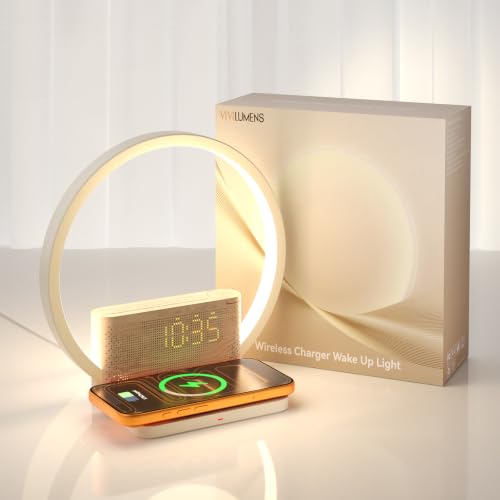 Vivilumens Sunrise Alarm Clock with 10W |
9.2/10 | Buy |
| Best Budget |
 Andoolex White Wooden Digital Alarm Clock with Qi |
8.8/10 | Buy |
 AFK Bedside Wireless Charging Station |
8.6/10 | Buy | |
| Best Value |
 ANJANK 4-in-1 Wireless Charging Alarm Clock |
8.1/10 | Buy |
| Best Premium |
 FREEFISH 6-in-1 Bedside Alarm Clock with |
8.1/10 | Buy |
Vivilumens Sunrise Alarm Clock with 10W
The Vivilumens Sunrise Alarm Clock brings together a 10W Qi wireless charging pad, a 20-sound sleep therapy machine, and a gradual 10-minute sunrise simulation in a clean wood-grain housing. It is a practical, space-saving bedside centerpiece for deep sleepers and nightstand minimalists wanting cord-free charging and customizable morning routines.
Pros
- Consolidates a wake-up light, 10W fast wireless charging pad, and white noise generator into a single wood-grain nightstand footprint.
- Digital display includes a full shut-off setting to eliminate unwanted nightstand light bleed in pitch-black rooms.
- Dual alarm architecture allows users to choose between light-only, sound-plus-light, or standard chime wake-up methods.
- Wide selection of 20 sound profiles with dedicated rotary volume control and multi-interval sleep timers.
Cons
- Capacitive touch tube sensor can suffer false triggers or touch failure if unshielded powered cables touch the desk near the lamp.
- Qi charging pad generally requires removing thick phone cases and demands precise device alignment to ensure steady power transfer.
- Display uses four fixed preset dimming levels rather than a continuous 0-100% stepless dial.
Andoolex White Wooden Digital Alarm Clock with Qi
Featuring a natural wood veneer casing, this Andoolex digital clock combines a Qi wireless charging pad and dual USB ports with stepless brightness and volume dials. It offers customizable waking and convenient bedside charging for modern bedrooms.
Pros
- Independent rotary dials allow precise, stepless control over screen dimming and alarm loudness
- Multi-device charging hub powers a smartphone wirelessly while running two USB-A cords simultaneously
- Clear multi-data display provides room temperature, date, and day without checking a mobile device
- Solid wood veneer exterior provides an aesthetically pleasing upgrade over standard plastic alarm clocks
- Independent dual alarms support varying wake times for couples or shift workers
Cons
- Requires a continuous Type-C power connection and does not operate cordlessly
- Manufacturer specifications do not detail internal battery backup behavior during AC power loss
- Smooth white veneer finish may show dust or scuffs if handled frequently with dirty hands
AFK Bedside Wireless Charging Station
The AFK Wireless Charging Station combines an upright phone charger, stereo Bluetooth speaker, and a loud dual alarm clock into a compact nightstand hub. It is an ideal space-saving choice for heavy sleepers, students, and busy professionals who want to declutter their bedside table.
Pros
- Consolidates a wireless charging dock, Bluetooth speaker, and digital alarm clock into one nightstand device
- Dual-alarm feature provides separate wake times for partners or backup alarms
- Charges through non-metallic phone cases under 5mm thick
- Built-in microphone with intelligent noise reduction enables speakerphone calls from the nightstand
- Compact and lightweight footprint (approx. 1.12 lbs) fits easily on small bedside tables or desks
Cons
- Cannot charge through phone cases thicker than 5mm or cases with metal plates, rings, or magnetic mounts
- Specific display dimming ranges and brightness step levels are not detailed in manufacturer specifications
- Specific wireless charging wattage and battery backup behavior during power outages are not listed in the product specifications
ANJANK 4-in-1 Wireless Charging Alarm Clock
The ANJANK 4-in-1 Wireless Charging Alarm Clock combines an easy-to-read LED timepiece with a space-saving multi-device bedside charging dock. Featuring six display brightness levels, three alarm volume settings, and a nine-minute snooze, it is ideal for Apple users looking to eliminate nightstand cable clutter.
Pros
- Consolidates three separate device chargers and a bedside clock into one tidy power cord
- Six distinct display dimming levels help prevent excessive nightstand glare in dark bedrooms
- Three adjustable alarm volume levels let sleepers tailor the wake-up sound to their preference
- Includes the required power adapter and cable in the box for immediate setup
- Raised charging surface and non-slip pads protect camera lenses and hold devices in place
Cons
- Incompatible with Samsung smartwatches and standard AirPods 4 models lacking active noise cancellation
- Wireless phone pad does not support magnetic MagSafe snapping or cases with metal rings, pop-grips, or thick card holders
- Step-based 6-level dimming toggle lacks a continuous 0-100% stepless dial control
FREEFISH 6-in-1 Bedside Alarm Clock with
The FREEFISH 6-in-1 digital alarm clock combines wireless phone charging, dual 5W Bluetooth speakers, an FM radio, and a dimmable warm night light into a compact wood-finish frame. It is an ideal nightstand solution for minimalists and commuters looking to reduce tabletop cord clutter.
Pros
- 6-in-1 multi-functional design frees up valuable nightstand real estate by replacing separate chargers, lamps, and speakers
- Bluetooth 5.4 time-sync functionality prevents clock drift and simplifies setting adjustments
- Dual 5W stereo drivers provide noticeably clearer, fuller audio output than standard piezo buzzers
- Screen can be toggled to complete darkness to accommodate light-sensitive sleepers
- Comes packaged with a dedicated 18W adapter and 1.2-meter Type-C cable
Cons
- Relies on continuous wall power with no documented internal battery backup to sound alarms during electrical blackouts
- Four stepped display brightness levels offer less granular adjustments than a stepless continuous rotary dial
- Requires proper phone alignment on the wireless charging pad to prevent interrupted overnight charging

Complete Guide to Setting and Calibrating Time on Wireless Charger Clocks
Adjusting the clock on a multi-function charging station often confuses owners because these devices combine multiple electronics into a single compact housing. Unlike traditional clocks with dedicated setting switches, charging docks frequently assign multiple secondary tasks to a few shared buttons. A single control may cycle display dimming during normal operation, trigger snooze when an alarm rings, and change internal time values when held down. Mastering the specific programming sequences of these integrated devices ensures you avoid late wake-ups, sleep-disrupting screen flashes, and incorrect alarm triggers.
Identifying Primary Control Interfaces and Button Configurations
Bedside charging clocks typically feature one of two main interface designs to control time and display functions. The first common style utilizes physical buttons mounted along the rear casing or base plate, which keeps the front aesthetic clean but requires turning the unit around to read labels. The second style relies on top-mounted tactile switches or stepless rotary dials, which allow adjustments without disturbing cable routing. Units like the Andoolex wooden alarm clock introduce dedicated rotary wheels for volume and dimmer calibration alongside labeled tactile buttons for clock settings.
Multi-device charging stations, such as the ANJANK dock, consolidate controls near the platform edges to protect internal charging coils from accidental pressure. Learning to distinguish between short presses and sustained presses is the most critical skill when navigating these button arrangements. A brief tap typically switches ambient light modes or toggles between temperature and calendar views. Holding a button for two to three seconds, however, almost always serves as the universal command to open the core time programming menu.
Step-by-Step Manual Time Programming Sequence
The manual programming process begins by placing the clock in its primary time display mode. Press and hold the designated Time, Set, or Clock button until the hour digits on the LED panel start flashing rapidly. This flashing visual cue indicates that the internal microcontroller has unlocked the time register and is ready to accept new inputs. If you do not press any additional buttons within five to ten seconds, most models will automatically exit this configuration state and return to normal operation without saving incomplete adjustments.
Once the hour digits begin flashing, use the Up and Down keys, or rotate the primary control wheel, to reach your desired hour. Pay close attention to the display icons during this stage to verify whether an AM or PM indicator illuminates alongside the digits. After selecting the correct hour, press the Time or Set button once with a short tap to lock the hour in place and advance the cursor to the minute digits. The minute numbers will immediately begin blinking, indicating they are ready for adjustment.
Adjust the minutes using the same Up and Down buttons until the display reflects the exact current minute. If you hold down the directional buttons, most digital clocks will advance the numbers in ten-minute increments to speed up the process. Once the minutes match your reference time, press the Time or Set button a final time to save the changes. The display digits should stop flashing and remain steady, confirming that your new time profile is actively running.
Managing 12-Hour and 24-Hour Military Time Formats
Selecting between a standard twelve-hour clock and a twenty-four-hour military format is an essential step during initial setup. Many imported electronics default to twenty-four-hour time, which displays thirteen hundred hours instead of one o’clock in the afternoon. On models like the ANJANK charging dock and FREEFISH bedside speaker, you can toggle between these two formats with a single tap of a dedicated twelve-twenty-four button while outside the main programming mode. Other devices require you to choose the format as the very first step upon entering the time-setting sequence.
Overlooking the AM and PM indicator is one of the most common causes of missed morning wake-up calls. When a clock operates in standard twelve-hour mode, an incorrect PM setting causes a morning alarm set for seven o’clock to remain silent until seven o’clock in the evening. Always look for a subtle dot, bell icon, or tiny text marker in the upper left corner of the LED screen to confirm your morning setting. If your clock uses a twenty-four-hour format, you eliminate this risk completely because morning and evening numbers are distinct.
Automatic Bluetooth Time Synchronization and Modern Protocols
Certain advanced hybrid charging stations remove the need for manual button combinations by utilizing smart wireless synchronization. The FREEFISH bedroom alarm clock incorporates Bluetooth connectivity to link directly with your smartphone or mobile tablet. Once paired over Bluetooth, the internal clock module automatically queries the mobile device and matches its network-synchronized time within seconds. This process completely bypasses manual button entry, delivering atomic-level timekeeping accuracy without complex programming sequences.

Automatic wireless synchronization also simplifies lifestyle adjustments when traveling across different time zones. Whenever your connected smartphone updates its internal clock to reflect local daylight or regional zones, the bedside alarm updates simultaneously upon reconnection. However, you should remember that Bluetooth range limitations and intermittent disconnections can delay these background updates. If your smartphone disconnects or turns off overnight, verify that the clock maintains its autonomous quartz timekeeping until the next wireless handshake.
Adjusting Daylight Saving Time Without Scrambling Saved Alarms
Bi-annual Daylight Saving Time shifts frequently cause confusion on multi-functional bedside charging stations. Some well-engineered units, including the Andoolex wooden digital clock, feature a dedicated one-key DST toggle switch located directly on the chassis. Pressing this dedicated switch instantly advances or rolls back the current hour value by exactly sixty minutes without forcing you through the full setup menu. This convenient shortcut saves your pre-programmed weekday and weekend alarm schedules from accidental erasure.
Clocks lacking a dedicated DST toggle require running through the standard manual programming routine to shift the hour value. When performing a manual adjustment, take care not to press the alarm adjustment keys accidentally, as these share adjacent chassis locations on compact housings. After shifting the hour forward or backward, always double-check both independent alarm times to ensure your scheduled wake-up routines remain unchanged. A quick evening verification guarantees that shifting the clock will not disrupt your morning work commute.
Preventing Midnight Resets and Power Interruption Issues
Waking up to flashing digits reading twelve o’clock usually points to a momentary residential electrical interruption. Many bedside wireless chargers rely on primary AC wall power or dedicated Type-C adapters to drive high-draw inductive coils and bright LED screens. When line voltage drops, clocks without battery backup memory instantly lose their volatile internal time registers. Understanding whether your clock features active operational backup or silent memory retention is crucial for preventing unexpected morning delays.
Certain models incorporate an internal coin-cell battery or secondary backup compartment designed solely to preserve time data during power drops. In these systems, the external screen and charging pad turn off during an outage, but internal quartz counting continues uninterrupted. When mains power returns, the display illuminates with the correct time already intact rather than defaulting to midnight. Regularly checking and replacing these internal backup batteries guarantees that storm-related power flickers will not erase your careful setup work.
Troubleshooting Display Glare and Time Setting Lockups
Display readability and responsiveness can occasionally falter due to physical placement issues or electrical noise on the nightstand. If your clock buttons fail to respond while setting the time, inspect the power cord and surrounding cables for proper grounding and clearance. In hybrid designs like the Vivilumens sunrise lamp, unshielded metallic cables touching capacitive sensor tubes can create weak electrical currents that disrupt button touch detection. Keeping cables neatly elevated and organized restores normal button responsiveness immediately.
Light-sensitive sleepers often struggle with bright display numbers illuminating the bedroom at night. Exploring options in our sunrise alarm clock guide demonstrates how gentle illumination curves and dimmable screens help maintain natural circadian rhythms. Units equipped with stepless rotary dimmer wheels or multi-level brightness buttons let you dial back glare down to comfortable nightstand levels. If your clock digits appear washed out or unreadable while setting the time, adjust the dimmer wheel to a higher daytime setting during the configuration process.
Phone cases thicker than five millimeters or cases with metallic kickstands can cause inductive charging issues that create localized chassis heat. Excessive heat transfer from poor coil alignment can sometimes cause clock microcontrollers to glitch or temporarily freeze their front control buttons. If the clock display behaves erratically while your phone is resting on the pad, lift the mobile device and allow the charging surface to cool down. Once internal temperatures stabilize, the clock buttons will respond smoothly to standard time-setting inputs.
Best Practices for Nightstand Stability and Daily Operation
Ensuring long-term timekeeping precision requires pairing your bedside charging station with an adequate power supply. Wireless charging pads demand substantial wattage to power inductive phone coils, auxiliary watch docks, and internal audio amplifiers simultaneously. Always use the manufacturer-specified adapter, such as an eighteen-watt fast charger, rather than plugging the clock into an underpowered legacy USB port. Supplying clean, steady voltage prevents screen flickering, buzzing transformer hum, and clock drift over extended months of operation.
Positioning the clock securely on a flat, anti-slip surface protects your devices from accidental drops while adjusting controls in the dark. Premium models integrate silicone pads and raised charging ridges to keep smartphones aligned directly over internal copper coils. When setting alarms or adjusting display brightness before sleep, hold the clock chassis steady with one hand while pressing buttons with the other. This simple habit keeps the phone firmly seated on the charging pad so your battery charges uninterrupted through the night.
Taking a few minutes to configure your bedside charging dock creates a smooth, stress-free evening and morning routine. Once the correct time, twelve or twenty-four-hour format, and alarm schedules are locked into memory, your bedside table transforms into an organized sleep haven. A reliable timepiece paired with efficient cord-free charging ensures you wake up refreshed and fully charged for the day ahead.
About the author
Jeremy Klein is an experienced sleep-product tester with a strong focus on testing methodology, data collection, and real-world product performance. His expertise includes evaluating sleep essentials and wake-up devices through structured testing and practical consumer-focused criteria.