
How Many Watts Does a Digital Clock Use: Bedside Energy Guide for 2026
How many watts does a digital clock use on your bedside table? Learn typical power draw, standby electricity costs, and display settings for October 2026.
 By Dan Caffrey
Updated October 6, 2026
By Dan Caffrey
Updated October 6, 2026
Bedroom timekeeping should provide dependable morning wake-ups without running up residential utility bills or adding unwanted heat to nightstands. When setting up a bedside table, many sleepers wonder how many watts does a digital clock use throughout continuous day and night operation. Unlike power-hungry household appliances or mobile electronics that require rapid charging cycles, standard bedside digital timepieces operate on remarkably modest electrical footprints. Choosing between compact LED numbers, passive LCD panels, or units with integrated battery backup configurations directly influences daily energy consumption and bedroom comfort.
Modern digital clocks rely on low-voltage direct current circuits that draw negligible electricity even when their displays remain active around the clock. Exploring top-rated alarm clocks for bedrooms shows that most standalone models balance crisp visibility with low power consumption. Understanding these electrical specifications helps homeowners optimize their sleep environments, manage cord clutter, and choose dependable hardware that keeps accurate time through every season. This guide explores typical wattage ratings, display technologies, backup battery architecture, and practical ways to keep nightstand electronics running efficiently.
| Award | Product | ACR Score About ACR ScoreThe ACR Score is our own rating from 0 to 10, based on performance, design and build, ease of use, and value. It reflects independent research and is never influenced by manufacturers, retailers, or affiliate commissions. Learn more › | |
|---|---|---|---|
| Best Overall |
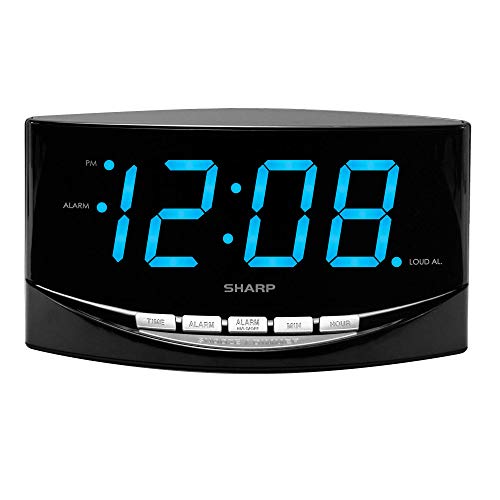
Sharp Digital Alarm Clock with 2-Inch Jumbo Blue
|
8.1/10 | Buy |
Sharp Digital Alarm Clock with 2-Inch Jumbo Blue
The Sharp Digital Alarm Clock pairs an oversized 2-inch blue LED display with selectable high and low volume settings for effortless across-the-room legibility and dependable waking. It is an ideal fit for seniors, heavy sleepers, and anyone looking for clean, front-facing controls to streamline their nightstand.
Pros
- Jumbo 2-inch blue numerals make checking the time effortless without reaching for eyeglasses
- Adjustable high or low volume switch accommodates both heavy sleepers and sensitive risers
- Front-mounted button array eliminates reaching behind the clock in the dark to set alarms
- Dual AA battery backup safeguards your time settings and wake-up schedules during power outages
Cons
- Two-level brightness switch lacks a gradual stepless slider for customized low-light dimming
- Blue LED light wavelength can produce visible ambient glow in pitch-black sleeping environments
- Two AA backup batteries are not included in the box and must be purchased separately
Understanding Digital Alarm Clock Wattage and Bedside Energy Consumption
Standard standalone bedside digital alarm clocks generally consume between 1 and 5 watts of continuous electrical power during normal operation. This low power requirement stems from efficient solid-state circuitry and low-voltage display modules designed for uninterrupted nightstand use. Basic timekeeping microchips require only minimal electrical current to drive their internal quartz oscillators and keep track of seconds, minutes, and alarm settings. As a result, leaving a digital clock plugged into a bedroom wall socket all day produces a virtually unnoticeable impact on monthly electric utility bills.
Variations in continuous wattage depend primarily on the lighting technology used to project or display the numbers. Clocks equipped with large, high-output light-emitting diode segments draw slightly more electricity than compact, reflective liquid crystal panels. Secondary features such as integrated nightlights, dynamic audio speakers, and auxiliary device charging docks can also shift the overall energy profile. Evaluating these specific hardware factors helps sleepers understand how bedside electronics draw electricity while maintaining dependable morning wake-up alerts.
Baseline Power Consumption Across Different Bedside Clock Categories
Passive liquid crystal display clocks represent the most energy-efficient bedside timekeepers available for home bedrooms. Without an active continuous backlight, a monochrome LCD clock draws fractions of a single watt, often operating comfortably below 0.5 watts of total power. Many passive LCD travel and desk models run for six months or longer on simple household button cells or AAA batteries without requiring mains power. When equipped with a gentle ambient sensor backlight, an LCD clock typically peaks at roughly 1 watt during dark nighttime hours.
Standard bedside LED alarm clocks fall into a predictable baseline range of 1.5 to 3 watts under typical household conditions. These units utilize segmented light-emitting diodes arranged in seven-segment numerical blocks to form digital characters. Because each illuminated segment draws dedicated direct current from the internal circuit board, overall wattage scales with digit dimensions and total segment illumination. Standard desktop units with one-inch digits strike a balanced middle ground between effortless nighttime readability and minimal standby electricity consumption.
Jumbo bedside displays push overall power consumption toward the upper end of the baseline scale, typically registering between 3 and 5 watts. Oversized digits measuring two inches or taller require larger surface-mount LED arrays or high-intensity backlighting to maintain visibility across a wide bedroom. The Sharp Digital Alarm Clock demonstrates this category with its prominent two-inch blue LED display engineered for effortless viewing from across the room. Even at maximum daytime brightness, a jumbo display operating near 4 or 5 watts uses far less energy than conventional living room lamps or computer peripherals.
How Display Technology, Digit Height, and Brightness Settings Change Energy Use
Display illumination represents the single largest contributor to continuous electricity consumption in modern bedside timepieces. Internal microcontrollers and quartz timing crystals consume negligible microamperes, leaving the display matrix responsible for the vast majority of continuous current draw. Blue, green, and bright white LEDs generally require higher forward operating voltages than traditional red or amber light-emitting diodes. Consequently, a cool blue digital display demands slightly more operational current across its internal traces than an equivalent red-spectrum segmented display.
Digit dimensions also directly dictate how much surface illumination must be produced to render the time legibly. A two-inch numerical readout uses longer individual LED filament traces or multiple clustered diode dies inside each digit bar. This extra surface area ensures that individuals with mild visual impairments or seniors can check the time without reaching for corrective eyeglasses. The modest increase in power consumption between compact and jumbo readouts remains minimal, usually translating into just 1 or 2 extra watts of continuous load.
Dimming mechanisms provide a practical method for reducing both bedroom light pollution and active electrical consumption. Most modern digital clocks incorporate stepped brightness toggles or continuous potentiometer dials that limit forward voltage to the display LEDs. Toggling a clock from its high brightness mode down to a softer low brightness setting can cut display wattage by twenty to forty percent. This brightness adjustment not only trims unnecessary electricity consumption but also protects nocturnal melatonin production by preventing harsh bedroom glare during rest.
Audio Transducers, Alarm Volume Settings, and Wake-Up Power Spikes
Bedside digital clocks spend nearly their entire operating lifespan in a steady-state standby timekeeping condition. The active alarm state represents a temporary operational surge that typically lasts between thirty seconds and several minutes each morning. During this active alarm phase, additional current flows to the integrated acoustic sounder to produce an audible waking tone. Understanding how audio transducers draw electrical current clarifies why morning alerts have no meaningful impact on utility expenses.
Piezoelectric buzzers are the most common acoustic sounders found in standard bedside alarm clocks. These compact components utilize a ceramic disk that vibrates rapidly when subjected to an alternating electrical frequency, producing a sharp, penetrating beep. Piezo transducers operate with exceptional electrical efficiency, drawing mere fractions of a watt even when sounding at elevated volume thresholds. Selecting between high and low volume settings on models with adjustable switches alters the drive signal slightly but produces negligible differences in total daily watt-hours.
Dynamic voice-coil speakers, commonly installed in FM radio alarm clocks or nature-sound sleep stations, require more operational current than piezo buzzers. Driving a miniature paper or mylar speaker cone to project music across a bedroom can push peak power consumption up to 3 to 8 watts during active playback. However, because users typically silence the alarm or turn off the morning radio within fifteen to thirty minutes, total energy consumption remains exceptionally low. Even heavy sleepers who rely on prolonged high-volume alarm cycles consume only trivial amounts of electricity during the acoustic alert cycle.
Auxiliary Nightstand Features: The Impact of Wireless Charging Pads and USB Ports
Standalone digital alarm clocks operate at very low baseline wattage, but multi-function bedside hubs alter the electrical profile substantially. Modern nightstands frequently serve as central charging stations for smartphones, wireless earbuds, and smartwatches. When an alarm clock integrates auxiliary charging hardware, its internal power supply must be engineered to deliver substantially higher amperage. Sleeper interest in an alarm clock with a wireless charger highlights how charging convenience reshapes nightstand energy demands.
Inductive wireless charging pads transmit electrical energy through magnetic coils, which naturally incur minor thermal and transmission conversion losses. A bedside clock with an integrated Qi wireless pad can consume anywhere from 7 to 15 watts of total wall power while rapidly replenishing a phone battery. Once the smartphone reaches a full state of charge, the inductive pad shifts into an ultra-low standby state that consumes less than 1 watt. The clock itself continues its baseline 2 to 3 watt timekeeping operation independently of whether a mobile device rests on the charging pad.
Integrated USB-A and USB-C charging ports present another source of variable bedside electrical demand. A standard legacy USB-A port generally outputs 5 volts at 1 ampere, translating into roughly 5 watts of power delivery during active cable charging. Advanced USB-C Power Delivery ports on modern multi-function clocks can supply 15 to 20 watts or more to support rapid charging protocols. Unplugging charging cables when devices finish replenishing ensures the bedside hub returns swiftly to its efficient, low-wattage standby baseline.
Circadian Wake-Up Systems and Sunrise Simulation Wattage
Sunrise simulation alarm clocks utilize high-lumen light arrays to provide gentle, biological awakening cues inside dark bedrooms. Unlike standard digital clocks that display only numerical digits, dawn-simulator clocks feature diffused lamps that illuminate the entire nightstand area. These optical wake-up systems rely on powerful LED driver boards capable of producing progressive lux increases over twenty to forty minutes. Evaluating popular sunrise alarm clock models reveals how illumination output shifts operational wattage during early morning hours.
During daytime standby and overnight timekeeping, a sunrise clock functions much like a standard LED timepiece, consuming between 1.5 and 3 watts. When the programmed dawn simulation sequence initiates, the internal lighting controller gradually increases current delivery to warm white and yellow LED arrays. At maximum illumination intensity, a dawn simulation light can draw between 10 and 25 watts of electrical power depending on lamp lumen ratings. This maximum illumination level typically lasts for only ten to fifteen minutes before the user turns off the lamp to begin their morning routine.
Calculating the daily energy footprint of a sunrise lamp shows that its operational cost remains negligible over time. Operating a 15-watt illumination lamp for thirty minutes each morning consumes roughly 0.0075 kilowatt-hours per daily wake-up cycle. Over an entire calendar year, that morning illumination cycle adds fewer than 3 kilowatt-hours to total household electricity usage. Sleepers gain the physiological benefits of gradual circadian awakening without noticeably increasing their residential energy consumption.
Power Supply Efficiency, Transformer Design, and Standby Vampire Load
Nearly all mains-powered bedside digital clocks remain connected to household wall receptacles 24 hours a day, 365 days a year. This constant connection means that internal power conversion components run continuously, raising questions about standby phantom load or vampire power. Older vintage alarm clocks utilized heavy iron-core linear transformers that constantly generated warmth, wasting 2 to 4 watts of electricity in phantom heat loss alone. Modern digital alarm clocks utilize compact switched-mode power supplies that convert alternating current to direct current with remarkable electrical efficiency.
Switched-mode power adapters dynamically regulate current delivery, minimizing wasted thermal energy when the clock rests in standard timekeeping mode. High-quality external wall adapters generally draw less than 0.1 to 0.3 watts of phantom power when completely unloaded. When powering an active digital clock, the conversion efficiency of these modern adapters typically exceeds eighty to eighty-five percent. This thermal efficiency prevents the back housing of the clock from becoming warm to the touch during long overnight hours on wooden nightstands.
Efficient transformer design also helps eliminate annoying high-frequency electrical coil whine in quiet bedroom environments. Poorly shielded or cheaply manufactured power adapters can emit a faint acoustic hum or buzzing noise that disrupts light sleepers. Well-engineered bedside clocks isolate their inductive coils and internal filter capacitors to ensure silent, disturbance-free nightstand operation. Checking that an alarm clock operates cool and quiet confirms that its internal power supply is converting mains electricity efficiently and safely.
Calculating Annual Kilowatt-Hour Consumption and Utility Costs
Determining the exact electrical impact of a bedside digital clock requires calculating its annual kilowatt-hour consumption. Kilowatt-hours represent the standard measurement unit that electric utilities use to bill residential households for energy usage. To find annual usage, multiply the continuous wattage of the clock by 24 hours per day, then multiply by 365 days, and divide by 1,000. This straightforward formula allows homeowners to translate small wattage numbers into concrete yearly energy metrics.
Applying this calculation to a standard 2-watt bedside digital clock reveals an annual consumption rate of approximately 17.52 kilowatt-hours. A slightly larger bedside unit with a brighter display consuming 3.5 watts will use roughly 30.66 kilowatt-hours over the same twelve-month period. Even a jumbo display clock operating continuously at 5 watts reaches an annual total of only 43.8 kilowatt-hours. For perspective, running a single 1,500-watt space heater for just one day consumes more electricity than a typical digital clock uses across an entire year.
The financial cost associated with running a dedicated bedside digital clock amounts to mere pennies per month in most residential areas. Even in regions where utility electricity rates trend higher, the total annual expense to power a digital clock remains remarkably low. Homeowners can keep a dedicated digital timepiece illuminated year-round without noticing any significant shift in their monthly utility expenses. This exceptional efficiency makes standalone digital alarm clocks one of the least expensive electrical conveniences in the modern home.
AC Mains Power versus Battery Backup Architecture
Understanding the distinction between primary AC mains power and auxiliary battery backup systems is essential for nightstand reliability. Most bedside alarm clocks rely on a dedicated AC wall plug to energize their display panels, acoustic sounders, and internal logic boards. However, sudden residential power outages or lightning storms can interrupt line voltage and threaten morning wake-up schedules. Manufacturers address this vulnerability by incorporating battery backup compartments into the base or rear chassis of the timepiece.
Many consumers assume that backup batteries will keep the clock fully illuminated and operational during an extended blackout. In reality, models like the Sharp Digital Alarm Clock utilize a dual AA battery backup designed primarily for memory retention rather than full active display operation. During an AC power interruption, the internal circuitry immediately cuts power to high-drain blue LED display segments to conserve battery chemical energy. The backup cells power only the ultra-low-wattage internal quartz timekeeper and microprocessor memory, preserving time and alarm settings until wall power returns.
This memory-preservation architecture ensures that backup batteries remain fresh and functional for many months or even years of standby duty. Because the two AA dry cells supply only microamperes during grid brownouts, they do not deplete quickly during brief nighttime interruptions. When mains electricity is restored, the clock display instantly illuminates with the correct time, preventing the dreaded flashing midnight reset. Checking and replacing backup cells periodically guarantees that your clock maintains its temporal memory whenever local utility service falters.
Comparing Dedicated Bedside Clocks to Overnight Smartphone Charging
Many people debate whether to use a dedicated digital alarm clock or rely entirely on a bedside smartphone. Evaluating this choice from an energy perspective reveals interesting differences between standalone appliances and complex mobile devices. A smartphone connected to a fast charger typically draws 10 to 25 watts of active power during its primary battery replenishment phase. Once the phone battery reaches full capacity, background cellular radios, app refreshes, and operating system updates continue to draw intermittent power throughout the night.
Standalone digital alarm clocks avoid this fluctuating power cycle by running simple, dedicated microchips that execute only basic timekeeping functions. A dedicated clock maintains an unvarying 2 to 3 watt steady-state load that produces minimal electromagnetic interference and zero thermal buildup. Beyond modest energy benefits, switching to a dedicated bedside timepiece supports digital detox habits by removing notifications from the sleeping environment. Sleepers can glance across the dark bedroom to check the time without exposing their eyes to addictive smartphone apps or melatonin-disrupting blue screen glare.
Dedicated bedside clocks also provide far greater morning reliability than mobile devices subject to overnight operating system reboots or dead batteries. A standalone clock will not miss an alarm because of an unexpected software update or a silent notification mute switch toggled by mistake. Investing a few watts of continuous household electricity into a dependable bedside clock provides both peace of mind and structured morning punctuality. The combination of modest energy draw and dedicated functional reliability makes standalone bedside clocks an enduring fixture in restful bedroom spaces.
Practical Tips to Minimize Bedside Energy and Nighttime Light Glare
Optimizing bedside clock efficiency often goes hand in hand with creating a more comfortable, rest-friendly bedroom atmosphere. Taking advantage of built-in dimming controls is the easiest way to reduce continuous LED display wattage while sleeping. Switching a bright blue or cool white display to its lower brightness setting before bedtime significantly cuts active diode power draw. This simple habit also reduces ambient bedroom glare, allowing sensitive sleepers to drift off without distracting light reflecting off bedroom walls.
Placing the digital clock in an optimal position on your nightstand further enhances readability and cable management. Routing the AC power cord neatly away from foot traffic prevents accidental disconnections that force the clock onto its battery backup memory. If using a multi-function clock with charging ports, unplugging secondary charging cables when not in use helps minimize unnecessary transformer idling. Ensuring adequate airflow around the clock housing also keeps internal step-down transformers running cool and performing with maximum electrical efficiency.
Simple, front-facing control layouts make it effortless to adjust display settings and alarm volume without fumbling in the dark. Units featuring clearly labeled buttons allow adults, seniors, and teens to customize their bedside experience in seconds. Whether you select a compact travel clock or an oversized jumbo display, modern digital clocks deliver exceptional timekeeping accuracy for just pennies a year. Choosing a dependable, low-wattage alarm clock ensures punctual mornings, restful nights, and peace of mind on your utility bill.
About the author
Dan Caffrey is a Certified Sleep Science Coach and Certified Stress Management Coach with editorial experience covering sleep health and sleep products. He combines consumer-focused research with sleep science to explain product benefits, limitations, and suitability in clear, approachable language.