
Do Light Alarm Clocks Work for Heavy Sleepers: Practical Guide for 2026
Explore do light alarm clocks work for heavy sleepers and discover why pairing sunrise light with high decibels or vibration ensures reliable waking in November 2026.
 By Daniel Noyed
Updated November 23, 2026

Waking up to a sudden, harsh buzzer often causes an uncomfortable spike in morning adrenaline, leaving deep sleepers groggy and disoriented for hours. Many people struggling through heavy sleep cycles wonder if gentle sunrise simulation can replace jarring noise, prompting the question of whether do light alarm clocks work for heavy sleepers who regularly sleep through standard alarms. While circadian lighting naturally supports morning hormone shifts, deep sleep stages present unique physiological hurdles that subtle bedside illumination cannot always overcome on its own.
Understanding how visual wake-up cues interact with human biology helps set realistic expectations for anyone overhauling their morning routine. Exploring a dedicated sunrise alarm clock guide reveals that while dawn simulation eases sleep inertia, high-arousal sleepers usually need supplementary sensory triggers. Comparing these illuminating devices alongside standard bedroom alarm clock options highlights why hybrid alerting methods deliver far greater morning consistency for stubborn sleepers.
| Award | Product | ACR Score About ACR ScoreThe ACR Score is our own rating from 0 to 10, based on performance, design and build, ease of use, and value. It reflects independent research and is never influenced by manufacturers, retailers, or affiliate commissions. Learn more › | |
|---|---|---|---|
| Best Overall |
 AuroraCalm Extra Loud Digital Alarm Clock |
8.9/10 | Buy |
| Best Budget |
 Peakeep Loud Twin Bell Alarm Clock for Heavy |
8.4/10 | Buy |
 Peakeep Small Digital Alarm Clock for Bedrooms |
8.3/10 | Buy | |
| Best Value |
 Netzu Loud Alarm Clock for Heavy Sleepers with Bed |
8.1/10 | Buy |
| Best Premium |
 Sonic Alert Sonic Bomb Dual Extra Loud Alarm Clock |
8.1/10 | Buy |
 AuroraCalm Extra Loud Alarm Clock for Heavy |
7.8/10 | Buy |
AuroraCalm Extra Loud Digital Alarm Clock
The AuroraCalm Extra Loud Alarm Clock delivers up to 115dB of adjustable wake-up volume paired with a flashing red alert light, dual alarm scheduling, and a fully dark-capable display. It offers a compact, dependable nightstand solution for heavy sleepers, teenagers, and shift workers who routinely sleep through standard mobile phone alarms.
Pros
- Maximum 115dB volume output with six adjustable volume tiers to accommodate different sleeping depths.
- Red flashing alert light adds a visual wake-up cue when audible tones alone are not enough.
- Alarm can still sound during household power outages using backup batteries while retaining clock memory.
- Screen can be dimmed completely off for light-sensitive individuals who require a pitch-black sleep environment.
- Compact 3.54 x 1.5 x 3.54-inch dimensions leave ample free space on smaller nightstands.
Cons
- Display turns completely off in battery backup mode during an outage to conserve emergency power.
- Aggressive 115dB sound profiles like the siren or jackhammer may startle light-sleeping partners or pets.
- Manufacturer specifications do not state the exact USB charging output wattage or power cord length.
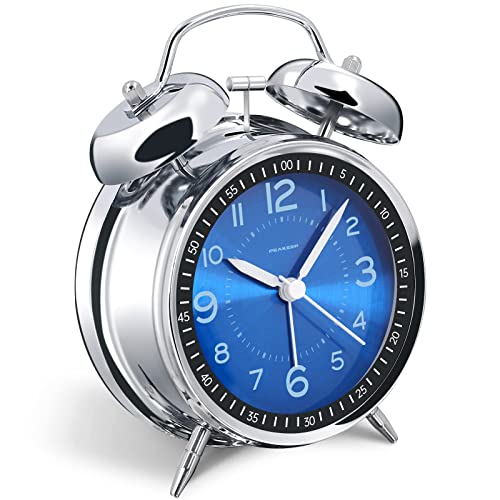
Peakeep Loud Twin Bell Alarm Clock for Heavy
Featuring an authentic twin-bell design with a physical striking hammer, this battery-operated Peakeep clock provides an extra-loud ring built to wake heavy sleepers without smartphone distractions. Its silent quartz sweep movement prevents distracting ticking noises, while a rear on-demand light button offers quick time checks without continuous bedroom glare.
Pros
- Physical twin-bell striking hammer delivers a very loud ring well suited for heavy sleepers and teenagers
- Quartz sweep movement operates completely silently without rhythmic ticking distractions
- On-demand backlight keeps the bedroom dark at night by lighting the face only when pressed
- Solid metal casing and front face provide durable craftsmanship and a distinctive jewel blue appearance
- Operates independently of wall outlets using a single AA battery for reliable bedside placement
Cons
- Lacks an electronic snooze button, requiring the user to flip the rear switch to silence the bell
- Analog fourth-hand alarm dial requires manual alignment rather than exact digital minute programming
- Requires one AA battery that is not included in the package
Peakeep Small Digital Alarm Clock for Bedrooms
The Peakeep Small Digital Alarm Clock pairs a crisp 6 x 3-inch blue LED display with an impressive 55 to 100 dB volume range across 5 settings. Built with 6 dimmer levels and a battery backup that actively triggers the alarm during power outages, it is an excellent, no-nonsense choice for heavy sleepers, students, and seniors.
Pros
- Reaches up to 100 dB with 5 selectable volume settings from 55 to 100 dB for deep sleepers
- Battery backup triggers the audible alarm during an AC power outage, not just internal memory retention
- Spacious 6 x 3-inch blue LED display with 6 brightness steps for flexible room lighting balance
- Comes with a 60-inch Type-C power cord providing plenty of reach to distant bedside wall outlets
- Compact footprint and stable desktop stand suit small nightstands, student dorms, and home offices
Cons
- Requires 4 AAA backup batteries that are not included in the box
- Uses 6 preset stepped brightness levels rather than a continuous 0-100% stepless dial
- Features a single alarm profile without dedicated weekday-only or weekend-only programming
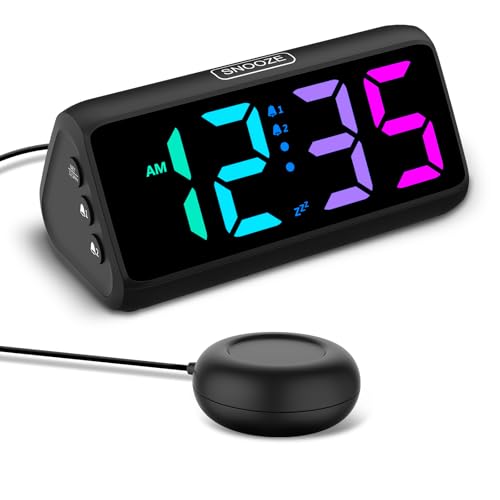
Netzu Loud Alarm Clock for Heavy Sleepers with Bed
The Netzu Loud Alarm Clock delivers a powerful wake-up solution featuring an included bed-shaking vibrator and an audible alert reaching up to 115 decibels. With an RGB customizable color display, five dimming levels including display-off, and dual alarms, it is a practical bedside choice for heavy sleepers, hearing-impaired users, and couples.
Pros
- Three versatile wake modes provide audible, physical tactile, or combined alert options.
- Listed 115 dB volume capability provides robust sound pressure for very heavy sleepers.
- Display can be turned completely off to eliminate nightstand glow in dark bedrooms.
- RGB customizable screen lets you change digit colors to match your personal preference.
- Dual alarm programming supports two distinct wake-up schedules simultaneously.
Cons
- Uses five fixed brightness steps rather than a continuous 0-100% stepless dimming dial.
- Maximum 115 dB alarm output can be quite jarring if placed immediately next to ear level on a compact nightstand.
- Product specifications do not list backup battery details or integrated USB phone charging ports.
Sonic Alert Sonic Bomb Dual Extra Loud Alarm Clock
The Sonic Alert Sonic Bomb is an intense bedside alarm clock pairing an adjustable 113dB siren with a physical bed-shaking vibration puck and red flashing alert lights. It is an ideal pick for deep sleepers, students, shift workers, and hearing-impaired individuals who consistently sleep through standard phone alarms.
Pros
- Massive 113dB maximum volume output easily cuts through heavy sleep cycles
- Included bed shaker puck offers a reliable tactile wake-up alternative for hard-of-hearing sleepers
- Three versatile notification modes (vibrate, buzz, or combo) provide customizable morning alerts
- Flexible controls let users fine-tune alarm duration (1-59 mins) and snooze duration (1-30 mins)
- Pulsing red alert lights add an extra layer of visual urgency in dark bedrooms
Cons
- The high volume and vigorous mattress shaker will likely disturb sleeping partners or light-sleeping roommates
- Does not include modern convenience features like built-in USB charging ports or wireless charging pads
- Aggressive industrial design with bold accents may not blend with subtle or traditional bedroom decor
AuroraCalm Extra Loud Alarm Clock for Heavy
The AuroraCalm Extra Loud Alarm Clock delivers up to 115dB of audio wake-up power paired with a flashing red alert light and dual alarms. It is an excellent bedside solution for heavy sleepers, teenagers, and shift workers who consistently sleep through standard phone alarms.
Pros
- Reaches a powerful 115dB volume level with a front-firing acoustic design
- Red flashing alert light offers visual reinforcement for hard-to-wake individuals
- Screen can be dimmed completely off to eliminate ambient glow in dark bedrooms
- Battery backup sounds the alarm during power outages while preserving internal time settings
- Built-in USB charging port and compact 3.54-inch wood-grain chassis reduce nightstand clutter
Cons
- The display remains powered off during battery backup mode until AC power is restored
- Intense siren and jackhammer sounds can startle sleeping partners or household pets
- USB charging port output wattage is not specified in the manufacturer documentation

Evaluating Light Alarm Effectiveness for Deep and Heavy Sleepers
Gradual light simulation alters morning physiology, but it rarely guarantees awakening for someone trapped in slow-wave sleep. The direct reality is that gentle dawn simulation alone often proves insufficient for true heavy sleepers, though it remains a powerful tool when integrated into a broader multi-sensory alerting system. Examining how biological sleep mechanisms respond to optical cues clarifies why light works best as a preparatory signal rather than a standalone alarm.
Circadian Biology and Sensory Gating During Slow-Wave Sleep
The human brain regulates sleep and wakefulness through specialized photoreceptors in the eyes known as intrinsically photosensitive retinal ganglion cells. These cells absorb optical wavelengths and signal the central biological clock, prompting the pineal gland to reduce melatonin production while encouraging the natural morning cortisol awakening response. In lighter sleep stages, this hormonal transition gently nudges the cortex toward conscious arousal.
Heavy sleepers spend substantial portions of their night in stage three non-rapid eye movement sleep, commonly called slow-wave sleep. During this phase, the brain creates a formidable sensory filter through the thalamus, heavily dampening external inputs to protect rest. Subtle shifts in ambient brightness rarely penetrate this neurological barrier with enough urgency to prompt physical movement or complete consciousness.
Light primarily functions to lighten sleep depth rather than deliver a sharp awakening shock. When optical stimulation occurs twenty to thirty minutes before a scheduled alarm, it helps transition the brain from deep delta waves into stage two sleep. This biological preparation reduces the debilitating grogginess known as sleep inertia, yet an additional sensory cue remains essential to complete the wake-up process.
Physical Bedside Obstacles That Inhibit Light Absorption
Beyond neurological gating, physical sleeping habits create significant barriers to light-based alarm clocks. Many deep sleepers shift positions constantly or sleep facing completely away from their bedside nightstand. If a sleeper rolls over and points their eyes toward the wall, the lux reaching their closed eyelids drops precipitously.
Bedding choices further compound this illumination loss. Pulling a thick duvet or pillow over the head blocks virtually all ambient photons, rendering even a bright lamp ineffective. Additionally, sleepers who use contoured blackout sleep masks will completely insulate their ocular receptors from morning light alarms.
The physics of light attenuation also plays a decisive role across typical bedroom layouts. Optical intensity diminishes rapidly across distance following the inverse-square law, meaning a clock placed three or four feet away delivers only a tiny fraction of its rated lux to the pillow. Unless a light source sits directly adjacent to the face with an unobstructed line of sight, its waking power remains sharply restricted.
Multi-Sensory Alerting: Combining High Decibels with Visual Cues
Because gentle dawn simulation alone leaves heavy sleepers vulnerable to oversleeping, combining optical stimulation with high-output acoustic alerts creates a far more dependable setup. Hardware like the AuroraCalm Extra Loud Alarm Clock for Heavy addresses this challenge by pairing front-facing speakers capable of delivering up to 115 decibels with prominent red flashing alert lights. This dual approach attacks sleep inertia simultaneously through the eyes and ears.
Standard smartphone alarms generally peak around sixty to seventy decibels, a level easily absorbed or integrated into ongoing dreams by exhausted sleepers. Elevating sound pressure to one hundred decibels or higher provides the concussive acoustic force necessary to shatter thalamic sensory gating. The Peakeep Small Digital Alarm Clock for Bedrooms demonstrates this balance by offering five adjustable volume tiers reaching up to one hundred decibels.
Visual alerts change character when shifted from gradual dawn simulation to active flashing strobes. Sudden bursts of red light create high-contrast flickering through closed eyelids, signaling immediate urgency to the brainstem. Pairing flashing visual strobes with escalating audio levels ensures that even if one sensory pathway is blocked, the other forces the sleeper awake.
Tactile Bed-Shakers: Bypassing Visual and Auditory Limitations
When high sound levels and flashing lights prove inadequate, physical vibration introduces a third waking dimension that cannot be ignored. The Sonic Bomb Dual Extra Loud Alarm Clock with Bed exemplifies this concept with its powerful bed-shaking unit, paired with an intense 113-decibel siren and flashing red alert lights. Placing a vibrating puck beneath a mattress or pillow physically shakes the sleeper awake.
Mechanical vibration activates cutaneous mechanoreceptors and proprioceptive sensors across the body, routing signals directly to the ascending reticular activating system. This somatosensory pathway operates completely independently of hearing or sight, making it invaluable for both deep sleepers and individuals with hearing impairments. The Netzu Loud Alarm Clock for Heavy Sleepers Black provides a similar multi-modal solution, offering three distinct modes spanning vibration only, ring only, or combined vibration and ringing.
Users can tailor tactile stimulation based on their living arrangements and partner schedules. Setting an alarm to vibration only allows a heavy sleeper to wake promptly without blaring loud acoustic sirens that disturb the entire household. For solo deep sleepers, engaging vibration alongside maximum volume creates a virtually inescapable wake-up routine.
Acoustic Habituation and Sound Selection Strategies

The human brain possesses an incredible ability to adapt to repetitive environmental stimuli, a phenomenon known as habituation. When a sleeper hears the exact same buzzer frequency every morning, the subconscious learns to classify the noise as non-threatening, allowing the person to sleep through it. Rotating acoustic profiles over time keeps sensory pathways sharp and reactive.
Advanced digital alarm clocks combat auditory fatigue by providing varied sound profiles. Clocks such as the AuroraCalm system incorporate six distinct wake-up sounds, including sirens, jackhammers, roosters, and beeps. Shifting between mechanical beeps and piercing sirens every few weeks prevents neural adaptation and restores waking reliability.
Some users attempt to wake up using gentle environmental sounds, such as those found on dedicated nature sound alarm options. While peaceful audio fosters calm mornings for light sleepers, heavy sleepers must ensure such sounds feature ascending volume curves or mechanical backups. Alternatively, classic twin-bell designs like the Peakeep Loud Alarm Clock for Heavy Sleepers utilize an aggressive physical hammer strike against twin metal bells that rings for up to fifty minutes.
Nightstand Ergonomics and True Bedroom Darkness
An effective morning wake-up clock must not compromise nighttime sleep quality. Digital displays that emit excessive blue or cool-white light throughout the night suppress natural melatonin release, delaying sleep onset and fragmenting sleep architecture. A sleeper who endures poor, fragmented sleep naturally awakens as a much heavier, more exhausted sleeper the following morning.
Comprehensive dimming controls are essential for maintaining a pitch-black sleeping environment. The Peakeep Small Digital Alarm Clock incorporates six adjustable brightness levels, while the Netzu digital model offers five dimmer steps alongside an option to turn the screen completely dark. Selecting a display with true zero-glare performance or soft night-light illumination ensures uninterrupted slow-wave recovery.
Nightstand cord management and device consolidation also impact evening relaxation. Integrating a streamlined charging alarm clock setup or using clocks with onboard USB ports, such as the AuroraCalm models, removes excess clutter from the bedside table. A clean, dark bedside area fosters the restorative rest necessary to respond effectively to morning wake triggers.
Power Supply Architecture and Outage Preparedness
A missed alarm caused by an overnight electrical blip is a common nightmare for heavy sleepers. Understanding the precise difference between active operational battery backup and passive memory retention is critical when choosing a bedside timepiece. Passive backup simply preserves internal clock time during an outage, keeping the screen dark and the buzzer silenced until mains power returns.
Certain digital designs, including models from AuroraCalm, maintain settings and ensure the alarm can still trigger during electrical interruptions using onboard backup memory cells. The Peakeep Small Digital Alarm Clock runs primarily via a Type-C adapter cord while relying on four AAA batteries to memorize settings and sound the alarm during unexpected grid drops. This dual-layer architecture prevents oversleeping when severe weather knocks out residential power.
In contrast, fully battery-powered mechanical options like the metal Peakeep Loud Alarm Clock operate completely off the grid using a single AA battery for months of continuous operation. Without reliance on wall transformers or household circuits, mechanical battery clocks eliminate vulnerability to utility outages. Deep sleepers living in regions prone to stormy weather often benefit from keeping an independent battery-driven unit as a primary or secondary backup.
Snooze Mechanics and Accidental Alarm Cancellation
Grogginess severely impairs executive cognitive function during the first few moments after waking. Heavy sleepers frequently reach out in a half-conscious state and accidentally slide a permanent off switch instead of hitting the snooze bar, leading to immediate oversleeping. Hardware ergonomics play a major role in preventing this common morning failure.
Effective bedside clocks provide broad, tactile top-mounted snooze bars that are physically isolated from permanent disarm switches. The Sonic Bomb clock allows users to customize snooze duration between one and thirty minutes, while also letting owners adjust overall alarm duration up to fifty-nine minutes. This extended ringing window prevents the clock from giving up before the sleeper has fully regained consciousness.
Strategic physical placement can permanently solve the groggy shutoff dilemma. Placing the alarm clock on a dresser or desk across the bedroom forces the heavy sleeper to climb out of bed, engage their leg muscles, and stand upright to silence the device. By the time physical movement has occurred, motor activation has dispersed the deepest layers of sleep inertia.
Designing a Bulletproof Hybrid Wake-Up System
Achieving consistent, anxiety-free mornings requires heavy sleepers to build a layered wake-up strategy rather than relying on a single sensory mechanism. Utilizing dual alarm settings, which come standard on devices like the Netzu, AuroraCalm, and Sonic Alert clocks, allows users to schedule a staged awakening. The first alarm can initiate soft lighting or moderate volume to begin lightening sleep depth gently.
Ten to fifteen minutes later, the secondary alarm should engage full multi-sensory alerting with piercing decibels, rapid visual strobes, and vigorous bed vibration. This two-phase progression respects human circadian biology by reducing morning shock while guaranteeing that the sleeper does not remain trapped in deep slow-wave slumber. Combining complementary sensory inputs creates a morning routine that works consistently across every season.
Ultimately, light alarm clocks provide genuine physiological benefits by shifting hormone balances and smoothing the transition out of deep sleep. However, heavy sleepers should view sunrise simulation as a supportive partner rather than a lone savior. Pairing intelligent illumination with high-decibel horns, physical bed-shaking pucks, and resilient power backups delivers the dependable waking performance deep sleepers truly need.
About the author
Daniel Noyed is a Certified Sleep Science Coach and experienced product editor with extensive knowledge of sleep health and sleep-related products. He has hands-on experience testing hundreds of products and translating technical features into practical guidance for everyday sleepers.