
What Is a Voice Clock: Practical Guide for 2026
Learn what is a voice clock and explore how talking bedside timepieces provide clear audio announcements and reliable daily reminders in October 2026.
 By Daniel Noyed
Updated October 13, 2026
By Daniel Noyed
Updated October 13, 2026

Squinting at a glowing digital screen across a pitch-black room can be frustrating, especially for individuals dealing with low vision, eye strain, or sudden disorientation in the middle of the night. Traditional digital bedside displays often force you to sit up, locate eyeglasses, or endure harsh blue backlighting just to check the time. Exploring what is a voice clock reveals an accessible alternative that replaces visual strain with instant acoustic feedback. Instead of demanding visual focus, these dedicated audio timepieces speak the current hour and minute out loud at the tap of a button. Many people looking to simplify their nightstand setup turn to reliable bedside options or explore bedside alarm clocks for bedrooms to improve nocturnal comfort and reduce nighttime screen distractions.
A dedicated talking timepiece bridges the gap between complex smart assistants and basic bedside hardware by providing immediate spoken updates without requiring wireless networks or complicated voice commands. Modern variations range from compact keychains to high-contrast tabletop buttons and full digital calendar day displays engineered for seniors or individuals managing memory loss. By incorporating tactile controls, adjustable audio volume, and automated reminder schedules, these specialized clocks deliver timekeeping independence while preserving a restful sleeping environment. Understanding how audio hardware, internal memory retention, and simplified physical interfaces function will help you decide if an audible clock matches your daily living needs.
| Award | Product | ACR Score About ACR ScoreThe ACR Score is our own rating from 0 to 10, based on performance, design and build, ease of use, and value. It reflects independent research and is never influenced by manufacturers, retailers, or affiliate commissions. Learn more › | |
|---|---|---|---|
| Best Overall |
Mitoart 7-Inch Digital Day Clock with Voice
|
8.9/10 | Buy |
| Best Budget |
 MAUJOY Talking Keychain Alarm Clock with Clear
|
8.8/10 | Buy |
| Best Value |
 BATVOX Large Talking Button Alarm Clock
|
8.3/10 | Buy |
 Rohome Talking Alarm Clock and Timer
|
8.0/10 | Buy | |
| Best Premium |
 Memo24 Talking Button Alarm Clock with English
|
7.8/10 | Buy |
Mitoart 7-Inch Digital Day Clock with Voice
The Mitoart 7-Inch Digital Alarm Clock provides an easy-to-read day and date display alongside convenient voice time announcements and multi-alarm scheduling. Designed specifically for seniors, caregivers, and visually impaired individuals, it delivers straightforward bedside orientation without complicated screen layouts.
Pros
- Bold 7-inch screen spells out full dates and weekdays without abbreviations for easy readability
- Voice announcement function supports nine languages and can be triggered via remote control
- Multiple alarm profiles provide structured scheduling for daily medication and routine reminders
- Automatic scheduled dimming drops screen luminance to 50 cd/m² every evening at 7:00 PM
Cons
- Fixed auto-dimming schedule (7:00 PM to 7:00 AM) does not adapt dynamically to ambient bedroom lighting
- Nighttime brightness floor of 50 cd/m² may still produce faint ambient glow in completely pitch-black bedrooms
- Voice time readout requires a deliberate button press on the remote or back panel rather than voice activation
MAUJOY Talking Keychain Alarm Clock with Clear
The MAUJOY Talking Keychain Alarm Clock delivers clear English voice time announcements and built-in alarm utility in an ultra-compact pocket format. It offers an accessible, zero-glare timekeeping solution ideal for visually impaired individuals, seniors with limited dexterity, and travelers seeking simple audible alerts.
Pros
- Instant audible time announcements in clear English with one-touch activation
- Extremely compact, pocket-friendly size measuring roughly 2.05 inches square and under an ounce
- Built-in keyring offers easy attachment to house keys, backpacks, or bedside lanyards
- Straightforward operation tailored for low-vision individuals, seniors, and travelers
Cons
- Compact keychain profile lacks visual bedside display features like large illuminated digits or dimming controls
- Spoken English announcements and alarm sounds may disturb sleeping roommates or quiet shared rooms
- No integrated multi-function bedside features like USB charging ports, wireless charging, or FM radio
BATVOX Large Talking Button Alarm Clock
The BATVOX Large Talking Button Clock is a battery-powered bedside timepiece that announces the time, day, and date aloud in a clear voice with a single tap. Featuring bottom-mounted volume controls and built-in time-memory retention during battery changes, it is an accessible solution for seniors, low-vision sleepers, and bedroom minimalists.
Pros
- Clear and loud audio announcements make time and date checks simple for visually impaired users and seniors
- High-contrast turquoise button on a silver housing provides immediate visual and tactile identification
- All setup controls and volume switches are placed on the bottom to safeguard against accidental schedule tampering
- Internal time-memory chip retains the programmed time and settings even during battery replacements
- Runs cordlessly on three included AAA batteries, avoiding messy nightstand wire clutter
Cons
- Default factory volume output is quite loud, requiring manual reduction via bottom keys prior to bedside use
- Lacks a visual digital display screen, making it unsuitable for sleepers who prefer a silent visual glance at the time
- Volume and schedule adjustments require picking up and flipping the clock over to access the bottom panel
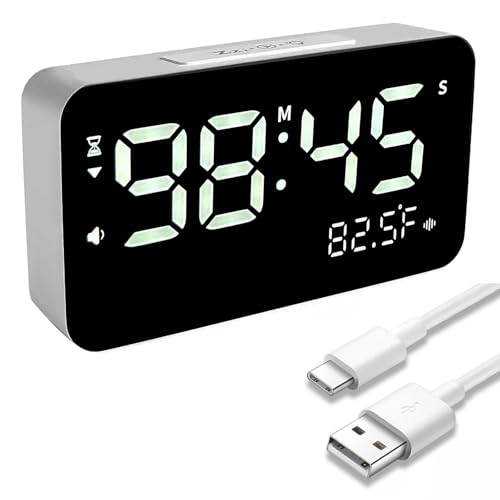
Rohome Talking Alarm Clock and Timer
Designed for accessibility, this compact clock provides audible time announcements and a 99-minute countdown timer for seniors or visually impaired users. It also monitors indoor temperature and features voice-activated display wake-up for effortless day or night viewing.
Pros
- Audio announcements assist visually impaired users
- Sound-activated display wake-up conserves battery
- Combines timer, clock, and temperature monitoring
- Supports both battery and continuous wired power
Cons
- Full battery recharge takes five hours
- Rear button required to completely stop alarm
Memo24 Talking Button Alarm Clock with English
The memo24 Talking Button Alarm Clock provides instantaneous spoken time, day, and date announcements with a single tap of an oversized red button. Featuring two volume levels, voice-guided setup, and included AAA battery power, it is a practical bedside companion for seniors and visually impaired individuals.
Pros
- Simple one-touch audio announcement requires no visual reading of numbers
- High-contrast red 2.8-inch button provides a large, accessible target in dim light
- Includes dual volume toggle switch (high and low) to accommodate hearing needs
- Comes complete with 2 AAA batteries for immediate out-of-the-box operation
- Features both spoken audio setup prompts and clear printed instructions
Cons
- Lacks a visual screen display for sleepers who prefer to glance at numbers silently
- Limited to two preset volume steps without fine-grained stepless adjustment
- Relies strictly on AAA batteries without an optional AC wall adapter connection
The Mechanics, Forms, and Daily Value of Spoken Timekeeping Devices
At its core, a voice clock is a specialized timekeeping device equipped with an integrated speech synthesizer and acoustic speaker that audibly announces the current time, day, or date upon physical activation or at scheduled intervals. Unlike standard LED or LCD clocks that rely exclusively on visual numerals, an audible timepiece translates internal digital quartz time into clear spoken language. This audio-first architecture eliminates the requirement to read small screens, navigate glowing displays in dark bedrooms, or interpret complex calendar abbreviations. While originally developed as an assistive tool for individuals with visual impairments, blindness, or cognitive conditions such as dementia, modern voice clocks now serve a wide spectrum of users who value tactile, screen-free time accessibility.
How Audible Speech Synthesizers and Trigger Mechanisms Function
Spoken time announcements rely on recorded or synthesized phonetic voice samples stored inside the internal read-only memory of the clock controller. When you press a designated button or trigger an automated event, the microchip retrieves the corresponding audio fragments for the exact hour, minute, and meridiem status, seamlessly stringing them together into a complete spoken sentence. Dedicated designs frequently utilize a natural human voice recording, such as the clear English male voice featured on the BATVOX Large Talking Button Clock and the memo24 Talking Button Alarm Clock for The Blind. These acoustic prompts remove the ambiguity of reading segmented LED digits that can blur when viewed without corrective lenses.
The physical triggering mechanism determines how smoothly you interact with the device during morning awakenings or overnight inquiries. Tabletop button models generally employ an oversized dome switch covering almost the entire upper surface of the housing, allowing users to tap the clock with an open palm or gentle touch without needing pinpoint finger precision. In contrast, multi-function digital units like the Mitoart Digital Alarm Clock with Date and Day offer activation via a rear confirmation button or an included infrared remote control, enabling users to hear spoken updates from across the bedroom. Portable keychain variants such as the MAUJOY Talking Clock Keychain for The Blind use a single, distinct tactile button that can be located by touch alone inside a pocket or purse.
Acoustic clarity remains paramount for voice comprehension, requiring balanced speaker drivers that produce intelligible speech without harsh harmonic distortion. The built-in speaker must project clear vocal frequencies that cut through mild background noise while avoiding the shrill, jarring tones common in standard piezo buzzers. Devices such as the Talking Alarm Clock and Countdown Timer also incorporate secondary audio broadcast features, such as hourly chimes that softly state the hour throughout the day. By relying on well-calibrated audio triggers, these timepieces provide predictable auditory cues that help users maintain an accurate sense of time without looking at a screen.
Desktop Button Domes Versus Handheld Keychain Hardware
Form factors in this category generally divide between stationary nightstand fixtures and ultra-compact pocket devices, each catering to distinct mobility and lifestyle requirements. Desktop button clocks feature a wide, weighted footprint engineered to remain stable when pressed firmly from odd bedside angles. Units like the memo24 Talking Button Alarm Clock for The Blind incorporate a substantial 2.8-inch activation dome with high-contrast color schemes, such as a vibrant red button mounted over a neutral casing. This high-contrast pairing creates clear visual separation for individuals with macular degeneration, glaucoma, or low peripheral vision who still retain partial light perception.
Handheld units prioritize portability, rugged housings, and featherweight ergonomics for active daily routines. The MAUJOY Talking Clock Keychain for The Blind exemplifies this compact philosophy by combining a sturdy plastic shell with an integrated metal keyring that clips directly to backpacks, purse straps, or house keys. Users who travel frequently or run errands can check the hour instantaneously while sitting on public transit, waiting at medical offices, or navigating unfamiliar environments where wall clocks are absent. The enclosed microswitches on quality keychains are slightly recessed to prevent accidental speech triggers while bouncing inside pockets, ensuring quiet operation when discretion is necessary.
Stationary multi-display clocks represent the largest physical tier, frequently utilizing seven-inch or larger screens designed to rest securely on a nightstand, desk, or dresser. The Mitoart Digital Alarm Clock with Date and Day features a prominent digital panel alongside its voice timing features, bridging the gap between a visual digital calendar and an audio speaker. These hybrid units often require dedicated placement near electrical outlets or sturdy shelves, making them less suitable for travel but ideal as permanent orientation stations in primary living areas. Choosing between a weighted button dome, a compact travel keychain, or a full-scale orientation display depends directly on whether your routine centers on bedroom stability or mobile convenience.
Visual Display Integration and Automated Nighttime Dimming
While voice prompts serve as the primary operational interface for many users, visual display integration provides vital orientation for family members, caregivers, and individuals with fluctuating vision. Large-format calendar clocks display the current time, complete day of the week, calendar month, and numerical date in bold, un-abbreviated text to eliminate cognitive strain. The Mitoart Digital Alarm Clock with Date and Day utilizes a seven-inch panel specifically arranged to prevent the confusion caused by truncated calendar indicators like TUE or OCT. For older adults experiencing early-stage memory loss, seeing the full day of the week prominently displayed provides reassuring orientation throughout waking hours.
Display luminescence requires careful management in bedrooms to prevent sleep disruption caused by intrusive ambient light. Standard LED displays that project bright blue or cool-white backlights can suppress natural nocturnal melatonin secretion and illuminate dark bedrooms like flashlights. To combat nighttime glare, sophisticated voice clocks offer scheduled automatic dimming, such as the Mitoart clock reducing screen output from daytime levels down to a soft, eye-friendly fifty candela per square meter between seven in the evening and seven in the morning. This ambient light management ensures that individuals resting nearby are not disturbed by radiant glare while maintaining clear contrast when daytime lighting returns.
Other models, such as the Talking Alarm Clock and Countdown Timer, implement voice-activated energy-saving display modes that extinguish the screen completely during quiet intervals. The panel only illuminates when an acoustic sound or tap is detected, preserving stored battery capacity and maintaining an undisturbed, pitch-black sleep environment. If you prefer waking up gradually with ambient light rather than sudden audio, you might also compare how sunrise alarm clocks for heavy sleepers use progressive lux illumination to stimulate morning wakefulness naturally. Combining audible voice readouts with intelligent, glare-free backlighting delivers balanced day and night bedside utility.
Internal Memory Retention and Outage Reliability
Losing accurate time settings during a power cut or battery replacement can turn an assistive device into a frustrating chore, particularly for individuals who cannot easily read tiny programming buttons. Traditional digital clocks without non-volatile memory chips instantly reset to a flashing 12:00 AM whenever electrical continuity breaks, requiring full manual reconfiguration. Advanced voice timepieces address this vulnerability through internal time memory architectures designed to preserve operational data during power interruptions. The BATVOX Large Talking Button Clock incorporates a dedicated memory circuit that retains current time and calendar tracking even while you remove and replace its three AAA cells, eliminating the need to reset the clock from scratch.
Power delivery methods vary significantly across the voice clock category, spanning disposable alkaline batteries, rechargeable internal cells, and standard alternating-current adapters. Units like the memo24 Talking Button Alarm Clock for The Blind rely entirely on replaceable AAA batteries, freeing the user from tangled bedside cords and eliminating dependency on nearby wall sockets. Battery operation allows the clock to be positioned exactly where the sleeper needs it most, whether on a nightstand, beside a favorite armchair, or mounted on a walker tray. When utilizing battery-operated models, regularly inspecting battery terminals and selecting leak-resistant alkaline cells ensures long-term electrical reliability.
Rechargeable variants such as the Talking Alarm Clock and Countdown Timer utilize integrated internal batteries that charge fully in approximately five hours via USB power inputs. These models offer the convenience of cordless tabletop placement while supporting continuous operation through an attached power cable if preferred. Unlike complex nightstand stations such as alarm clock and wireless charger units that demand heavy wall current to power inductive charging coils, standalone voice clocks consume minimal wattage. This modest power draw allows standard battery configurations to provide extended operational service without frequent maintenance.
Acoustic Volume Adjustment and Speaker Clarity
Spoken word intelligibility depends heavily on physical volume management, as hearing acuity varies widely among individuals requiring auditory time announcements. A voice prompt that is whisper-quiet will fail to wake deep sleepers or assist older adults with age-related hearing loss, while an excessively loud announcement can startle household members in the dead of night. Hardware models such as the BATVOX Large Talking Button Clock place dedicated volume keys on the underside of the housing, allowing users to dial in appropriate acoustic output while preventing accidental volume shifts during daily button presses. Starting at a moderate level and testing spoken clarity from your normal resting position helps establish an optimal listening threshold.
Stepped volume switches provide another practical acoustic solution for quick adjustments between daytime and nighttime hours. The memo24 Talking Button Alarm Clock for The Blind features a physical two-position toggle switch allowing instant selection between high and low acoustic output to accommodate individual hearing capacity. Having a direct mechanical switch rather than a software menu makes it simple for caregivers or family members to adjust volume without altering timekeeping settings. Quality voice speakers are engineered to deliver crisp consonant sounds, which are vital for distinguishing spoken numbers that sound similar, such as fifteen and fifty.
Acoustic placement within the bedroom significantly impacts how sound waves disperse across the mattress and pillows. Placing a voice clock on a solid, uncarpeted wooden nightstand allows the surface to reflect low-frequency vocal tones, improving perceived warmth and audio clarity. Conversely, tucking a clock behind heavy drapery or beneath soft bedding can muffle vocal frequencies, making spoken words difficult to comprehend. Maintaining an unobstructed line of acoustic travel between the speaker grill and your pillow ensures that every time announcement and alarm chime sounds crisp, intelligible, and comfortable.
Daily Scheduling, Multiple Alarms, and Medication Reminders
Modern voice clocks function as comprehensive daily schedule managers rather than simple morning wake-up buzzers. For individuals managing chronic medical regimens, cognitive memory loss, or complex daily routines, keeping track of recurring medication times presents a substantial challenge. Products like the Mitoart Digital Alarm Clock with Date and Day support multiple independent alarm profiles that can be designated for medication reminders, morning awakenings, or hydration prompts. Pairing auditory announcements with prominent day-and-date indicators helps seniors stay oriented throughout fluctuating daily schedules without relying on handwritten notes.
The operation of the primary wake-up alarm on a voice timepiece differs fundamentally from aggressive mechanical sirens or piercing high-frequency electronic buzzers. When an alarm activates on button-style units like the memo24 or BATVOX clocks, a single firm tap on the prominent top dome silences the sound immediately. This large target eliminates the frantic, groggy search for tiny slide toggles or miniature disarm switches that often leads to knocked-over bedside water glasses. Because the disarm and announcement functions share the primary tactile surface, waking up and checking the time becomes a seamless, stress-free action.
Secondary utility features, such as countdown timers and temperature tracking, further extend the practical value of multi-purpose devices. The Talking Alarm Clock and Countdown Timer incorporates a ninety-nine-minute digital countdown timer alongside indoor temperature monitoring that switches between Celsius and Fahrenheit. These supplementary tools allow the clock to transition effortlessly from a nightstand morning alarm to a functional kitchen timer, study companion, or workout timer. Enabling optional hourly chimes provides passive, non-disruptive time milestones that reinforce daily structure for those who lose track of passing hours during quiet indoor activities.
Voice Clocks Compared to Voice-Activated Smart Speakers
With the widespread prevalence of Wi-Fi smart speakers and smartphone voice assistants, buyers frequently wonder why dedicated voice clocks remain essential bedside tools. Smart assistants rely on active microphone arrays, cloud computing servers, and continuous internet connectivity to interpret spoken user queries. When a home internet router loses connection or a cloud service experiences downtime, smart voice assistants frequently fail to respond, leaving users without time verification or dependable alarm triggers. A standalone voice clock operates entirely on localized, self-contained circuitry that functions reliably regardless of local Wi-Fi stability or router dropouts.
Physical tactile accessibility represents another major advantage of dedicated audible hardware over hands-free smart speakers. Individuals dealing with speech impediments, respiratory weakness, tremors, or post-stroke aphasia may find vocalizing complex commands to an artificial intelligence assistant difficult or frustrating. In contrast, tapping a large physical dome button or pressing a keychain toggle requires zero verbal communication, delivering an immediate spoken response through simple mechanical contact. This physical certainty provides immense reassurance to individuals who prefer tangible, fail-safe controls over unpredictable voice-recognition algorithms.
Privacy and digital simplicity also play significant roles in nightstand electronics selection. Many people deliberately practice bedroom digital detoxing, seeking to remove internet-connected microphones, data trackers, and notification-heavy smartphones away from their sleep sanctuaries. Dedicated voice clocks collect no user data, feature no intrusive updates that alter button functions overnight, and do not emit unwanted advertising chimes. By keeping timekeeping strictly offline, these specialized devices offer dependable, lifelong bedside utility that protects nighttime quietude and personal household privacy.
Essential Ergonomics and Setup Practices for Long-Term Independence
Establishing long-term timekeeping independence requires thoughtful initial setup and careful alignment with the user’s specific motor and cognitive capabilities. When unboxing a button-style talking clock, configuring the time and date should ideally be performed using the provided audio setup prompts or clear large-print instructions. Models like the BATVOX clock strategically position secondary configuration buttons on the bottom panel, safely shielding critical settings from accidental modification during daily palm taps. Caregivers and family members can set the initial time, volume, and alarm parameters once, confident that normal daily usage will not inadvertently alter the programmed schedule.
Placement ergonomics should match the user’s habitual movement patterns and physical mobility. For bedside use, positioning a talking button clock within easy arm’s reach on a stable nightstand ensures that checking the time during midnight awakenings requires minimal physical exertion. Placing rubberized anti-slip pads beneath lightweight models prevents the clock from sliding backward against the wall when pressed firmly from a lying position. For mobile users carrying keychain clocks like the MAUJOY unit, attaching the device to a brightly colored lanyard or securing it to a designated bag compartment ensures it remains quickly accessible whenever needed.
Ultimately, a well-chosen voice clock restores daily dignity, self-reliance, and peace of mind to individuals navigating vision challenges or memory hurdles. Whether you select an oversized calendar display with automated dimming, a rugged handheld keychain, or an intuitive desktop button dome, the primary benefit remains immediate, screen-free time awareness. Investing in a reliable spoken timepiece eliminates nocturnal squinting, supports healthy daily schedules, and delivers dependable auditory feedback whenever you need to know the hour.
About the author
Daniel Noyed is a Certified Sleep Science Coach and experienced product editor with extensive knowledge of sleep health and sleep-related products. He has hands-on experience testing hundreds of products and translating technical features into practical guidance for everyday sleepers.