
How to Teach Analog Clock: Practical Guide for 2026
Learn how to teach analog clock with practical steps, visual tools, and clear milestones for young learners in this updated November 2026 guide.
 By Dan Caffrey
Updated October 31, 2026

Morning routines often unravel when children struggle to understand how much time remains before school or breakfast. While digital numerals offer an instant readout, they fail to convey the spatial progression of passing minutes and approaching wake-up hours. Learning how to teach analog clock bridges this developmental gap, helping young minds visualize time as a continuous circular journey rather than isolated glowing digits. Pairing early time-telling instruction with supportive routines like kids ok to wake alarm clocks can turn abstract scheduling into intuitive, self-directed morning habits.
Developing a genuine grasp of the traditional dial requires breaking down hours, minutes, and clockwise movement into manageable developmental stages. Tactile educational tools provide the hands-on feedback children need to connect moving pointers with actual daily routines. Whether children practice on color-coded wall displays, wipe-clean demonstration boards, or manipulative wooden games, steady progression builds lasting confidence. This comprehensive guide outlines the exact foundational sequence, visual strategies, and practical tools needed to master the face of the clock.
| Award | Product | ACR Score About ACR ScoreThe ACR Score is our own rating from 0 to 10, based on performance, design and build, ease of use, and value. It reflects independent research and is never influenced by manufacturers, retailers, or affiliate commissions. Learn more › | |
|---|---|---|---|
| Best Overall |
Roymnie 8-Inch Kids Learning Wall Clock
|
9.2/10 | Buy |
| Best Value |
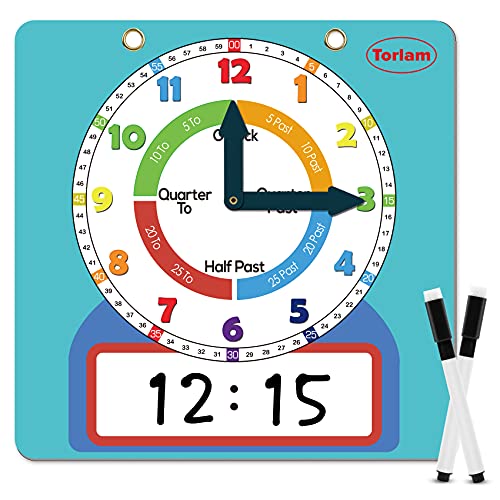 Torlam 12-Inch Magnetic Dry Erase Learning Clock |
8.6/10 | Buy |
| Best Budget |
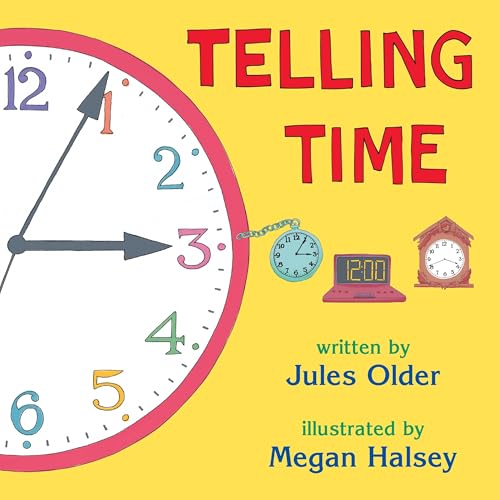 Charlesbridge Telling Time Book |
8.4/10 | Buy |
| Best Premium |
 Coogam Wooden Teaching Clock and Time Board Game |
8.4/10 | Buy |
Roymnie 8-Inch Kids Learning Wall Clock
The Roymnie 8-Inch Kids Learning Wall Clock provides a colorful, color-coded analog dial with clearly marked minutes to help young learners master time-telling fundamentals. Featuring a silent continuous-sweep movement and cordless AA battery operation, it keeps bedroom sleep environments completely free of distracting ticking noises.
Pros
- Continuous-sweep second hand movement runs silently without repetitive ticking sounds that can keep light sleepers awake
- Vibrant, multi-colored dial layout breaks down hours and minutes clearly for young learners and students
- Simple cordless installation requires only one standard AA battery, keeping walls and nightstands cable-free
- Lightweight 0.88-pound construction mounts easily on standard household drywall hooks or classroom boards
Cons
- Operates strictly as a visual timekeeping and teaching clock without an audible morning alarm buzzer
- Lacks backlighting or glow-in-the-dark numerals, requiring ambient room lighting to check the time at night
- Requires a single AA battery that is not included in the packaging
Torlam 12-Inch Magnetic Dry Erase Learning Clock
The Torlam 12-inch Magnetic Dry Erase Learning Clock is an oversized demonstration timekeeping board featuring movable hands and a write-and-wipe digital time box. It is an ideal screen-free tool for parents, educators, and young learners seeking an interactive way to master analog and digital routines.
Pros
- Generous 12x12 inch face ensures easy reading of numerals and minute tick marks from across the room
- Magnetic back and hanging rope offer versatile placement on whiteboards, refrigerators, or bedroom walls
- Dual analog-and-digital layout helps children connect traditional clock faces with digital displays
- Reusable laminated write-and-wipe surface allows endless daily schedule updates without paper waste
Cons
- Fully manual demonstration board without internal motorized movement, quartz timekeeping, or automated alarms
- Laminated cardboard construction requires careful handling to prevent bending or moisture exposure over time
- Requires manual resetting and parental interaction rather than operating as an automated wake-up clock
Charlesbridge Telling Time Book
Charlesbridge Telling Time offers a clear, illustrated guide to reading both digital displays and analog clock faces for children and parents establishing morning routines. It serves as an accessible educational foundation for young sleepers learning to navigate bedside alarm clocks independently.
Pros
- Clear educational guide covering both digital readouts and analog dials for young learners
- Zero screen glare or blue light emission, making it suitable for evening bedside reading
- Slim 9-inch square profile fits easily on nightstands and small bedroom shelves
- Lightweight design under 0.3 pounds is easy for young children to hold and read
Cons
- Educational paperback book only; does not function as an active electronic timepiece or audible alarm
- Paperback binding requires standard care to avoid bent corners or cover wear over time
Coogam Wooden Teaching Clock and Time Board Game
The Coogam Wooden Teaching Clock is a in-depth Montessori learning set designed to help children master both analog and digital time concepts through interactive play. Featuring movable wooden hands, dry-erase practice cards, and a multi-player board game, it is ideal for parents and educators introducing daily schedule and routine awareness.
Pros
- Sturdy solid wood construction delivers long-lasting durability without requiring batteries or power cords
- Effectively bridges the gap between traditional analog clock faces and digital numeric displays
- Included dry-erase flashcards allow repeated practice for handwriting and time recognition
- Lightweight and compact design makes it easy to move between study desks, play areas, and bedside tables
Cons
- Not an active electronic timepiece; does not feature an audible alarm buzzer, motor, or real-time quartz movement
- Requires active parent or teacher guidance to walk early learners through the multi-level card challenges
- Flashcards and board game accessories require careful storage to avoid losing pieces
Foundational Framework for Teaching Analog Time
Teaching a child to interpret an analog clock requires unraveling a visual system that adults often take for granted. Unlike digital screens that deliver a direct numerical readout, circular clock dials require learners to decode angles, relative hand lengths, and two distinct scales layered onto the same twelve numbers. Breaking this learning process down into clear, progressive phases prevents cognitive overload and builds genuine mathematical comprehension. When educators and parents follow an intentional sequence, children transition smoothly from recognizing broad daily rhythms to reading exact minutes with precision.
Cognitive Milestones and Necessary Prerequisites Before Starting
Children need specific foundational math concepts before they can successfully interact with the two hands of an analog timepiece. Basic numeral recognition from 1 to 12 is essential, but full mastery of the clock face also demands a secure grasp of counting up to 60. Learners who struggle with sequence counting often feel overwhelmed when transitioning from the perimeter hour digits to the minute tick marks. Introducing clock mechanics before a child understands basic numerical ordering frequently results in rote guessing rather than genuine understanding.
Skip counting by fives forms the critical bridge between the hour markers and the sixty-minute circle. A child who can confidently chant five, ten, fifteen, and twenty will decode the position of the minute hand much faster than one forced to count individual tick marks one by one. Spatial awareness also plays a significant role, particularly the concepts of halves and quarters. When children understand how to slice a round shape into halves and fourths, the linguistic phrases associated with clock reading immediately make intuitive sense.
Deconstructing the Clock Face: Anatomy of Hands and Numbers
The visual design of a standard clock dial can feel confusing because two separate pointers share a single pivot point while tracking entirely different units of time. The shorter pointer always governs the hour, while the longer pointer measures elapsed minutes. Teaching children to examine hand length before reading any numbers prevents the common error of reversing the two values. Emphasizing that the short hand moves slowly across large hour blocks while the long hand travels rapidly around the full perimeter reinforces their distinct operational roles.
Clockwise rotation represents another core concept that requires deliberate demonstration. Children must learn that numbers advance in a fixed circular direction from right to left across the bottom and upward along the left side. Using a dedicated educational dial such as the Roymnie Wall Clock for Kids Learning Battery helps significantly because its 8-inch face features distinct colors for each hour section and explicitly labels the minute tick marks. The extended minute pointer on this model reaches directly to the perimeter increments, removing visual ambiguity during early practice sessions.
Step One: Mastering the Hour Hand and Exact Hourly Increments
Instruction should always begin strictly with the hour hand while completely setting aside minute calculations. When introducing the dial, position the minute pointer straight up at the 12 position and explain that this orientation signifies a brand new hour, traditionally spoken as o’clock. Move the short pointer from one numeral to the next, prompting the student to state each new hour aloud. Keeping the minute pointer anchored at the top eliminates distractions and allows the child to focus entirely on how the short pointer indicates the primary time block.
Connecting these hourly milestones to familiar real-world routines solidifies the practical value of time-telling. Asking a child what happens at eight o’clock in the morning, twelve o’clock noon, or seven o’clock in the evening attaches physical meaning to positions on the dial. Children remember hand orientations far better when they associate them with breakfast, recess, or bedtime. Repeating these check-ins across multiple days establishes an intuitive framework of the entire twenty-four-hour day.
Step Two: Introducing Half Past and Understanding Rotational Progression
Moving the minute hand halfway around the dial down to the 6 position introduces the concept of thirty minutes past the hour. Visualizing the circle split vertically down the middle helps learners grasp why this position is called half past. At this stage, show how the long pointer has traversed thirty of the sixty individual minutes that constitute a complete hour cycle. Reinforce that thirty minutes always corresponds to the downward-pointing minute hand resting directly on the six.
The primary stumbling block for most learners during this phase involves the shifting position of the hour hand. When the minute pointer rests on the 6, the hour pointer sits squarely halfway between two numerals rather than pointing directly at one. Novice learners often mistake this intermediate position and name the upcoming number prematurely. Teachers must guide children to look backward along the clockwise path to identify which hour number the pointer has most recently passed.
Step Three: Skip Counting by Fives and Decoding the Minute Track
Once hourly and half-hourly increments are secure, expand the minute vocabulary by mapping five-minute intervals across all twelve dial numerals. Guide the student to touch each large numeral while skip counting aloud: one represents five minutes, two represents ten, three represents fifteen, and four represents twenty. Repeating this exercise clockwise around the entire dial reveals that the numeral twelve completes the full sixty-minute cycle. Connecting each dial number directly to its five-minute equivalent unlocks the core functional code of analog timekeeping.
Individual tick marks between the five-minute numbers should be addressed after the student masters skip counting. Demonstrate that the small single lines represent single elapsed minutes, allowing one to read times like twenty-three or forty-seven. Teach the student to find the nearest preceding five-minute marker first, and then count forward by ones to reach the exact position of the minute hand. This two-step strategy prevents children from counting dozens of tiny marks from the top of the clock, dramatically improving reading efficiency.
Step Four: Quarter Hours and Everyday Conversational Terminology
Conversational time-telling relies heavily on fractional terminology that can baffle children raised primarily on digital displays. Dividing the circular clock face into four equal quadrants establishes a visual foundation for phrases like quarter past and quarter to. When the minute hand points horizontally to the 3, it has completed one-fourth of its total hourly journey, representing fifteen minutes. Similarly, when the minute pointer reaches the 9, three-fourths of the hour has passed, leaving only fifteen minutes before the next hour arrives.
The phrase quarter to presents a particular linguistic challenge because it refers forward to the approaching hour rather than backward to the current one. Saying quarter to four means the time is numerically 3:45, a concept that often causes young minds to misread the hour hand. Illustrate this distinction clearly by drawing attention to the remaining empty wedge between the nine and the twelve. Showing that the clock is literally fifteen minutes away from the next hour helps reconcile conversational English with numerical reality.
Bridging the Analog Dial and Digital Readouts
Most modern children encounter digital numbers long before they interact with mechanical clock hands on a wall. Connecting the circular dial to a two-part digital format helps synthesize their understanding of hours and minutes. A dry-erase demonstration tool like the Large Magnetic Dry Erase Learning Clock for Kids proves remarkably effective for this dual-format instruction. Measuring twelve inches across, its laminated write-and-wipe surface allows students to move physical plastic hands and write the matching digital time directly beneath the analog face.
Coordinating the visual dial with write-and-wipe exercises demystifies the colon separator used in digital time displays. Children quickly learn that the number before the colon corresponds directly to the short hour hand, while the digits following the colon represent the minute count. Transitioning from dedicated demonstration boards to everyday bedroom timekeeping clocks encourages learners to cross-reference analog pointers against digital bedside numbers. This side-by-side comparison eliminates cognitive friction and confirms their real-world reading accuracy.
Multisensory and Game-Based Learning Strategies
Rote drills and repetitive worksheets can quickly drain a child’s enthusiasm for learning to tell time. Incorporating tactile, game-based learning tools transforms abstract math lessons into engaging, hands-on play. A versatile manipulative like the Coogam Wooden Clock Teaching Time Toy exemplifies this approach by combining a solid wooden clock with an interactive board game for multiple players. The included double-sided dry-erase flashcards feature three distinct difficulty tiers, allowing parents to tailor challenges to the child’s exact learning stage.
Pairing tactile toys with educational literature provides valuable narrative context for young readers. Informative books like Telling Time: How to Tell Time on Digital and Analog Clocks from Charlesbridge illustrate everyday scheduling scenarios through engaging storytelling and colorful diagrams. Reading about relatable characters managing their school days, sports practices, and bedtimes reinforces why reading a clock matters in daily life. Combining interactive story sessions with hands-on manipulative practice creates a rich, multisensory learning environment.
Common Pitfalls and How to Correct Them
One of the most frequent errors among young learners occurs when the minute hand approaches the end of an hour, such as at 2:50 or 2:55. Because the hour hand has drifted very close to the 3, children often misidentify the time as 3:50 or 3:55. Correct this mistake by reminding the child of the clock’s strict boundary rule: an hour does not change until the minute hand crosses the twelve. Having the student place a straight edge along the hour hand to verify whether it has physically crossed the numeral line helps dispel visual confusion.
Another widespread stumbling block involves reversing the functional roles of the hour and minute pointers. Children in a hurry may glance at a clock showing 12:15 and misread it as 3:00 because their eyes fixate solely on pointer positions without evaluating length. Overcome this confusion by prompting the student to physically identify the short hand first during every practice attempt. Establishing a disciplined habit of finding the hour pointer before even glancing at the minute pointer eliminates accidental reversals.
Establishing an Environment That Reinforces Daily Time-Telling
Classroom and bedroom environments should feature high-visibility analog dials situated at comfortable eye levels for children. Selecting a silent, non-ticking wall clock ensures that quiet study spaces and restful bedrooms remain free from distracting mechanical clicks. The continuous-sweep movement found in dedicated learning wall clocks provides a smooth visual flow that does not disrupt light sleepers. Placing such a timepiece directly across from a child’s bed or desk invites spontaneous, pressure-free time checks throughout the day.
Daily domestic routines offer countless organic opportunities to reinforce clock-reading skills without formal test pressure. Inquire how many minutes remain until an evening activity starts or when bedtime begins. Patience and consistent encouragement remain the most vital ingredients throughout this developmental journey. Celebrating small victories along the way keeps motivation high and ensures that every child masters analog timekeeping with lasting confidence.
About the author
Dan Caffrey is a Certified Sleep Science Coach and Certified Stress Management Coach with editorial experience covering sleep health and sleep products. He combines consumer-focused research with sleep science to explain product benefits, limitations, and suitability in clear, approachable language.