
How to Set an Alarm Clock With 3 Hands: Practical Guide for 2026
Master how to set an alarm clock with 3 hands using straightforward dial adjustments and timing calibration tips for reliable morning wakeups in November 2026.
 By Nena Farrell
Updated November 24, 2026

Nightstand screen glare and complicated smartphone menus frequently disrupt healthy evening wind-down habits. When transitioning toward a distraction-free bedroom environment, learning how to set an alarm clock with 3 hands provides a straightforward way to manage daily wake-up routines without digital clutter. Traditional timepieces rely on physical dials and dedicated mechanical controls, which eliminate midnight notifications and unexpected software updates. Selecting dependable bedside hardware from our collection of top-rated alarm clocks for bedrooms ensures clear timekeeping while keeping evening stress to a minimum.
Operating an analog dial or hybrid bedside clock requires understanding how internal gears coordinate movement across the face. A standard three-hand layout typically features an hour hand, a minute hand, and a continuous second hand, alongside a dedicated alarm indicator dial or fourth pointer. Mastering the rear adjustment dials and physical toggle switches prevents common timing errors and unexpected morning delays. Whether you favor a classic quartz movement or a contemporary digital alternative with rotary dials, mastering these mechanical controls establishes an effortless, punctual morning routine.
| Award | Product | ACR Score About ACR ScoreThe ACR Score is our own rating from 0 to 10, based on performance, design and build, ease of use, and value. It reflects independent research and is never influenced by manufacturers, retailers, or affiliate commissions. Learn more › | |
|---|---|---|---|
| Best Overall |
 Little Dog Rechargeable Bedside Alarm Clock |
9.2/10 | Buy |
| Best Budget |
 Plumeet Battery-Operated Digital Travel Alarm |
8.9/10 | Buy |
| Best Value |
 FAMICOZY 4.5-Inch Silent Analog Bedside Alarm |
8.3/10 | Buy |
 DreamSky Auto Set Digital Bedside Alarm Clock |
8.3/10 | Buy | |
| Best Premium |
 HELAOBAN Kids Alarm Clock & 60-Min Timer |
8.3/10 | Buy |
 uscce Loud Bedside Alarm Clock with Powerful Bed |
8.1/10 | Buy |
Little Dog Rechargeable Bedside Alarm Clock
The Little Dog Rechargeable Digital Alarm Clock combines high wake-up volume and dual independent alarms with an internal rechargeable battery that sounds the alarm even during blackouts. Featuring flexible weekday, weekend, and daily scheduling plus full display dimming, it is an ideal choice for heavy sleepers and nightstand minimalists.
Pros
- Built-in rechargeable battery operates both the clock memory and the active alarm during electrical outages
- Dual alarm system supports distinct schedules for Monday through Friday workdays versus weekend routines
- Adjustable display dimming allows users to set brightness low or turn the LED screen completely off at night
- Dedicated exterior buttons for DST and 12/24-hour time adjustments avoid confusing multi-button sequences
- Compact 4.64-inch size conserves valuable nightstand space and easily packs for travel
Cons
- Continuous full-brightness display on battery power alone lasts approximately 48 hours before needing a recharge
- Display brightness settings operate differently on cordless battery power compared to continuous plug-in power
- Initial programming may require reviewing the quick operation guide or video instructions to learn button functions
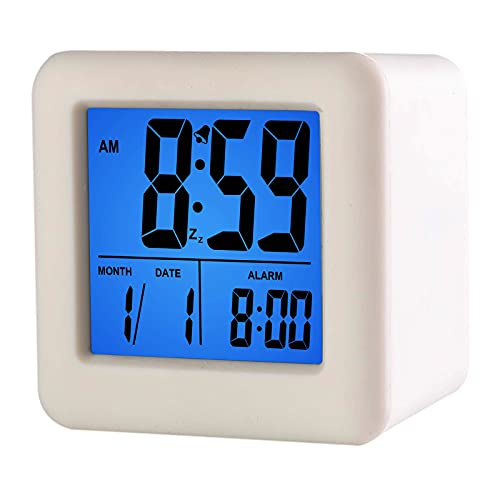
Plumeet Battery-Operated Digital Travel Alarm
The Plumeet Digital Travel Alarm Clock is a compact, battery-powered bedside clock featuring a bold 3-inch LCD screen, ascending beep alarm, and a shock-absorbing silicone sleeve. It is an ideal pick for students, frequent travelers, or anyone seeking simple, cord-free timekeeping without smartphone distractions.
Pros
- Protective silicone casing helps guard against accidental drops from nightstands or luggage handling
- Cordless battery operation eliminates messy cables and keeps the alarm running during household power outages
- Clear 3-inch LCD readout displays the time, calendar date, and active alarm setting at a single glance
- Progressive crescendo beep starts softly and gradually increases over 60 seconds to wake sleepers reliably
- Large top-mounted snooze button is easy to hit while half-awake for a 5-minute rest interval
Cons
- Requires 2 AA batteries that are not included in the package
- Lacks an AC adapter or USB power option for continuous corded bedside operation
- Snooze duration is fixed at 5 minutes with no programmable interval adjustments
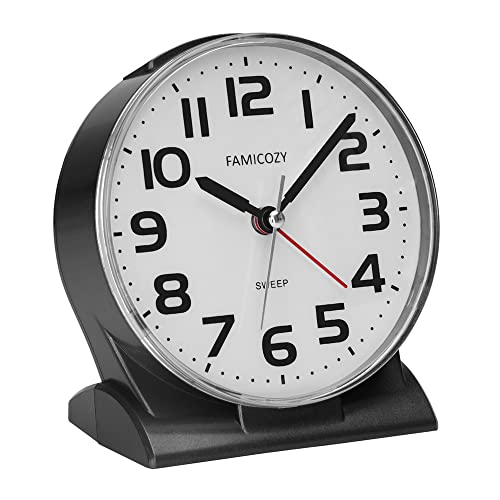
FAMICOZY 4.5-Inch Silent Analog Bedside Alarm
The FAMICOZY 4.5-inch analog bedside alarm clock features a silent sweep second hand, high-contrast bold numerals, and a gentle crescendo wake-up alarm powered by two AA batteries. It is an ideal, hassle-free bedside timepiece for seniors, light sleepers, and digital detoxers seeking simple knob-based controls without glowing screen glare or confusing menus.
Pros
- Silent sweep second hand eliminates repetitive ticking noises that disturb light-sensitive sleepers
- Large, high-contrast numerals and an angled face ensure clear visibility for seniors and visually impaired users
- Simple physical interface with rear adjustment knobs and a distinct side on-off toggle requires no digital programming
- Top-mounted dual snooze and soft backlight button activates an eye-friendly 5-second illumination in pitch darkness
- Cordless design runs on standard AA batteries, making nightstand placement clean and independent of wall outlets
Cons
- Requires manual time and alarm setting via rear knobs without automatic network or atomic synchronization
- Dial illumination is strictly on-demand for five seconds and does not provide continuous nighttime visibility
- Runs exclusively on two AA batteries that are not included in the package
DreamSky Auto Set Digital Bedside Alarm Clock
The DreamSky Auto Set Digital Alarm Clock is a compact bedside timepiece featuring a 4.3-inch LCD with blue digits, indoor temperature, calendar readouts, and stepless 0-100% dimming. It is an ideal pick for anyone seeking hassle-free automatic time setup, ascending beeps, and nightstand USB device charging without clutter.
Pros
- Pre-programmed auto-time feature configures proper time immediately upon plugging in across four major U.S. time zones.
- Full-range 0% to 100% dimmer dial enables fine-tuned brightness adjustment to accommodate light-sensitive bedrooms.
- Secondary pass-through USB port lets you charge a mobile phone without taking up an extra wall outlet.
- Gentle ascending beeper ramps up gradually instead of blasting high volume instantly.
- Included cell button battery saves your time and alarm settings during unexpected power outages.
Cons
- Button cell backup maintains memory only and will not illuminate the screen or sound the alarm during a power outage.
- Blue digit wavelength on an LCD screen may not suit sleepers who prefer warm amber or red display tones.
- Lacks dual-alarm programming or weekday-versus-weekend custom scheduling options.
HELAOBAN Kids Alarm Clock & 60-Min Timer
Combining a silent analog clock with a 60-minute visual countdown timer, this dual-display device helps children grasp time management concepts with ease. Its straightforward, tick-free operation makes it especially practical for study spaces, bedrooms, or kids needing visual task pacing.
Pros
- Dual display combines analog clock and countdown timer
- Silent, non-ticking movement for quiet spaces
- Accessible layout supports visual learners and ADHD routines
- Lightweight cordless build fits easily on small desks
Cons
- Requires two AA batteries that are not included
- No rechargeable battery or AC power adapter option
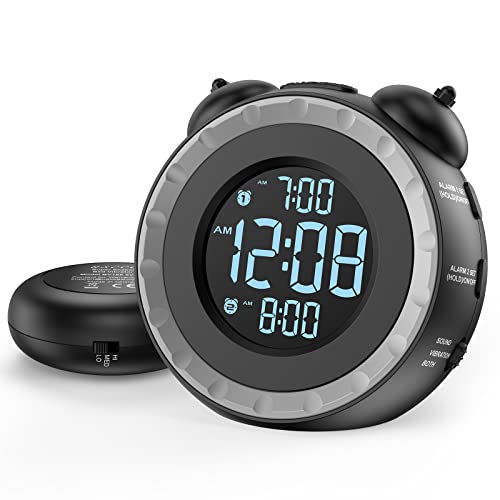
uscce Loud Bedside Alarm Clock with Powerful Bed
The uscce Dual Alarm Clock pairs a customizable 3-level vibrating bed shaker with versatile wake-up tones and a 0-100% brightness dial, making it a reliable, compact bedside choice for heavy sleepers, couples, and the hearing-impaired.
Pros
- External 3-level bed shaker provides a strong tactile alternative or supplement to audible alarms
- Stepless 0 to 100% rotary dimmer allows precise brightness control down to complete display shut-off
- Dual rotary ear knobs make adjusting clock and alarm times intuitive right out of the box
- Battery backup sounds the audible alarm and retains internal settings during AC power interruptions
- Integrated USB port charges mobile devices directly from the clock to save wall outlet space
Cons
- Vibrating bed shaker puck and USB charging port do not operate when running solely on AAA backup battery power
- Requires two AAA backup batteries that are not included in the standard retail package
- Lacks dedicated weekday-only or weekend-only programming modes, requiring manual toggling on days off

Guide to Setting Three-Hand Alarm Clocks and Bedside Dials
Setting a traditional analog alarm clock requires understanding mechanical relationships that differ significantly from modern digital screens. While a digital device uses software buttons and electronic menus, an analog clock relies on physical gears, rotary knobs, and moving hands to trigger an internal microswitch. Knowing how to set an alarm clock with 3 hands allows you to configure your wake-up schedule accurately without dealing with confusing submenus. This guide explains how to identify each hand, synchronize timekeeping, calibrate alarm accuracy, and evaluate modern bedside alternatives.
Identifying the Hands and Indicators on Bedside Dials
A classic three-hand timepiece features an hour hand, a minute hand, and a continuous second hand sweeping across a numbered dial face. The hour hand is the shortest and thickest pointer, rotating around the twelve-hour perimeter twice every twenty-four hours. The minute hand is noticeably longer, extending toward the outer track of minute index markers to display individual minute increments. The third hand is a slender second hand that moves continuously around the dial, powered by an internal quartz oscillator.
Many users searching for three-hand clock instructions are puzzled by how the alarm itself is targeted without a fourth pointer. On some traditional three-hand models, the alarm time is set using an internal rotating dial disc or an auxiliary indicator window embedded behind the clock face. On other analog models, such as the FAMICOZY 4.5-inch silent clock, the layout actually includes a distinct fourth indicator hand specifically painted or shaped to mark the alarm target. Distinguishing between the primary timekeeping hands and the alarm indicator prevents accidentally altering your wake-up time when you simply intended to set the hour.
Step-by-Step Procedure for Setting the Current Time
Setting the current time on an analog bedside clock begins with inspecting the rear panel for the designated time control knob. Most quartz alarm clocks feature two rotary knobs on the back housing, usually marked with a clock icon or labeled with the word time. Before making any manual adjustments, insert fresh alkaline batteries into the battery bay, paying strict attention to the molded polarity markings. Using fresh cells ensures that the quartz stepping motor receives consistent operational voltage from the very start.
Once the battery is secured and the movement begins running, gently turn the time knob to position the hour and minute hands. Clockmakers strongly recommend rotating this knob clockwise so the hands advance forward through natural gear alignment. Turning the hands backward against gear teeth can introduce mechanical backlash or loosen the friction fit of the minute hand over time. Continue advancing the hands until the minute pointer precisely matches the current minute index mark of an accurate reference clock.
After aligning the hands to the correct time, observe the second hand for thirty seconds to ensure uninterrupted movement. A steady, unhindered motion confirms that the internal quartz crystal is oscillating properly and that the mechanical gear train is clear of obstructions. If the hands hesitate or stop moving, remove the battery and verify that the contact terminals are clean and making tight physical contact. Establishing accurate baseline timekeeping is essential before you attempt to calibrate the alarm triggering point.
Calibrating the Alarm Hand and Setting the Wake-Up Time
Adjusting the alarm mechanism requires locating the second rear knob, typically identified by an alarm bell icon or a dedicated label. This knob directly drives the alarm indicator hand, which moves independently from the main timekeeping gear train. Unlike standard digital alarms where you type exact numbers into a software field, an analog alarm relies on positioning this physical pointer over the desired hour on the dial. Gently rotate the alarm knob in the direction indicated by the directional arrow embossed on the plastic housing.
When aligning the alarm hand with your target wake-up time, observe the exact direction of rotation specified by the manufacturer. Most analog movements require turning the alarm knob counterclockwise or in a single designated direction to avoid jamming the mechanical trigger lever. As the pointer approaches your desired wake-up hour, slow down your rotation to position the tip precisely over the appropriate minute graduation. Because standard analog dials cover twelve hours across a relatively small diameter, estimating precise single-minute increments requires careful visual alignment.
For example, setting an alarm for 6:30 requires positioning the alarm pointer exactly halfway between the 6 and 7 hour markers. If you need a wake-up call at 6:15, the pointer should rest approximately one-quarter of the distance between the two markers. Due to mechanical clearances in mass-produced quartz movements, the physical trigger switch inside the clock may close a few minutes early or late relative to the dial face. Learning the specific offset of your timepiece through practical observation allows you to compensate accurately when positioning the pointer.
Engaging and Disarming the Physical Alarm Switch
Positioning the alarm hand does not arm the sounder until you activate the physical alarm switch located on the exterior housing. On well-designed bedside models like the FAMICOZY analog clock, this control takes the form of an oversized sliding toggle on the side or top panel. Moving this toggle to the on position connects the internal buzzer circuit, enabling the electrical contacts that close when the hour hand aligns with the alarm pointer. A clearly visible red or white color indicator on the switch helps you confirm the armed status at a quick glance before bed.
Understanding the mechanical nature of the twelve-hour dial is critical for preventing unexpected midday alarms. Because an analog clock face repeats its cycle every twelve hours without distinguishing between AM and PM, an armed alarm will trigger twice every twenty-four hours if left active. If you set your clock for 7:00 AM and leave the physical switch in the on position, the alarm will ring again at 7:00 PM while you are eating dinner. Developing the habit of sliding the switch to the off position immediately upon waking prevents annoying evening interruptions.
When morning arrives and the buzzer sounds, disarming the clock requires simply sliding the physical toggle to the off position. Alternatively, many analog clocks include a top-mounted snooze button that temporarily interrupts the buzzer for five minutes without disarming the main switch. If you rely on the snooze bar, remember that the alarm will continue re-triggering at regular intervals until the master toggle switch is moved to the off position. This straightforward physical interface provides tactile certainty that touchscreens and complex button menus rarely match.
Silent Quartz Sweep Movements Versus Traditional Stepping Motors
Traditional analog bedside clocks were notorious for emitting an audible ticking sound as an internal stepping motor pulsed every single second. For light sleepers, this repetitive mechanical click can create significant auditory distraction, interfering with sleep onset and nocturnal sleep continuity. Modern bedroom quartz designs have resolved this issue by adopting silent sweep movements that drive the second hand in a smooth, continuous glide. Models such as the FAMICOZY 4.5-inch clock utilize continuous gear motion to deliver accurate timekeeping without bedside noise.
Eliminating mechanical clicking sounds transforms the bedroom into a restful sanctuary suited for deep, restorative sleep. Sleep hygiene research consistently highlights that continuous ambient quiet promotes faster sleep transitions and fewer spontaneous awakenings throughout the night. A silent sweep movement operates without clicking while maintaining the classic visual charm of moving clock hands on a bedside table. This silent operation makes analog quartz clocks particularly well-suited for bedrooms, nurseries, private study areas, and minimalist nightstands.
In addition to acoustic quietness, silent sweep quartz movements consume minimal electrical energy from standard alkaline batteries. A single standard AA or AAA battery often powers a continuous sweep movement for six to twelve months of daily use without interruption. The lack of electronic display backlights, wireless connectivity radios, and processor overhead makes these mechanical timepieces exceptionally energy-efficient. Replacing the primary cell once a year provides dependable, silent timekeeping without adding cords or power adapters to your nightstand.
Verifying Trigger Accuracy with a Practical Test Run
Because physical gear trains carry minor mechanical tolerances, conducting a test run before relying on your clock for an important morning is essential. To perform this test, set the alarm pointer to a specific reference point, such as exactly 12:00. Next, arm the physical alarm switch by sliding the toggle to the on position. Using the time adjustment knob on the rear panel, slowly rotate the hour and minute hands clockwise toward 12:00 while listening carefully for the acoustic buzzer.

Note the exact position of the minute hand when the buzzer begins sounding to determine your clock’s unique mechanical variance. If the buzzer trips when the minute hand is at 11:55, your clock triggers five minutes early relative to the painted dial markers. If the alarm sounds when the minute hand reaches 12:05, the internal contact switch is set five minutes slow. This variance is entirely normal in consumer quartz movements and results from tiny gaps between gear teeth known as mechanical backlash.
Once you know the specific trigger offset of your clock, you can compensate easily whenever you set your morning wake-up schedule. If your clock consistently trips five minutes early, simply position the alarm pointer five minutes past your intended wake-up time to achieve perfect synchronization. Conducting this dry run takes less than two minutes and eliminates the uncertainty often associated with analog alarm pointers. It also confirms that the battery possesses sufficient voltage to drive the buzzer at full acoustic volume.
Common Mechanical Setup Errors and Gear Preservation
The most common mistake users make when operating a three-hand alarm clock is forcing the adjustment knobs in the wrong direction. Quartz clock movements utilize delicate plastic gears that mesh tightly to transmit motion between the stepping motor, hands, and alarm trigger cams. Rotating the alarm setting knob in the reverse direction can bend the internal contact arms or strip gear teeth, causing the pointer to slip. Always follow the directional indicators molded on the back panel to maintain smooth mechanical operation for years.
Another frequent error involves using heavy-duty zinc-carbon cells instead of high-capacity alkaline batteries in bedside clocks. As zinc-carbon batteries discharge, their output voltage drops precipitously, which can cause the quartz crystal circuit to lose timing accuracy. Low operating voltage can also cause the second hand to stall or prevent the alarm buzzer from generating sufficient acoustic pressure to wake deep sleepers. Using fresh, name-brand alkaline batteries ensures stable voltage delivery and prevents internal battery leakage that could corrode the electrical terminals.
Users also occasionally press too hard on the clock face or adjust the hands directly using their fingers. Touching the hands through the dial opening can bend the thin aluminum pointers, causing them to collide with each other as they rotate. If the hour hand catches on the minute hand or the alarm pointer, the entire movement will seize, causing the clock to stop completely. Always use the rear adjustment knobs to position the hands, and ensure the protective glass or acrylic lens remains securely fastened over the dial.
Visual Timers and Multi-Display Clocks for Household Schedules
While traditional three-hand clocks excel at simple morning wakeups, households with young children often benefit from hybrid designs that pair analog dials with visual countdown tools. The HELAOBAN 3-in-1 clock illustrates this approach by featuring a standard silent analog clock face on one side and a sixty-minute visual timer on the other. This dual-display arrangement helps children connect the abstract concept of moving clock hands with concrete time management during study sessions or morning preparation.
Visual timers represent time as an expanding colored disc that gradually shrinks as minutes elapse, making elapsed time immediately apparent even to young kids. Combining a mechanical clock face with a visual countdown timer bridges the gap between learning to read three-hand dials and developing independent daily routines. If you want to help young learners associate specific times with morning routines, our guide to visual ok-to-wake alarm clocks outlines color-based sleep training tools that complement standard clock faces.
For adults, having a dedicated physical countdown timer alongside an analog bedside clock provides a practical tool for structured productivity routines. Because both functions operate silently without digital screens or smartphone notifications, they maintain an atmosphere free from electronic interruptions. Placing a dual-display unit on a desk or nightstand supports structured time management while preserving the calm, focused aesthetic of an analog dial.
Comparing Three-Hand Analog Dials to Modern Digital Bedside Clocks
Deciding whether to use a three-hand analog clock or a modern digital bedside clock depends largely on your personal sleep habits and scheduling requirements. Analog clocks offer unmatched simplicity, zero blue light emissions, and complete freedom from distracting digital interfaces. With no screen backlights illuminating the bedroom, a basic quartz clock creates a pitch-black sleeping environment that naturally supports melatonin production. However, analog clocks lack modern conveniences such as automated Daylight Saving Time adjustment, multi-day scheduling, and customizable digital alarms.
Modern digital clocks, such as the DreamSky auto-setting clock or the Little Dog rechargeable model, address these limitations with sophisticated feature sets. Digital units frequently incorporate large blue or white LED numbers, calendar displays, indoor temperature sensors, and dual alarms that allow separate schedules for weekdays and weekends. Furthermore, digital clocks often include full-range stepless dimmers that adjust from zero to one hundred percent, allowing sleepers to dial out screen glare while enjoying exact minute-to-minute alarm programming.
The choice often comes down to whether you prioritize mechanical minimalism or advanced electronic versatility. If you simply need a dependable, distraction-free morning reminder that operates without a wall cord, a silent three-hand analog clock is hard to beat. If your lifestyle demands separate wake-up schedules for partners, automatic time synchronization, or multi-tone wake-up options, a modern digital bedside clock provides the necessary programming flexibility.
Outage Resilience and Power Architectures Across Bedside Devices
Power reliability is a critical consideration when choosing any bedside timekeeping device. Traditional three-hand analog alarm clocks enjoy a distinct advantage here because they operate entirely on self-contained AA or AAA alkaline batteries. Because they do not rely on household AC mains power, an analog clock will continue keeping accurate time and sounding its morning alarm even during severe overnight power outages. This inherent resilience provides peace of mind in areas prone to stormy weather and utility brownouts.
Digital bedside clocks handle power outages through various electrical architectures that buyers should evaluate carefully. Some digital clocks, like the DreamSky model, use cell button batteries strictly for memory backup, which preserves time and settings during an outage but will not illuminate the display or sound the buzzer. Other contemporary designs, like the Little Dog rechargeable clock, feature built-in rechargeable batteries that actively sound the alarm and light the display during grid interruptions. For sleepers who prefer powering mobile devices overnight while maintaining a clutter-free nightstand, exploring bedside alarm clocks with integrated chargers provides insight into inductive charging pads and output ports.
Understanding the distinction between active operational battery backup and passive memory retention prevents oversleeping during unexpected residential blackouts. If your digital clock only offers memory retention, a midnight power failure will leave your alarm completely silent when morning arrives. For critical wake-up schedules, keeping a primary battery-powered analog clock on your nightstand or selecting a digital model with full operational battery support ensures you wake up on time regardless of grid stability.
Acoustic Crescendo Profiles and Bed-Shaker Options for Deep Sleepers
How an alarm clock wakes you up has a profound impact on your morning mood and cardiovascular response. Traditional analog clocks and compact travel models often feature progressive crescendo alarms that begin with gentle, quiet beeps before gradually escalating in volume. Models like the Plumeet digital travel clock and the FAMICOZY analog clock use this ascending acoustic profile to ease sleepers out of deep sleep without triggering an abrupt adrenaline surge. A gradual wake-up minimizes sleep inertia, helping you feel more alert and composed as you start your day.
For deep sleepers, teenagers, and individuals with hearing impairments, a standard acoustic chime or gentle analog buzzer may prove insufficient. In these situations, specialized digital sleep electronics offer powerful awakening alternatives that go far beyond standard sounders. The uscce dual alarm clock, for example, pairs an extra-loud buzzer with a three-level adjustable vibrating bed-shaker puck that slides under your pillow or mattress. The physical tactile vibration cuts through deep sleep cycles without requiring ear-splitting decibel levels that might disturb neighboring bedrooms.
Combining acoustic choices with tactile alerts allows households to tailor their wake-up environments to individual physical needs. While a classic three-hand dial is ideal for light to moderate sleepers seeking quiet minimalism, heavy sleepers often require the penetrating physical stimulation of a bed shaker or multi-decibel digital siren. Evaluating your individual arousal threshold ensures that your bedside equipment delivers dependable awakening without unnecessary morning stress.
Mastering the mechanical operation of a three-hand alarm clock empowers you to build a reliable, screen-free morning routine. By identifying the unique functions of the hour, minute, and alarm hands, rotating adjustment knobs in the proper direction, and verifying trigger accuracy with a simple test run, you eliminate guesswork from your wake-up schedule. Whether you embrace the quiet simplicity of a silent sweep analog dial or transition toward a feature-rich digital bedside clock, matching your device to your specific sleep habits ensures you wake up refreshed and on time every morning.
About the author
Nena Farrell is a product writer and reviewer specializing in sleep products, sunrise alarm clocks, smart-home technology, and everyday household devices. Her hands-on approach focuses on real-world usability, practical features, and how products fit naturally into daily routines.