
How to Set a Wind up Alarm Clock: Step-by-Step Guide for 2026
Master how to set a wind up alarm clock with clear instructions for October 2026. Discover key winding habits, alarm alignment, and regulation tips.
 By Nena Farrell
Updated October 6, 2026
By Nena Farrell
Updated October 6, 2026

Nightstand screens and persistent smartphone alerts frequently disrupt restorative sleep, prompting many sleepers to turn to traditional mechanical timepieces for an evening digital detox. Learning how to set a wind up alarm clock offers complete independence from electrical grid outages, dead lithium batteries, and middle-of-the-night mobile updates. A classic spring-driven movement provides tactile operation alongside an unmistakable acoustic chime or mechanical bell that rouses deep sleepers without blue-light screen glare. Finding dependable models among modern reliable bedside alarm clocks allows you to maintain a punctual morning schedule while keeping the bedroom completely dark.
Operating a mechanical timepiece requires understanding the separate controls situated on the rear casing, including distinct keys for timekeeping and alarm springs. Proper handling prevents accidental overwinding while ensuring the internal escapement runs smoothly throughout the night. Whether you rely on an analog clock with luminescent dial markings or contrast it with modern electronic options, dial calibration remains straightforward once you identify the adjustment knobs. This guide details every mechanical step, from turning the setting knobs in the correct direction to fine-tuning movement accuracy for consistent daily timekeeping.
| Award | Product | ACR Score About ACR ScoreThe ACR Score is our own rating from 0 to 10, based on performance, design and build, ease of use, and value. It reflects independent research and is never influenced by manufacturers, retailers, or affiliate commissions. Learn more › | |
|---|---|---|---|
| Best Overall |
MARATHON Mechanical Wind-Up Alarm Clock
|
9.2/10 | Buy |
| Best Budget |
 Equity by La Crosse 14075 Analog Wind-Up Alarm
|
8.9/10 | Buy |
 Equity by La Crosse 24014 Loud Bell Analog Alarm
|
8.9/10 | Buy | |
| Best Value |
 KEYPOWER Small Mechanical Wind-Up Twin Bell Alarm
|
8.9/10 | Buy |
 whcusmm Vintage Wind-Up Twin Bell Alarm Clock
|
8.8/10 | Buy | |
| Best Premium |
 uscce Loud Bedside Alarm Clock with Powerful Bed
|
8.1/10 | Buy |
MARATHON Mechanical Wind-Up Alarm Clock
The Marathon Mechanical Wind-Up Alarm Clock delivers dependable morning wake-ups using a loud progressive interval ring and a high-contrast analog dial with 12- and 24-hour markings. Requiring no batteries or electricity, it is an excellent zero-glare bedside choice for digital detoxers, heavy sleepers, and emergency outage kits.
Pros
- Zero reliance on batteries or electrical outlets ensures waking reliability even during severe storms or blackouts
- Loud progressive interval ring provides an assertive wake-up without electronic audio distortion
- Integrated accuracy adjuster switch enables straightforward calibration if time drifts
- Dual 12- and 24-hour dial markings are legible and simple to interpret
- Luminescent hand accents offer low-light readability without casting an ambient room glow
Cons
- Requires routine manual winding to keep the clock movement and alarm mechanism active
- Mechanical clockwork produces an audible ticking sound that may bother noise-sensitive sleepers
- Luminescent hands require light exposure to charge and lack an electric on-demand backlight
Equity by La Crosse 14075 Analog Wind-Up Alarm
The Equity by La Crosse 14075 is a classic 3.65-inch analog wind-up alarm clock featuring a loud wake-up alarm and luminous dial markings that require zero batteries or electricity. It offers dependable bedside timekeeping and emergency power-outage reliability for heavy sleepers, minimalist bedrooms, and digital detoxers.
Pros
- Requires zero batteries or electrical wall outlets, providing dependable operation during overnight power outages.
- Loud alarm sound helps ensure deep and heavy sleepers wake up promptly.
- Luminous hands and markings allow time-telling in dark rooms without casting ambient electric light across the bedroom.
- Lightweight, compact 4 x 2 x 4.25-inch build fits easily on small bedside tables or travel bags.
Cons
- Runs up to 30 hours per wind, requiring routine daily winding to maintain accurate time.
- Lacks electronic digital features like customizable snooze intervals, dual alarm schedules, or USB charging ports.
- Luminous markings rely on ambient light exposure to charge and do not provide an active electric backlight.
Equity by La Crosse 24014 Loud Bell Analog Alarm
The Equity by La Crosse 24014 is a compact analog alarm clock featuring a loud bell wake-up mechanism, luminous hands, and a polished silver metal finish. It is ideal for heavy sleepers, students, and digital detoxers seeking simple, cord-free bedside timekeeping without distracting digital screens.
Pros
- Loud physical bell alarm provides an assertive wake-up call for heavy and deep sleepers
- Luminous hands offer nighttime visibility without emitting continuous ambient glow or blue light into dark bedrooms
- Protective base pad shields nightstand surfaces from scratches and scuffs
- Durable build combining a polished silver metal chrome case with a clear dome glass lens
- Compact 4.5 x 2.5 x 5.5 inch profile takes up minimal space on crowded nightstands
Cons
- Analog design lacks programmable multi-stage snooze intervals and weekday/weekend scheduling found on digital clocks
- Luminous hands require ambient light exposure during the day to glow and lack an on-demand electric backlight
- Physical bell alarm volume is fixed and cannot be adjusted down for sleepers who prefer gentle wake-up tones
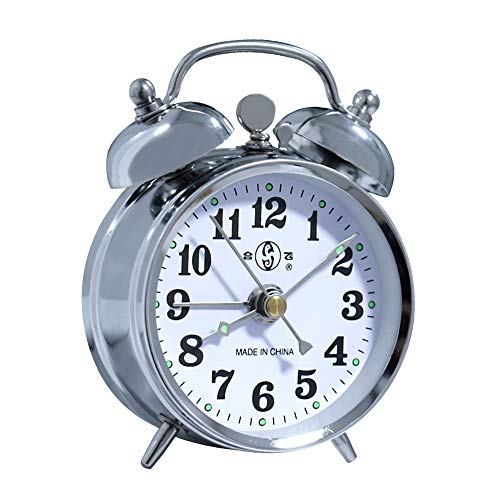
KEYPOWER Small Mechanical Wind-Up Twin Bell Alarm
The KEYPOWER mechanical wind-up alarm clock delivers a completely battery-free wake-up solution featuring physical twin bells and glow-in-the-dark hands. It is an ideal bedside choice for heavy sleepers, minimalists, and digital detoxers who want a loud, reliable ring without nightstand cords or screen glare.
Pros
- 100% mechanical wind-up design eliminates the need for batteries, power adapters, or charging cables
- Physical twin-bell ringing mechanism produces a loud, unmistakable acoustic chime to wake deep sleepers
- Glow-in-the-dark hands and hour markers provide nighttime reading without casting disruptive electronic glow
- Compact 4-inch frame takes up minimal nightstand real estate and packs easily for travel
- Classic silver aesthetic complements vintage, minimalist, and traditional bedroom decor
Cons
- Requires regular manual winding to prevent the clockwork movement from stopping
- Lacks electronic convenience features such as an automatic snooze timer, dual schedules, or adjustable volume
- Traditional mechanical escapement produces an audible ticking sound that may bother light sleepers in quiet rooms
whcusmm Vintage Wind-Up Twin Bell Alarm Clock
The whcusmm Vintage Wind-Up Alarm Clock is a battery-free mechanical twin bell timepiece featuring a durable gold metal build and a piercing acoustic ringer. It is an ideal bedside choice for heavy sleepers, vintage enthusiasts, and digital detoxers who want dependable wake-ups without electronic screens or power cords.
Pros
- Operates completely cord-free and battery-free via a traditional manual wind-up spring.
- Physical twin bell acoustic chime delivers a piercing ring suitable for deep sleepers.
- Sturdy solid metal construction with an elegant polished gold finish.
- Produces zero ambient light pollution or blue-light glare in dark bedrooms.
- Compact 2.76-inch square footprint fits virtually any nightstand or desk space.
Cons
- Requires regular manual winding to maintain accurate timekeeping and alarm operation.
- Mechanical gear movement produces an audible ticking sound that may bother light sleepers.
- Lacks modern digital conveniences such as electronic snooze, dual alarms, or customizable tones.
uscce Loud Bedside Alarm Clock with Powerful Bed
The uscce Dual Alarm Clock pairs a customizable 3-level vibrating bed shaker with versatile wake-up tones and a 0-100% brightness dial, making it a reliable, compact bedside choice for heavy sleepers, couples, and the hearing-impaired.
Pros
- External 3-level bed shaker provides a strong tactile alternative or supplement to audible alarms
- Stepless 0 to 100% rotary dimmer allows precise brightness control down to complete display shut-off
- Dual rotary ear knobs make adjusting clock and alarm times intuitive right out of the box
- Battery backup sounds the audible alarm and retains internal settings during AC power interruptions
- Integrated USB port charges mobile devices directly from the clock to save wall outlet space
Cons
- Vibrating bed shaker puck and USB charging port do not operate when running solely on AAA backup battery power
- Requires two AAA backup batteries that are not included in the standard retail package
- Lacks dedicated weekday-only or weekend-only programming modes, requiring manual toggling on days off
Complete Guide to Operating, Calibrating, and Maintaining a Wind-Up Alarm Clock
Setting up a mechanical timepiece requires an understanding of purely physical components working in harmony. Unlike digital circuits that rely on microprocessors and quartz crystals, a mechanical clock translates stored kinetic energy from coiled mainsprings into precise gear movements. Mastering this process ensures punctual mornings while protecting delicate internal brass gears from premature wear. Taking a methodical approach to setting the time, arming the chime, and winding the movement establishes a dependable bedside routine.
Anatomy of the Rear Housing: Identifying Arbors, Keys, and Knobs
Inspecting the rear plate reveals a distinct layout of mechanical controls that differ substantially from electronic pushbuttons. Most traditional twin bell and compact analog timepieces feature two winding keys and two rotary setting knobs. The central key controls the timekeeping mainspring, while the offset key powers the separate acoustic hammer mechanism. Setting knobs are typically smaller, textured brass or molded plastic posts designed for gentle fingertip adjustment.
Distinguishing between the time winding key and the alarm winding key is essential before applying torque. Manufacturers often stamp intuitive symbols or lettering near each arbor, indicating which spring drives the gear train. The time key connects directly to the barrel containing the primary movement spring, which governs hour and minute hand advancement. The secondary key tensions a dedicated spring that drives the clapper against the external twin bells or internal metal chime box.
In addition to the winding keys, you will observe an alarm shutoff lever and a speed regulation switch. The alarm shutoff control appears either as a sliding toggle on the rear casing or a top-mounted push rod positioned between exterior bells. A small recessed slot marked with positive and negative symbols houses the regulating lever for daily calibration. Understanding these specific components prevents accidental strain on the internal balance wheel and hairspring assembly.
Step-by-Step Procedure for Setting the Current Time
Setting the correct time begins by locating the time-adjustment knob positioned near the center of the rear casing. Grasp the small knurled knob firmly between your thumb and index finger without pulling outward on the arbor. Rotate the knob so the hands on the front dial move in a clockwise direction to match the current hour and minute. Rotating clockwise prevents unwanted friction against the internal friction clutch that protects the gear train.
While some robust clock movements tolerate brief counter-clockwise adjustments, turning the hands forward remains best practice. Moving the minute hand forward ensures proper alignment with the hour wheel and prevents misaligning the internal trip lever for the alarm. If you overshoot the intended time by a few minutes, continue rotating clockwise through a complete twelve-hour cycle rather than forcing the hands backward. This patient approach preserves the tooth geometry of delicate brass pinions.
Synchronize your setting against an accurate external reference clock when the minute hand aligns precisely with a major dial marker. High-contrast dials, such as those found on Equity analog models with bold black Arabic numerals, make visual alignment straightforward. Ensure the hour hand tracks proportionally as the minute hand completes each revolution around the dial. Once the hands display the exact time, release the knob without applying any lateral pressure to the arbor.
Aligning the Alarm Hand and Setting the Wake-Up Indicator
The wake-up mechanism operates via a dedicated alarm hand, which is often shorter or highlighted in a contrasting color on the dial face. Find the alarm setting knob on the rear panel, which is physically smaller than the winding keys and positioned separately from the time knob. Turn this knob in the specific direction indicated by the embossed directional arrow on the casing. Forcing the alarm knob against its designated rotational direction can distort the internal cam mechanism.
Analog alarm dials operate on a standard twelve-hour mechanical rotation without distinctions for morning or evening. When you position the alarm hand at six o’clock, the release mechanism trips whenever the hour hand reaches six, regardless of whether it is dawn or dusk. Sleepers should keep the shutoff lever disarmed during the afternoon if they intend to wake the following morning. This inherent mechanical trait simply requires arming the chime as part of your evening bedtime preparation.
Understanding the tolerances of a twelve-hour mechanical dial helps manage wake-up expectations. Because the alarm dial is compact, setting the indicator hand between dial marks can produce a slight variance of several minutes. Precision timepieces like the MARATHON Mechanical Wind-Up Alarm Clock offer clear dial indexing to minimize this margin of error. If you require waking at an exact minute, test the release point during daytime hours to observe precisely when the cam drops.
Winding the Springs: Applying Proper Torque Without Overwinding
Energizing the clock requires winding the mainsprings manually, a task that demands gentle, steady tactile awareness. Place your fingers onto the wings of the timekeeping key and rotate it in the direction indicated by the rear casing arrow. You will hear and feel the crisp click of the ratchet pawl engaging the teeth of the winding arbor ratchet wheel. Rotate the key in smooth half-turns rather than rapid, forceful snaps that place shock loads on the spring arbor.
Spring breakages occur from metal fatigue or excessive brute force rather than from being fully wound. When winding the key, pay close attention to the gradual increase in mechanical resistance. As the coiled steel mainspring tightens around the arbor within the brass barrel, turning the key becomes noticeably firmer. Stop turning the instant you feel firm resistance, as attempting an extra partial turn past this physical stop can damage the spring hook.
Wind the alarm key separately using the same attentive tactile technique. The alarm spring is typically shorter and stiffer than the time spring because it expends its kinetic energy rapidly to vibrate the striking hammer. Giving the alarm key several complete turns stores sufficient tension to ring the twin bells vigorously. Winding the alarm spring partially yields a brief ring, whereas winding it fully provides extended acoustic duration for heavy sleepers.
Arming, Testing, and Silencing the Alarm Mechanism
Once both springs hold tension and the hands indicate the desired wake-up time, arm the mechanical striker. For clocks equipped with an external shutoff toggle on the rear plate, slide the switch into the active position. If your clock features a traditional twin-bell architecture, ensure the central stop button is pulled upward to unblock the hammer movement. Inspect the hammer to verify it rests freely between the metallic bell cups without being physically wedged.
Performing a controlled daytime verification test ensures the tripping cam functions seamlessly before you rely on the clock overnight. Advance the time knob gently until the hour and minute hands reach the exact position indicated by the alarm hand. The internal release lever should drop into the notch on the hour wheel cam, allowing the hammer to strike the bells. Once the loud acoustic alert begins, activate the shutoff lever to confirm it halts the hammer immediately.
Silencing the alarm in the morning simply requires depressing the top shutoff button or flipping the rear sliding toggle to the off position. Because mechanical clocks lack electronic snooze chips, silencing the clock completely disengages the striking hammer for that wake-up cycle. Keep the shutoff engaged until the following evening so the clock does not ring twelve hours later during late afternoon routines. Resetting the shutoff switch each night becomes an intuitive bedtime ritual.
Regulating Movement Accuracy: The Balance Wheel Adjuster
Mechanical clocks rely on an oscillating balance wheel and hairspring rather than a quartz crystal, which means ambient temperature and spring tension can cause slight time drift. If your clock gains or loses time over a twenty-four hour span, you can easily calibrate its accuracy using the rear regulator switch. This adjustment mechanism connects directly to the balance spring curb pins, altering the active vibrating length of the hairspring. Shortening the active length accelerates the oscillation, while lengthening it slows down the beat.
Locate the small recessed lever or screw slot labeled with positive and negative symbols on the back plate. The positive sign indicates faster movement, while the negative sign indicates slower movement. If the clock runs slow by a few minutes per day, nudge the regulator lever a fraction of a millimeter toward the positive marking. Always make minuscule adjustments, as moving the lever too far can drastically alter the daily timing curve.
Allow the clock to operate for a full twenty-four hours after each adjustment before evaluating the results. Compare the clock against a synchronized digital reference to gauge whether the timing error has decreased. You may need to repeat this micro-adjustment process over two or three days to achieve optimal mechanical accuracy. Precision movements feature responsive regulator switches that make stabilizing daily timekeeping straightforward and predictable.
Daily Winding Schedules and Mechanical Maintenance for Longevity
Establishing a consistent daily winding routine preserves stable timekeeping and prevents unexpected stoppages during the night. Most mechanical alarm clocks feature a thirty-hour power reserve, providing a comfortable buffer beyond a standard full day of operation. Winding the clock at the same time every evening ensures the mainspring operates within its optimal torque delivery curve. As a mainspring winds down to its final hours of tension, diminishing torque can cause the balance wheel to lose amplitude and run slightly slow.
Environmental placement plays a substantial role in maintaining mechanical movement health over many years. Position the clock on a level, sturdy nightstand away from direct sunlight, heating vents, or high-humidity bathroom doorways. Excessive moisture can degrade internal steel pivots, while high temperatures thin out synthetic clock oils on the pallet jewels and escapement teeth. A stable, level surface also ensures the balance staff pivots rest evenly within their bushings, preventing uneven frictional drag.
Routine physical care requires nothing more than gentle exterior dusting and occasional inspection of the winding keys. Never spray aerosol lubricants, household penetrants, or cleaning solvents into the rear casing vents, as these chemicals dissolve specialized horological oils and attract abrasive dust. If the movement becomes sluggish after years of continuous bedside operation, consult a professional clockmaker for ultrasonic cleaning and re-lubrication. Proper handling ensures a mechanical timepiece delivers decades of dependable, battery-free service.
Mechanical Wind-Up Clocks vs. Modern Bedside Electronics
Choosing between a traditional wind-up clock and contemporary bedside electronics depends heavily on your lifestyle, sleep hygiene priorities, and acoustic preferences. Mechanical timepieces excel in environments where you want zero screen glare, complete independence from household power grids, and an intentional digital detox. In contrast, sleepers seeking gradual illuminated mornings may prefer modern sunrise wake-up lights that simulate dawn to ease morning grogginess through progressive visual stimuli. Both styles serve distinct sleep environments, depending on whether you value optical tranquility or simulated morning rays.
Acoustic performance also represents a major operational distinction between these two bedside technologies. Traditional twin-bell clocks produce an immediate, high-intensity mechanical clatter that physically shakes the clock chassis and penetrates deep sleep cycles. Meanwhile, hybrid digital devices like the uscce dual alarm incorporate adjustable vibration pucks that shake the mattress directly, catering effectively to individuals with hearing loss without filling the room with piercing sound. Mechanical bells provide unyielding acoustic volume, while electronic clocks grant granular volume attenuation for shared bedrooms.
Power architecture remains the ultimate deciding factor for nightstand reliability during storm seasons or rural brownouts. A fully wound mechanical clock operates entirely off physical kinetic energy, ensuring that your alarm sounds even if local electrical lines collapse. Modern digital alternatives solve nightstand clutter by functioning as integrated nightstand charging stations, though they rely on battery backup systems to maintain memory during blackouts. Selecting the right bedside instrument means balancing mechanical independence against digital multi-function convenience.
Practical Troubleshooting for Common Mechanical Alarm Issues
When a wind-up clock stops ticking unexpectedly despite being wound, the culprit is often surface leveling or balance wheel hesitation. Pick up the clock and gently rotate it back and forth in a smooth, horizontal semi-circle to encourage the balance wheel into motion. Listen closely for an even, balanced tick-tock cadence rather than an irregular, lopsided beat that signals escapement binding. Ensure the casing rests flat on all rubber or metal footpads so the internal balance arbor does not rub against the plates.
If the alarm fails to strike at the designated hour, inspect the shutoff switch and the physical hammer clearance. Verify that the rear shutoff toggle is switched completely into the active position rather than caught midway between settings. On twin-bell models, ensure the metal bells have not rotated loose on their mounting posts, which can pin the clapper against one side and prevent resonant ringing. Tightening the top mounting nuts provides adequate travel space for the hammer to strike both bells forcefully.
In instances where the time hands seem stuck or lag behind while the ticking remains audible, examine the dial clearance through the front glass lens. A bent minute hand can catch on the hour hand or graze the inner surface of the protective acrylic crystal, halting hand movement without stopping the escapement. If the hands make physical contact, gently press the hands apart using non-marring tweezers or seek professional horological service. Resolving these minor mechanical conflicts restores reliable timekeeping and preserves your morning schedule.
Operating a manual alarm clock connects you with a timeless tradition of tactile timekeeping that remains entirely self-sufficient. By turning the setting knobs clockwise, respecting mainspring tension thresholds, and verifying the shutoff mechanism, you ensure reliable operation without relying on cords or batteries. Consistent daily winding and slight regulator adjustments keep the clock accurate across seasons of daily use. Whether deployed as a dependable travel companion or a handsome bedside fixture, a properly set wind-up clock guarantees punctuality through every quiet night.
About the author
Nena Farrell is a product writer and reviewer specializing in sleep products, sunrise alarm clocks, smart-home technology, and everyday household devices. Her hands-on approach focuses on real-world usability, practical features, and how products fit naturally into daily routines.