
Do Sleep Training Clocks Work: A Practical Guide for 2026
Learn if do sleep training clocks work in October 2026 with guidance on visual color cues, dimmable displays, and consistent toddler bedtime routines.
 By Daniel Noyed
Updated October 8, 2026
By Daniel Noyed
Updated October 8, 2026

Early morning wake-up calls from young children often leave parents searching for gentle ways to establish healthy bedroom boundaries. Toddlers lack a cognitive understanding of standard wall clock digits, which makes it challenging for them to know whether five in the morning is appropriate for playing or sleeping. This reality leads many exhausted caregivers to wonder, Do Sleep Training Clocks Work, or are visual sleep trainers merely decorative nightstand accessories? In reality, clear visual cues bridge the developmental gap between abstract time concepts and physical behavior, especially when paired with an ok-to-wake visual alarm clock designed specifically for early learners.
Visual sleep indicators utilize predictable color transitions and recognizable symbols to signal acceptable wake-up intervals without jarring buzzer alarms. Modern bedside options combine dimmable night-lights, soothing sound profiles, and dedicated nap countdowns to build consistent sleep routines. By evaluating the underlying mechanics of visual cueing alongside practical hardware specifications, parents can determine whether these digital timepieces provide a realistic bedtime solution for their household.
| Award | Product | ACR Score About ACR ScoreThe ACR Score is our own rating from 0 to 10, based on performance, design and build, ease of use, and value. It reflects independent research and is never influenced by manufacturers, retailers, or affiliate commissions. Learn more › | |
|---|---|---|---|
| Best Overall |
MooLarm Ok to Wake Sleep Trainer Toddler Alarm
|
8.9/10 | Buy |
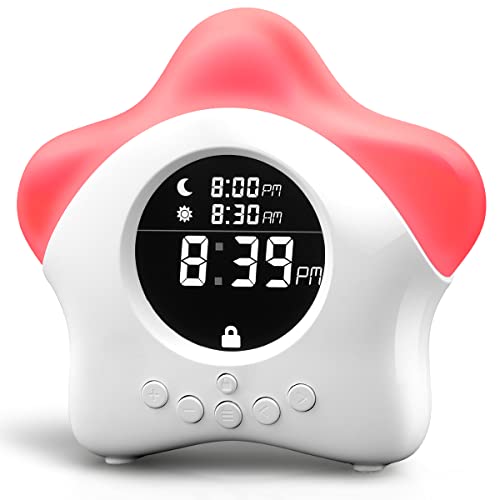 Learn & Climb Toddler Sleep Training Clock
|
8.4/10 | Buy | |
| Best Budget |
 ANNNGUL Kids Ok to Wake Clock
|
8.1/10 | Buy |
MooLarm Ok to Wake Sleep Trainer Toddler Alarm
The MooLarm Sleep Training Alarm Clock uses clear sun, moon, and color cues alongside an integrated 17-sound noise machine to help toddlers build healthy sleep schedules. It is a practical bedside tool for parents seeking an effective way to teach early-rising children when to stay in bed and when it is okay to wake up.
Pros
- Clear sun and moon visual indicators teach early risers when to stay in bed without needing to read time digits
- Versatile 17-sound audio library eliminates the clutter of having a separate nursery sound machine
- Convenient independent nap timer prevents accidental resets of the daily morning wake schedule
- Four-level dimming with automatic nighttime reduction helps prevent excess bedside glare during sleep
Cons
- Stepped 4-level dimmer does not offer continuous stepless 0 to 100 percent brightness tuning
- Visual coaching cues may require consistent parental reinforcement before young toddlers follow them reliably
- Lightweight 0.7-pound build can be easily tipped over or displaced by curious children if kept within arm's reach
Learn & Climb Toddler Sleep Training Clock
The Learn & Climb Stay-in-Bed Clock is an electronic toddler sleep trainer featuring a clear LCD display and a color-coded light system to help kids know when to stay in bed and when to wake up. It is an ideal bedside tool for parents seeking consistent morning routines and better sleep habits for toddlers and young children.
Pros
- Color-coded visual cues help non-time-reading toddlers easily understand when it is acceptable to leave bed
- Supplied with a sturdy DC power adapter and USB cord for immediate out-of-the-box operation
- Battery backup preserves essential alarm and time settings if wall power drops or cords are bumped
- Includes comprehensive sleep training materials like an eight-week reward chart and bedtime storybook
- Dedicated nap countdown mode simplifies daytime rest routines without overriding primary alarm times
Cons
- Backup batteries are not included and only preserve memory settings rather than powering active lights or audio
- Speaker volume is limited to two preset levels rather than a continuous variable adjustment slider
- Requires continuous connection to AC wall power to keep the nightlight and digital display active
ANNNGUL Kids Ok to Wake Clock
The ANNNGUL Kids Alarm Clock is a compact bedside sleep trainer that uses clear red and green light indicators to teach toddlers when to stay in bed and when it is okay to get up. Featuring 10 night light colors, 5 brightness levels, and accessible front-facing buttons, it is well suited for parents seeking an intuitive morning routine helper.
Pros
- Red and green visual wake indicators help toddlers understand sleep boundaries before they can read numbers
- Front-mounted controls eliminate the frustration of navigating hidden buttons on the bottom of the clock
- 10 vibrant night light color options and 5 brightness settings allow customized bedtime lighting
- Comes complete with both the required power cable and AC wall adapter in the box
- Settings preservation prevents the need to reprogram routines after brief power disconnections
Cons
- Must remain plugged into an electrical outlet to function and cannot operate cordlessly on battery power alone
- Brightness adjustment uses 5 preset steps rather than a continuous 0-to-100 percent stepless dial
- Lacks separate weekday and weekend dual-alarm scheduling options
How Visual Sleep Trainers Function and Why Consistency Matters
Visual sleep training clocks do work effectively for toddlers and young children, but their success depends on cognitive developmental readiness, visual clarity, and steady household consistency. Rather than functioning as an automated behavioral cure, an ok-to-wake clock acts as an external communication tool that translates abstract numerical time into tangible visual signals. When parents pair predictable colored illumination with clear daytime expectations, children quickly learn to recognize when it is appropriate to stay quietly in bed and when they may leave their room. Without an underlying behavioral routine, however, even the most feature-rich bedside clock will simply become another glowing nightstand accessory.
Developmental Readiness and Concrete Cognitive Stages
Toddlers typically begin grasping cause-and-effect relationships and basic color associations between two and three years of age. Before this developmental milestone, young children exist in cognitive stages where digital numerals like 6:00 AM carry zero practical meaning regarding daily schedules. Introducing a visual clock too early often causes confusion, because an eighteen-month-old toddler cannot yet link an arbitrary glowing icon to bodily rest expectations. By age three, children readily identify primary colors like red and green, allowing them to follow simple rules tied directly to visual feedback.
Cognitive development at this age relies heavily on concrete external boundaries rather than internal time estimation. When a child wakes up in a dark room at four in the morning, their natural instinct is to seek parental interaction because they cannot tell whether morning has arrived. A visual sleep trainer provides an immediate, concrete answer right from the nightstand without requiring a caregiver to enter the room. This immediate feedback helps reduce morning separation anxiety, giving the toddler a clear sense of control over their morning routine.
The Color Signaling Hierarchy and State Transitions
The foundational mechanism behind visual sleep training relies on an intuitive color hierarchy that children can interpret at a glance. Most dedicated clocks utilize either a two-stage or three-stage lighting transition to communicate bedroom rules throughout the night. Two-stage systems, such as the red light and green light configuration on the ANNNGUL Kids Alarm Clock, provide a simple binary choice where red signals sleep and green grants permission to get out of bed. This binary format works exceptionally well for younger toddlers who might find complex transition states overwhelming.
Three-stage systems introduce an intermediate transitional hue, shifting from red to yellow and ultimately to green. The Learn & Climb Stay-in-Bed Clock for Kids utilizes this progression to help older toddlers anticipate the impending start of the morning. A gentle yellow glow informs the child that wake-up time is approaching, encouraging them to rest quietly or engage in calm in-bed activities. Symbolic visual elements like the sun, moon, and star graphics on the MooLarm Ok to Wake Sleep Training Kids Sun Moon Alarm reinforce these color cues, offering dual confirmation for children who respond strongly to pictorial cues.
Display Dimming Controls and Melatonin Protection
Bedside lighting must support natural circadian rhythms rather than disrupting delicate sleep cycles. Exposure to bright, cool-spectrum illumination in the middle of the night suppresses natural melatonin secretion, which can cause midnight wakefulness or early morning sleep fragmentation. Sleep training clocks must provide deep dimming capabilities so that the nighttime glow remains comforting without illuminating the entire bedroom like a standard lamp. Selecting warm red or amber night-light settings preserves nighttime darkness while still remaining visible from the child’s mattress.
Adjustable brightness controls allow parents to fine-tune illumination levels according to their child’s sensitivity to ambient light. The ANNNGUL Kids Alarm Clock features a five-level adjustable dimmer, while the MooLarm design incorporates four distinct brightness steps alongside ten night-light color selections. The MooLarm also includes an automated dimming feature that softens display output during scheduled nighttime hours to prevent inadvertent glare. If you are comparing bedside electronics for other family bedrooms, exploring standard bedroom digital alarm clock options provides helpful insight into display contrast and zero-glare nightstand engineering.
Auditory Cues versus Silent Visual Awakening
One crucial distinction between adult alarm clocks and toddler sleep trainers is whether the wake-up transition includes an audible alarm. Traditional alarms use acoustic buzzers to force sleepers awake, but waking a soundly sleeping toddler counteracts healthy physical development. Sleep training clocks are primarily designed to keep awake children quietly in bed, rather than prematurely interrupting deep morning sleep cycles. For this reason, silent visual transitions represent the preferred operating mode for many households during early childhood sleep training.
When acoustic prompts are desired, gentle chimes and multi-level volume adjustments prevent jarring morning startle responses. The Learn & Climb Stay-in-Bed Clock for Kids incorporates an integrated speaker with two selectable sound levels, allowing caregivers to keep morning prompts discreet. Meanwhile, the MooLarm clock serves as an integrated sound machine offering seventeen soothing audio options, including white noise, nature sounds, and gentle melodies. Parents seeking gentle acoustic awakening for older children can also examine specialized nature sound alarm clocks to evaluate how gradual ambient audio eases morning wakefulness.
Daytime Nap Timers and Independent Countdown Schedules
Toddler sleep routines extend beyond overnight rest, making daytime nap management an essential operational requirement. Resetting primary morning wake-up schedules twice a day to accommodate afternoon naps creates unnecessary programming friction and invites user error. Dedicated sleep training clocks solve this problem by incorporating separate countdown nap timers that function independently from daily morning alarms. This operational separation preserves the primary morning schedule while offering temporary visual cues for midday resting intervals.
Countdown flexibility allows parents to align clock operation with varying afternoon nap lengths. The MooLarm Ok to Wake Sleep Training Kids Sun Moon Alarm provides selectable countdown durations of thirty, sixty, ninety, and one hundred twenty minutes. Caregivers can activate a two-hour countdown with a single button press, prompting the clock to display quiet resting colors until the timer expires. Once the nap countdown finishes, the device shifts to its standard daytime indicator without disrupting the established morning alarm program.
Power Supply Architecture and Outage Backup Retention
Bedside sleep trainers require dependable electrical delivery to prevent middle-of-the-night resets that can confuse young children. Most units operate via standard AC wall adapters or USB power cables, drawing continuous electricity from a bedside wall socket. The ANNNGUL Kids Alarm Clock, for instance, includes a dedicated wall adapter and cord and must remain plugged into mains power to function continuously. Continuous power ensures that bright LED color changes and internal clock microprocessors run without draining disposable batteries.
Residential power blinks or brief brownouts can wipe unprotected clock memory, resetting the digital display to midnight and silencing scheduled morning cues. To protect against this vulnerability, devices like the Learn & Climb Stay-in-Bed Clock for Kids incorporate an internal battery backup compartment alongside a sturdy DC power adapter port. While the backup batteries do not illuminate the full LED light display during a prolonged outage, they protect programmed time schedules and internal quartz synchronization until line voltage returns. Routing power cords securely behind heavy furniture also prevents children from unplugging the device.
Behavioral Reinforcement Tools and Consistent Routines
Hardware features alone cannot successfully train a child without structured parental guidance and positive behavioral reinforcement. An ok-to-wake clock functions best as a visual anchor within a wider bedtime routine that includes reading, winding down, and clear verbal agreements. Incorporating interactive educational materials helps demystify the clock’s rules before nighttime use begins. The Learn & Climb model addresses this behavioral component directly by including an illustrated storybook, a quick-start tip sheet, and an eight-week reward chart to engage children visually.
Reward systems give children tangible motivation to stay in bed until the visual wake signal appears. When a toddler successfully waits for the green light, placing a sticker on an eight-week chart provides immediate positive validation that builds confidence. Parents should focus on achievable steps during the initial days, setting the wake-up light just a few minutes after the child’s natural waking time. Gradually advancing the target time by ten-minute increments over several weeks prevents early resistance and helps the child experience regular success.
Button Layouts and Childproof Interface Ergonomics
Control ergonomics dictate how easily parents can program schedules and whether curious hands can accidentally alter settings. Clocks with complicated button menus hidden on the rear housing often require parents to keep instruction manuals handy for simple adjustments. The ANNNGUL Kids Alarm Clock addresses usability by arranging primary control buttons intuitively across the clock face, streamlining daily adjustments between twelve-hour and twenty-four-hour formats or snooze intervals. Placing essential buttons in accessible layouts reduces setup frustration during late-evening schedule adjustments.
Physical button placement must also balance adult accessibility with toddler tamper resistance. When buttons are placed prominently on the front or top of the housing, younger children may view the clock as an interactive toy and press buttons during early morning hours. Utilizing clocks with discreet bottom-mounted controls or setting lockout switches ensures that programmed wake-up schedules remain intact even if a curious child handles the device. Taking a few seconds to verify the visual state and alarm icons before bedtime guarantees that the clock triggers its color changes exactly when intended.
Recognizing Realistic Limits and Practical Troubleshooting
Visual sleep clocks are highly effective tools, but they cannot resolve underlying physiological sleep disruptions such as illness, overtiredness, or severe sleep regression. Expecting an ill or teething toddler to remain quietly in bed simply because a digital clock illuminates red is unrealistic and counterproductive to positive parenting. Visual trainers are designed to guide healthy, well-rested children who simply lack an internal sense of morning scheduling, rather than forcing sleep upon a child in distress. Maintaining realistic expectations prevents parental frustration when developmental regressions temporarily disrupt morning routines.
Inconsistent parental enforcement represents the most common reason visual sleep training clocks fail in practice. If a parent repeatedly enters the room and permits the child to start the day while the clock is still glowing red, the child quickly learns that the visual cue carries no real meaning. Holding firm to the visual boundary, while offering calm verbal reassurance if the child wakes early, teaches them that the green light remains the true gateway to morning activities. Consistent morning routines establish clear expectations that help toddlers feel secure in their bedroom environment.
Matching the right bedside clock to your family’s needs ultimately depends on your child’s age, room lighting sensitivity, and daily schedule complexity. Younger toddlers often thrive with straightforward two-color visual indicators, while older children benefit from transitional yellow warning lights, storybooks, and structured reward charts. By pairing dependable hardware features like dimmable backlights and independent nap timers with patient, consistent parental boundaries, families can transform chaotic dawn awakenings into peaceful, predictable morning routines.
About the author
Daniel Noyed is a Certified Sleep Science Coach and experienced product editor with extensive knowledge of sleep health and sleep-related products. He has hands-on experience testing hundreds of products and translating technical features into practical guidance for everyday sleepers.