
Are Atomic Watches Worth It: Practical Guide for 2026
Learn if are atomic watches worth it in October 2026 with our breakdown of radio synchronization, talking features, battery life, and senior accessibility.
 By McKenzie Dillon
Updated October 6, 2026
By McKenzie Dillon
Updated October 6, 2026

Few daily experiences are more frustrating than waking up to a drifting clock that throws off your morning schedule, especially during biannual daylight saving time shifts. While many people turn to their smartphones or standard quartz pieces to check the hour, question-minded buyers often ask are atomic watches worth it when searching for absolute timekeeping accuracy and simplified daily living. Traditional quartz movements inherently drift by several seconds every month, requiring periodic manual recalibration and tedious button-pressing sequences. Connecting personal timepieces to official national atomic standards completely eliminates this drift, ensuring that your daily schedule remains perfectly synchronized without continuous maintenance.
Modern radio-controlled timepieces bridge the gap between portable wrist convenience and specialized home timekeeping, complementing dedicated top-rated bedroom alarm clocks across busy households. These devices capture ultra-low-frequency radio broadcasts from government atomic stations, adjusting their internal gears and digital displays overnight to maintain fractional-second accuracy. For seniors, visually impaired individuals, or anyone seeking a phone-free digital detox, atomic talking watches offer instant vocal time announcements and self-setting reliability. Understanding how these specialized radio receivers operate, how they manage battery life, and how their physical interfaces function helps you determine whether investing in atomic precision suits your daily routine.
| Award | Product | ACR Score About ACR ScoreThe ACR Score is our own rating from 0 to 10, based on performance, design and build, ease of use, and value. It reflects independent research and is never influenced by manufacturers, retailers, or affiliate commissions. Learn more › | |
|---|---|---|---|
|
Hearkent Atomic Talking Watch with LCD Big
|
8.4/10 | Buy | |
| Best Overall |
 MAUJOY Atomic Talking Alarm Watch with U.S. Atomic
|
8.9/10 | Buy |
| Best Budget |
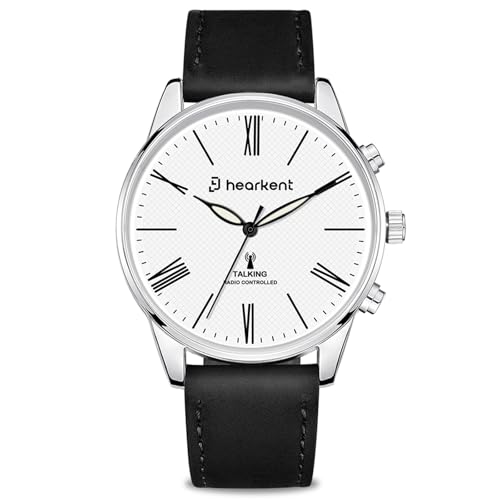 Hearkent Atomic Talking Watch with Alarm and Date
|
8.3/10 | Buy |
| Best Value |
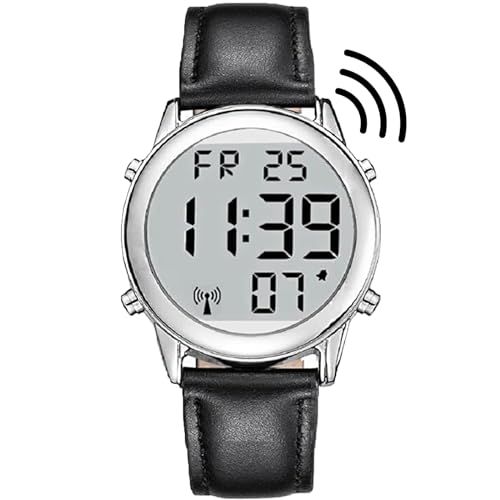 RUNCAR Atomic Talking Watch for Visually Impaired
|
8.3/10 | Buy |
| Best Premium |
 Hearkent Atomic Talking Watch for Seniors
|
8.9/10 | Buy |
 Hearkent Atomic Talking Watch for Seniors
|
8.0/10 | Buy |
Hearkent Atomic Talking Watch with LCD Big
The Hearkent Atomic Talking Watch provides clear voice timekeeping, large high-contrast LCD numbers, and automatic U.S. atomic clock synchronization. It is a dependable choice for seniors, low-vision sleepers, and travelers wanting accurate time and alarm alerts without manual adjustments.
Pros
- Synchronizes automatically with official U.S. atomic clock signals and handles daylight saving adjustments
- Audible voice readout makes checking the time simple for visually impaired individuals and seniors
- Over one year of battery life eliminates nightly plug-in charging routines
- Simple four-button design isolates time, date, and alarm status without complex sub-menus
Cons
- Requires following the manual to select your local time zone prior to initial atomic synchronization
- Wearable wrist form factor lacks a dedicated upright nightstand kickstand base
- Audio announcements cannot be muted selectively if operating in a shared, quiet sleeping space
MAUJOY Atomic Talking Alarm Watch with U.S. Atomic
The MAUJOY Atomic Talking Watch delivers clear spoken time, date, and alarm announcements alongside automatic U.S. atomic clock radio calibration. It is a dependable personal timepiece for seniors, visually impaired users, and travelers seeking reliable reminders without complex menus.
Pros
- Automatically synchronizes with official U.S. atomic clock radio signals for hands-off timekeeping and DST updates
- Dedicated tactile voice buttons announce time, date, and alarm settings clearly for visually impaired individuals and seniors
- Large positive LCD display numerals provide clean visual legibility alongside classic analog watch hands
- Integrated daily alarm and optional hourly chime support consistent schedules and timely medication reminders
- Comes ready to operate with an authentic Japanese Miyota movement and a pre-installed Maxell lithium battery
Cons
- Initial setup requires pressing and holding two buttons for five seconds to exit factory sleep mode before first use
- Time zone must be selected manually following the instruction manual before atomic radio synchronization can calibrate the local hour
- Wearable wrist format lacks a tabletop kickstand or AC power cord found on conventional bedside nightstand clocks
Hearkent Atomic Talking Watch with Alarm and Date
The Hearkent Atomic Talking Watch provides clear voice announcements for time, date, and alarm status, paired with automated radio-controlled synchronization across four U.S. time zones. It is an accessible choice for seniors, blind individuals, and low-vision users who need dependable timekeeping without eye strain.
Pros
- Speaks time, date, day, and signal status clearly in an easy-to-understand American accent
- Automatic atomic time sync ensures ongoing accuracy and handles Daylight Saving Time automatically
- Dedicated alarm setting and spoken status check assist with daily wake-up and reminder routines
- Comfortable leather band provides a soft, breathable fit for everyday wear
Cons
- Initial activation requires following a specific multi-button holding sequence
- Traditional manual time adjustments via the crown are disabled in favor of automated controls
- Time zone presets are restricted to the four standard continental U.S. zones
RUNCAR Atomic Talking Watch for Visually Impaired
The RUNCAR Atomic Talking Watch delivers audible time, date, and alarm announcements in a clear American voice alongside automatic U.S. atomic clock synchronization. It serves as a dependable, high-contrast daily and bedside timekeeping aid for seniors, visually impaired individuals, and low-vision sleepers.
Pros
- Audible American English voice readout speaks the time, date, and alarm status clearly
- Automatic atomic radio sync self-sets time and adjusts for daylight saving time
- High-contrast face with bold black numerals assists individuals with low vision
- Dedicated four-button layout offers direct access to key readouts without deep menus
Cons
- Initial setup requires manual time zone selection before auto-sync begins
- Atomic signal reception may be sensitive to interior room placement and building construction
- Holding the small 8 o'clock button for configuration may require steady finger dexterity
Hearkent Atomic Talking Watch for Seniors
The Hearkent Atomic Talking Watch combines automated WWVB radio-controlled accuracy with clear American English voice announcements for time, date, and alarm status. Featuring high-contrast analog numerals and an elastic stainless steel band, it offers dependable accessibility for seniors and visually impaired users.
Pros
- Automated WWVB radio signal updates eliminate manual time adjustments and seasonal Daylight Saving Time resets.
- Audible American English voice readout offers independence for blind, low-vision, and senior users.
- Stretchable stainless steel expansion band allows easy slip-on wear without struggling with small clasps.
- Dedicated four-button configuration provides separate physical controls for time, date, reception check, and alarm status.
- Bold black hands and large dial numerals provide high visual contrast for quick daytime checks.
Cons
- Initial setup requires manually designating the correct U.S. time zone among the four continental options before atomic synchronization operates properly.
- WWVB radio reception can occasionally be shielded by dense building materials or geographic interference.
- The men's sizing and metal case dimensions may feel slightly loose or substantial on smaller wrists.
Hearkent Atomic Talking Watch for Seniors
The Hearkent Atomic Talking Watch provides clear American English voice announcements for time, date, and alarm settings alongside automatic WWVB radio synchronization. Designed with high-contrast bold dial numerals and dedicated push buttons, it is an ideal choice for seniors and visually impaired individuals needing reliable audible timekeeping.
Pros
- Automatic atomic radio sync keeps time precise without requiring ongoing manual time adjustments
- American male voice announcements are easy to understand for checking the time, date, and alarm status
- High-contrast white-and-black analog face assists users who retain partial vision
- Dedicated four-button layout assigns one function per button to minimize accidental mispresses
Cons
- Initial setup requires setting the correct U.S. time zone manually before automatic radio sync functions properly
- Radio WWVB signal reception can be blocked or delayed inside certain dense concrete or metal-framed buildings
- Men's case sizing and structured leather strap may feel somewhat large on smaller wrists
Evaluating Atomic Timekeeping and Accessibility Value
Determining whether atomic timekeeping justifies the investment depends heavily on personal priorities regarding precision, convenience, and physical accessibility. Unlike traditional quartz timepieces that slowly accumulate seconds of drift every month, radio-controlled atomic watches automatically calibrate against official reference standards. This automated synchronization eliminates the regular chore of manual corrections, daylight saving adjustments, and calendar updates. When combined with assistive voice synthesizers, these specialized devices offer profound autonomy for seniors and individuals living with low vision.
How Atomic Radio Synchronization Operates in Everyday Life
Atomic wristwatches do not house internal atomic clocks; instead, they contain miniature radio receivers tuned to extreme low-frequency broadcasts. In North America, the primary signal originates from the National Institute of Standards and Technology station WWVB, located in Fort Collins, Colorado. This station continually broadcasts a coded 60-kilohertz signal derived from a cluster of cesium atomic fountains. By capturing this transmission, the watch microchip decodes the exact coordinated universal time, adjusting its internal quartz counter to match fractional-second accuracy.
Most atomic timepieces schedule their synchronization routine during the deep night, typically around two or three in the morning. Nighttime synchronization is an intentional engineering decision because solar radiation ionizes the upper atmosphere during daylight, which severely attenuates longwave radio frequencies. Lower nighttime atmospheric interference allows the low-frequency WWVB signal to bounce efficiently between the ground and the ionosphere, covering thousands of miles. As a result, users awaken each morning to a movement that has quietly corrected any tiny mechanical or electronic variance.
Daily Convenience Versus Manual Quartz Timepieces
Standard quartz watches are remarkably accurate for everyday use, but they still deviate by several seconds each week due to temperature shifts and battery voltage changes. Over several months, this subtle drift compounds into several minutes of discrepancy, which can cause missed appointments or bus connections. Atomic timepieces permanently solve this drifting problem by continuously pulling their baseline reference from national time standards. Wearers never need to cross-check their wrist against a smartphone or computer monitor to verify absolute accuracy.
The biannual shift between standard time and daylight saving time represents another routine headache that atomic technology cleanly eliminates. Traditional analog timepieces demand manual stem pulling and crown rotation, which can be difficult for individuals with arthritis or limited finger dexterity. Atomic watches automatically process daylight saving flags embedded in the radio data stream, advancing or retarding the internal timekeeping register on the designated calendar date. This automatic transition prevents the common morning confusion that occurs when domestic clocks remain out of sync.
Audio Synthesis and Assistive Voice Technology
For visually impaired individuals and elderly wearers, the value of an atomic watch extends far beyond mere mathematical precision. Many atomic models integrate synthetic speech microcontrollers programmed with clear American English voice profiles that announce the hour, minute, date, and operating status. A quick press of a dedicated button provides instant auditory confirmation of the current time without forcing the user to squint at fine dial indices. This capability allows seniors with macular degeneration or cataracts to manage their daily schedules with total privacy and independence.
Beyond telling the current hour, speech modules often support audible daily alarms and recurring hourly chime alerts. These acoustic reminders prove invaluable for managing structured daily medication routines, therapy appointments, and household tasks. Hearing a pleasant voice confirm that an alarm is active at seven-fifty in the morning removes the anxiety of wondering whether a silent mechanical toggle was set properly. The combination of self-setting radio calibration and vocal feedback makes these watches essential tools rather than decorative novelties.
Initial Configuration and Regional Time Zone Selection
A common misconception among prospective buyers is that an atomic watch requires zero initial human input out of the box. While the device handles daily time calibration autonomously, the radio signal broadcast from Colorado carries coordinated universal time rather than local municipal time. Because the United States spans four primary mainland time zones: Eastern, Central, Mountain, and Pacific; the wearer must select their appropriate regional zone during initial setup. Once this regional baseline is programmed into the memory register, the internal processor applies the correct hourly offset automatically.
Attempting to set an atomic watch using a traditional winding crown can damage the motorized movement or confuse the internal microcontroller. Manufacturers like Hearkent and MAUJOY specifically instruct users to configure time zones through dedicated button combinations rather than mechanical stem manipulation. During first activation, wearers hold down designated pushers to wake the movement from its factory power-saving sleep state. Watching the analog hands sweep rapidly around the dial to align with the electronic register confirms that the initial setup was executed successfully.
Signal Propagation Obstacles and Reception Optimization
Atomic synchronization is not entirely infallible, as radio reception depends heavily on geographic location, building construction, and local electromagnetic noise. Densely constructed urban structures containing heavy steel rebar, metal siding, and low-emissivity window glass can substantially degrade 60-kilohertz signal strength. Household appliances, including fluorescent lighting ballasts, computer power supplies, and bedside charging adapters, can also generate localized radio frequency interference. When a watch encounters heavy electromagnetic clutter, it may fail to complete its nightly synchronization sequence.
Maximizing signal reception simply requires understanding how low-frequency radio waves interact with residential architecture. Placing the watch near an exterior window facing toward Fort Collins, Colorado, overnight dramatically improves the likelihood of a successful radio handshake. Avoiding direct placement near high-output bedside transformers or crowded power strips also protects the sensitive internal ferrite core antenna from stray magnetic fields. Fortunately, even if a watch misses an overnight transmission due to temporary atmospheric storms, its internal quartz movement maintains precise time until the next clear signal arrives.
Hardware Engineering and Power Management
Operating a miniature radio receiver and an acoustic speech synthesizer places far greater electrical demand on a watch than running a standard quartz gear train. To handle these intermittent power spikes, manufacturers utilize high-capacity lithium coin cells, such as Japan Maxcell cells, paired with efficient micro-motor gearboxes like Japan Miyato movements. Quality atomic movements are engineered with intelligent power profiles that only activate the energy-hungry radio receiver for a few minutes once or twice per day. This optimized schedule allows standard primary lithium batteries to deliver reliable operation for well over a year.
To preserve precious battery reserve while products sit in distribution warehouses, manufacturers ship these timepieces in a dormant factory sleep mode. When entering sleep mode, physical gear trains halt and hand movements stop completely, reducing standby battery drain to microscopic levels. Buyers should follow the manufacturer instructions upon unboxing, which usually require pressing and holding two buttons simultaneously for several seconds to wake the processor. Understanding this activation process prevents buyers from mistakenly believing that a newly delivered timepiece arrived with a depleted battery.
Tactile Ergonomics and Dial Legibility
The physical interface of an atomic talking watch is deliberately engineered to accommodate reduced tactile sensitivity and visual limitations. Most models employ a standardized four-button layout positioned neatly around the case perimeter at the two, four, eight, and ten o’clock positions. The two o’clock button typically triggers the audible time announcement, while the four o’clock button speaks the full date and day of the week. Physical separation between these pushers ensures that users can operate the watch by feel alone without looking down at the dial.
Visual presentation receives equal design attention, offering options between bold analog dials and large-character positive LCD screens. Analog versions feature stark white or matte black faces with thick, high-contrast numerals and bold black hands that resist glare under bright room lighting. Digital LCD variations display prominent, uncluttered positive numbers that remain clearly legible across varied viewing angles. Whether wearing a flexible stainless steel expansion band or an adjustable sewn leather strap, users enjoy effortless all-day comfort alongside exceptional legibility.
Comparing Wrist-Worn Atomic Precision to Bedside Sleep Clocks
While an atomic wristwatch provides unmatched personal mobility throughout the day, it functions best as part of a broader household timekeeping strategy. Many households integrate wearable atomic timepieces with dedicated bedside wireless charging clocks to keep both their wearable gear and handheld devices organized on the nightstand. Bedside clocks offer continuous ambient illumination, larger secondary displays, and higher acoustic volume than any compact wrist speaker can generate. Having an atomic reference on your wrist allows you to verify that your nightstand clocks remain perfectly synchronized down to the exact second.
Sleeping environments also require different arousal sensory cues than daytime routines, making specialized bedside hardware a practical necessity. For example, individuals who struggle with morning grogginess often pair an atomic wrist watch with gradual wake-up light clocks designed to ease the wake-up transition through simulated dawn. A wrist-based speaker is ideal for daytime calendar reminders, but morning wakeups benefit from high-output acoustic buzzers, room-filling simulated sunlight, or tactile mattress shakers. Using each device for its intended purpose creates a balanced daily routine that combines daytime mobility with restful sleep hygiene.
Long-Term Value and Buying Recommendations
Evaluating whether an atomic watch is worth the financial investment ultimately hinges on your specific lifestyle and accessibility requirements. If you regularly struggle with manual time adjustments, dread daylight saving time resets, or require vocal time announcements due to declining vision, these devices deliver exceptional practical utility. They provide true set-it-and-forget reliability, requiring zero maintenance beyond an occasional battery replacement every year or two. The modest price premium over basic quartz wristwatches is easily justified by the daily independence and continuous precision they provide.
When selecting an atomic watch, prioritize models from reliable manufacturers that offer clear American English voice synthesis, straightforward four-button control schemes, and durable casing materials. Ensure that you select a band style, such as an elastic stainless steel stretch band or a breathable leather strap, that matches your personal mobility needs. As long as you take a few moments to set your regional time zone and position the watch near an open window for initial calibration, an atomic watch will serve as an exceptionally dependable daily companion.
About the author
McKenzie Dillon is a Certified Sleep Science Coach and experienced sleep-product editor who has personally tested dozens of sleep products. Her expertise bridges sleep technology, product evaluation, and practical guidance for creating more comfortable sleep and wake-up routines.